

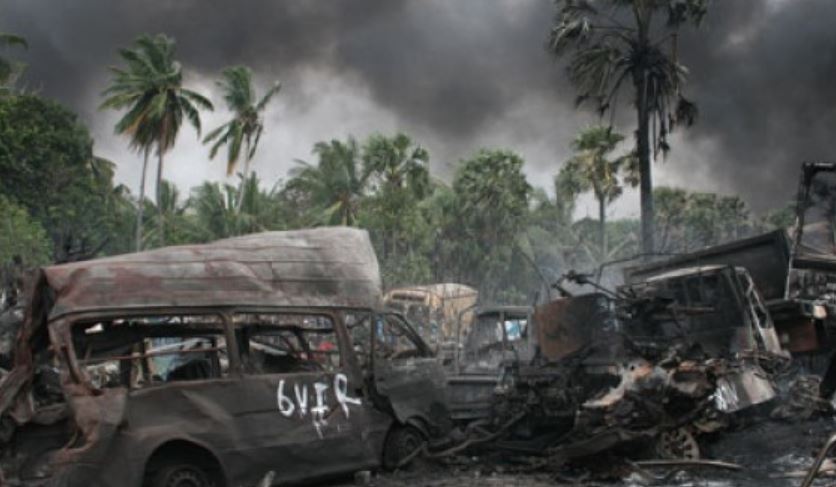
Those who have read Shash Trevett’s debut pamphlet, From a Borrowed Land, will recognise a number of the poems in her debut full collection, The Naming of Names, if often in slightly amended form; and those who have read the anthology Out of Sri Lanka (of which Trevett was an editor and which included a couple of her poems) will know something of the political context and poetic heritage from which this new work comes. I’ve written previously about the earlier two collections in pieces you can read here (From a Borrowed Land) and here (Out of Sri Lanka) and not wanting to repeat what I have already said about this poet’s often heartbreaking, thoughtful, and beautiful work I will concentrate in this review on the broad structure, the core themes and key metaphors of The Naming of Names, and I’ll hone in on a couple of poems that exemplify these.
The fundamental importance of names (names of people, names of objects, names of places) to the way we generate meaning has been a concern of writers from Shakespeare to Proust and well beyond, and Trevett adds her voice to this tradition with great accomplishment. For her, it is the names themselves, but also the naming of them, that allows us to retain some form of connection with those who have left us. Not just the giving of a name to a person, but the repeated acknowledgement of it, the saying of it, the recitation of it, perhaps even the incantation of it.
A person’s name is analogous to their culture and identity – there is an etymology there, a sociology and an archaeology almost. We learn about a person from their name as we learn about their culture and history, by burying down into the details. One of Trevett’s chosen metaphors is that of the story, which we tell and retell to pass heritage and memory down the generations. The following stanza is from ‘The Naming of Names 6’, a prose poem which gives us a fascinating insight into the poet’s own name, Shash. The poem ends:
The naming of names and the way we carry them helps us write the story our children will make their own. By repetition on certificates, censuses and passports, they seem set in stone. And yet, through war, necessity or custom my family’s use of names has been water-like, flowing through languages and prejudices. An unforeseen consequence of all our unmoorings.
The surprising second half of this stanza/paragraph reveals that where name-naming might sometimes be seen as anchor-like, ‘set in stone’ and perhaps a means of stability in a turbulent world, Trevett has found that for her family, names have taken on more the quality of water itself, flowing through the turmoil of religion, ethnicity, gender and geography. The poem itself is an example of the name as the starting point of, or perhaps the support that helps the writing of, a story.
Many of the ‘Naming of Names’ poems (there are eleven) are simple alphabetised lists of some of those who died in the twenty-six-year Sri Lankan Civil War – taken from lists in reports by the Sri Lankan North East Secretariat on Human Rights (NESHR), themselves, as Trevett points out, only a fraction of those who actually lost their lives. These names do feel more ‘set in stone’, as though they are names lining a wall of remembrance. There is a formality, even grandeur, in this presentation, and the poems are I think, in one sense at least, intended to honour the dead – certainly to remember them. But right at the beginning of the collection Trevett puts this much more beautifully, in three short stanzas entitled ‘Dear Reader’, where (as in her family’s experience of naming names) there is not the coldness of stone in the names, but the warmth of life. I quote the poem (or perhaps I should call it poetically lineated prose) in full:
This book is filled with names. They will be strange
and unfamiliar to you. As you turn these pages you will be tempted
to gloss over, skim, even ignore them. Please don’t. There is music
in these namesEach is a whisper of a life lived and loved. Each a Tamil man,
woman or child killed by the state. Each a forgotten victim, mere
collateral damage, peripheral, expendable.These names are mausoleums for those denied gravestones.
They are the staccatoed prayers of remembrance.
The hiss of incense on a funeral pyre.
This touching exhortation reads like a plea to return dignity to those denied it by the calamity and disgrace of the civil war. It layers metaphor upon metaphor to emphasise the semantic depth of these names, but they require the attention of the reader, the looker or the hearer, and their active collaboration in remembering. Trevett knows her readership, which is why she knows these will be unusual to the eyes and ears of many, most, English speakers. And they are. It is difficult to read through them, especially aloud, without stumbling and using what feel like disrespectful mispronunciations. I gave up attempting to read them aloud, although I had wanted to try and incant them (inspired possibly by ‘The Naming of Names 7’: “From deep within her came a chanting”), and I ended up wishing I could hear them spoken out loud by a Tamil speaker. But even allowing your eye to land on each name, allowing it space for a moment in your head, as you might look at and appreciate an unusual flower, I think gets towards the affect Trevett is looking for. A number of poems dig into the translations of names, and in the final poem of the collection, ‘To Name their Names’, Trevett lists alphabetically a selection of names and provides the meaning of each, bringing out a sense of the beauty that each one carries within it, as those who bore the names did while living. Jeevakumar, we learn, is a child brimming with life; Lavanya is she with a fighting spirit; Kokila is a nightingale; and Thannimalai is a waterfall.
The collection is structured into four parts, but these are not so much like chapters of a book or acts of a play as movements of a piece of music. The theme remains, but the work speeds up and slows down, widens and then narrows, progresses as the poems speak to each other and develop, as it were, dialectically. The first section takes us starkly and shockingly into the heart of the civil war itself, with details of atrocities such as those listed so coldly in ‘How to Dispose of Tamils’. But even in the earliest poems there is a suggestion of a wider context and analogous peoples, for example ‘Curiosities’, where Billie Holiday’s song Strange Fruit about lynchings of black people in the US, is used to springboard an almost surreal contemplation of war’s horror, with body parts and parts of names hanging in trees “A jigsaw / of possible pairings”.
Billie sang of southern trees
but strange too are the ones growing
in the garden around Jaffna.Body parts protrude from mango, neem
or guava trees. A leg here, an arm there. Etched on these are fragments of names: Sinna…., Path…. or ….ini.
The second part personalises the civil war and focuses the name metaphor on Trevett’s own family with ‘The Naming of Names 6’ quoted above and follows her family’s emigration to England. Tree imagery carries through with “The hanging roots of the banyan tree / like swinging ropes, promise hours of fun” (The Missing Children) echoing chillingly with ‘Curiosities’ from them first part. Here Trevett’s own challenges on adopting a new language and the stark sense of the alienation experienced by a young girl as one culture is forcibly overlayered onto another: “All copies / of my precious Ambulimama / had disappeared… // And in their place a pile of books in English… / …A galleon in full sail on their spines.” (The Armada Children’s Library). This poem cleverly uses the old Armada children’s books logo to reference British colonialism, which is so bitterly turned on its head in Trevett’s complimentary pair of angry political poems which criticise the UK political establishment for blocking the entry of desperate refugees, especially children through the Illegal Migration Bill and the rejection of the Dubs amendment. You were happy enough to exploit the rest of the world during the time of Empire, the poet seems to be saying, but where is your pity for those who need your help now?
The third part continues the metaphorical strands of gardens, flowers, and the mining of language but filters them specifically through a female lens. The poems in the part each present a portrait of an individual woman or girl: the internal emotional journey of a relationship in ‘Blue Lotus Flowers’, a young Eoran girl from the 1700s in ‘Patyegarang’, the reclaiming of an identity of Na’amah (no longer just the wife of Noah) in ‘I was Na’amah’, a fleeting moment of “movement and light” for the poet’s own daughter Beck, among various others. The reference to racism in the US (it could be anywhere) from the first part comes back around in ‘Ann Lowe 1953’ where we hear Jackie Kennedy’s disturbing off-hand comment about the fashion designer who created her wedding dress; “A coloured woman made it”. Such echoes and reflections are what keeps this collection bound together as a serious and coherent work.
The fourth and final part circles back to overt references to the Sri Lankan civil war, but now the tone has changed, anger and horror has given way to sadness – and it is a strength of the collection that it does not attempt to console: there can be no consolation. The tree image that has been present throughout is now “The last mango tree” which “stands alone / in a garden that was once full”. Catastrophes like the 2019 bombings of churches across Sri Lanka go almost unnoticed, or at least quickly forgotten, and the world it seems is incapable of learning lessons from the past: “things happen / and the world moves on.” Trevett offers only a warning, in the form of a picture of a tyrant based on Auden’s ‘Epitaph on a Tyrant’ – but where Auden’s tyrant is dead and rendered in the past tense, Trevett’s is in the present, he lives on in many forms, and the best we can do is beware of him. “He is the man you should never invite to dinner…// He is the man you should never share a joke with…// He is not a man you should ever criticise.” And key to Trevett’s project, I think, is that while Auden’s tyrant cried and “little children died in the streets”, the violence done by Trevett’s tyrant is as much to do with the violence of language as the political reality of the violence it becomes: “He can transform commas and semi-colons / into nooses; full-stops and exclamation marks / into gravestones.” The violence done to and with language is at the centre of many of the poems here.
The book is more than anger and sadness though. To misquote Wilfred Owen, Shash Trevett’s subject is civil war, and the pity of civil war – the poetry is in the pity. And it is that sense of pity – not feeling pity for someone but acknowledging the pity of something – in its full and profound meaning at the heart of the human condition, which drives these poems onwards and turns them into weapons against tyranny. Because in a sense all of the poems in this collection are part of an ongoing struggle against that undying tyrant. The requirement on the reader to actually read the names of the dead, not skip past them, to engage and join the poet in acts of remembrance and identification, is part of that struggle – let’s call it a struggle against evil. And it is possibly part of the reason that Anthony Ezekiel Capildeo chose to describe the collection as a “globally significant achievement”.
In a world where a lot gets said about very little, and it sometimes seems that little gets said of real significance, poetry which has something genuinely important to say should be applauded, celebrated, and above all, read.
If you haven’t read Shash Trevett yet, please do.
You can buy The Naming of Names here.
 Wood Bee Poet