
The life of their land 

Out of Sri Linka: Tamil, Sinhala & English poetry from Sri Lanka & its diasporas 

Eds. Vidyan Ravinthiran, Seni Seneviratne & Shash Trevett 


There is an interesting phrase in Gordon Weiss’s 2011 book on the root causes and final days of Sri Lanka’s 26-year civil war, ‘The Cage’. Weiss describes the careful record keeping and desperate telephone calls of a small group of Tamil government doctors who were trapped along with thousands of civilians in the ‘siege zone’ as the Sri Lankan army finally closed in on the Tamil Tigers. These were, Weiss says, integral to “the compilation of memory” that subsequently provided evidence of atrocity that would otherwise have been obliterated entirely. “Instinctively (the doctors) understood better than most that the only gravestone that those who died would receive would be in the form of the ticks and marks on a hospital casualty form”, he writes, and “…(o)ften the UN would speak to the doctors from their radiotelephones, listening to their pleas for help and intervention while the dull sound of exploding shells crackled up the line…” (p276). 

There is a comparison to be made I think (albeit one that I have to be careful in making) between the heroically steady and precise record keeping of those doctors, and their real-time testimonies of witness, and the enormous job of compilation that the three editors of this first ever anthology of Sri Lankan and diasporic poetry have undertaken. The voices that they allow to emerge, rising as they do from both within layers of division inside Sri Lanka over the last 60 or 70 years, and from around the world as the diasporic community has grown over the same period, create a rich and varied psychological/political landscape which is as unique – and often as harrowing – as the experience of Sri Lankans over the period since independence from British colonial rule in 1948. It is hard not to read this project of anthologisation as one in which a compilation is taking place so that a shared cultural memory is not obliterated by the deliberate forgetfulness of the powerful global forces that shape history. 


Something in the region of 140 poets are represented in the anthology and as such it is quite an imposing tome, especially if, as it was for me, all but a handful of them are entirely unfamiliar names. But for that same reason, sitting down to read it – and to use it as a springboard to learn more about the country and its shocking recent past – was an exciting as well as an imposing prospect. 

The editors have presented the poets in alphabetical order, almost always my preference in anthologies but in the case of this volume literally the only realistic choice, as attempting to divide them into the three linguistic/cultural/political strands represented here would have been disastrous and entirely against the spirit of the book. Those strands of course are central to the anthology as they are to the country but binding them together through the randomness of the first letter of the poets’ surnames locks them into a unity that transcends their wild differences. It also allows for ‘serendipitous connections’ as the editors say in their introduction; and making these connections was part of the joy of reading this anthology. The introduction provides names to get you started (George Keyt as springboard for English language Sri Lankan poetry; Mahakavi – pen name of Thuraisamy Rudhramurthy – for Tamil; and Siri Gunasinghe for Sinhala) and then the potted biographies that precede each poet’s work allow you to follow familial and sometimes literary connections that make you feel as though you are on a guided journey of discovery. But above this are the more genuinely chance juxtapositions that you come across if you follow the anthology in order (which I did for the As and Bs until I increasingly allowed myself to be led by the editors and pot luck); Tamil shoulder to shoulder with Sinhalese, shoulder to shoulder with Burgher – but of course these encounters also go further than ethnic/linguistic communities, they put the Hindu beside the Buddhist, the old beside the young, the radical beside the more traditional, the immediately horrific and terrifying beside the reflective and the humorous. Also, the dead beside the living, although taking 1948, the year of independence, as its general (sometimes ignored) starting point, there are more living than dead poets here. 

An example of the editors’ successful approach to presenting the poems comes right at the beginning where the first and third poets in the anthology, Aazhiyaal and Packiyanathan Ahilan (Tamils) stand either side of the second, Bashana Abeywardane (Sinhalese). ‘Manampri’ by Aazhiyaal references the shocking rape and murder – described in the poem’s footnote – of a young left-wing student and a Tamil woman to evoke the menace of male violence still stalking the streets like a hungry animal (“The avid hunger in those eyes / makes me aware of an unknown tongue”). Ahilan’s ‘Corpse No. 182’ gives a brief, harrowing description of the discovered corpses of a mother and child in the terrifyingly cold language of the administrator (“They were fused into one body. // I cleaned them and noted them down: / Corpse No. 182.”). And sandwiched between these two, what should we make of the cautious note of optimism Abeywardane sounds in ‘The Window of the Present’ which unites he “long dead” of both the north and the south: “Nightmares, long dead, / peer through the shattered panes of the / window of the present” before hinting that the memory of them may give reason of hope: “But who is to say / that even this July a breath of summer’s hope, would not / steal through the shattered panes of the window of the present.” Abeywardane’s tentative sense of the hope represented by remembering the violence of the past, already weak (indeed its very weakness within the poem is ironically what carries its power) feels altogether suffocated by the horrors presented in the work of the two poets either side of him. If this reads as a criticism of bringing these three poets together, it is not meant as one; an anthology of poetry representing such a divided country over such an unspeakably blood-soaked seventy or so years, needs to deal with the sheer scale of the unimaginable violence of four more or less contiguous civil wars. Any sense of hope needs surely be weighed against the terrible psychological burden of recent history that must (and I can only guess here of course) be carried by many if not all Sri Lankans. The chance juxtaposition of these three poets seems to give a sense of this burden, which is why I think it is a good example of what the editors’ choice to present the poets alphabetically has added to this anthology. 

I mentioned the introduction in passing earlier, and it is worth emphasising what an important essay this is, setting the general context of Sri Lanka politically since 1948 (though of course not going into detail, the editors recommend three books which will allow the reader to gain a more complete understanding of the country, ‘The Cage’ is one, and they are all linked below) and crucially providing a few pages of context for Tamil, Sinhala and Anglophone poetry as well as a note on civil war poetics, and also on what they term the eccentric poetries included in the volume. This eccentricity is in part referring to the fact that some poems here are not written by poets at all but by “photographers, government workers, novelists (and) journalists…who were pressed by extraordinary circumstances towards a lyric recognition of complexities otherwise beyond understanding”. But it also refers to “a strong, unexpected current of dark humour” which the editors point out both opposes and survives the “malaise akin to psychic numbing” which can result, according to late academic Malathi de Alwis, from “several decades of living with unrelenting violence and atrocity”. They are right about both its unexpectedness and its strength.  

The following, from V.V. Ganeshananthan, a diaspora writer based in Minnesota, turns the atrocities of 2009 and other violence into a series of tongue-twisters, corrupting the childlike innocence of ‘She sells seashells’, evoking the relentless bombing of civilians on the beach, while letting neither the Tamil Tigers nor the government forces off the hook, particularly skewering then-Prime Minister Mahinda Rajapaksa. It is quite astonishingly effective and memorable, and it is undeniably shot through with bitter humour:  

The misters assisted in shelling these shells on the seashore war, 

The shells they shelled were not sea-shells, I’m sure. 

... 

And as the misters shelled the seashore during the war 

The terrorists held the people as shell-shields before -  


Hard to say. Hard to ring any bells. What are tongue-twisters for?  


2 


The mighty military mounted a magnificent Mullivaikkal monument to most magnanimous majesty Mahinda. Mahinda manages most magnificently militarily! 


(from ‘The Five-year Tongue Twisters’) 

Not all the poems are concerned directly with post-independence violence, and another level of humour comes through in other more traditionally influenced poets, such as Regi Siriwardena, who (in ‘Birthday Apology and Apologia’) makes it through four stanzas of twenty lines each to mark his eightieth birthday before finishing with the relief of a slightly grumpy old man “And so, to quote a poet I never liked, / ‘Port after stormy seas.’ To all those friends / Too many to be named – who’ve helped me past / The whirlpool and the rocks, my heartfelt thanks. / This makes eighty pentameters. THE END.” I can imagine the poet putting his pen down with a clunk, sitting back in his chair and reaching for a large drink at this point. 

Many poems here are written by those of the diaspora who look back on Sri Lanka (in space and/or time) from different kinds of exile and reflect on the country they or their family has been forced to leave. These poems often have a special strength that comes, I think, from a simultaneous distance and proximity they have in relation to the horrors suffered in their homeland. Thiru Thirukkumaran for example is a Tamil poet who lives in Ireland: 

Even now, as the winter snow lies scattered  

across the doorway, spilled like the brains 

from a friend’s shattered skull, 

I cannot be rid of my memories. 


(‘Resurrection’) 

And Dipti Saravanamuttu is a poet and academic who moved to Australia with her family in 1972: 

In ‘88, the Sri Lankan civil war 

is your permanent backdrop 

to reading eighteenth-century novels 

and theorising the (gendered) subject. 

‘Sinhalese subversives... Tamil terrorists’ 

someone reads to the meeting, from 

a conservative newspaper. 

listening to this stuff feels like 

an exercise in learning how 

the enemy thinks –  

‘Rhetorical indoctrination’ you say 

grimly, and everyone laughs. 


(‘Landscape Art’) 

For both these poets, the dissonance between their out of Sri Lanka experience with memories and events rooted within the country itself creates a gap which cannot quite be given expression but which their poetry seeks to fill. For many of the diasporic poets represented here, the gap is also generational, and their poetry often appears to be filling it by reflecting on notions of home and belonging. The following is by one of the anthology editors, Vidyan Ravinthiran, who is caught in a world where ‘home’ means very different things to him and his parents – and we are left to wonder what a family home means at all if it means something different to parents and their children, and indeed what then does being away from home mean?: 

...by ‘home’, I mean the house 

my parents live in and where I grew up; 

like and unlike them saying ‘back at home’ 

when they intend Sri Lanka, and not Leeds 

where they live and I haven’t, not for years. 


(‘Ceylon’) 

Part of the magic of any anthology is that it allows the reader to see links, themes, ironies, patterns that they would have been very unlikely ever to have found without the diligent work of the editor(s), and this one is no different. I was satisfyingly struck by a reference to cobwebs in a phrase quoted in the biogaphy of Kala Keerthi Carl Muller (a satirist, whose poem ‘Deiyyo Saakki!’ would certainly fit into the aforementioned category of the ‘darkly humorous’) which sent my mind straight back a much earlier poem in the anthology, by Parvathi Solomons Arasanayagam. 

The Muller quote: 

I feel there is no necessity to elevate Nature and tell of those same old time-worn things like “Gossamer cobwebs” and “silver moon-shafts” and “golden daffodils”. 

Arasanayagam, from ‘Human Driftwood’: 

Sometimes the walls I gaze on are blank 

but silence has its own language, 

I watch intently the perfection of spider webs 

forming on those whitewashed spaces, 

delicate yet tensile, feel my own mind 

in the filaments of that complex weaving. 

It is as though the younger Arasanayagam has heard the point Muller makes, and she has said, yes what you say is true, but there are different ways of elevating nature. And she frees the cobwebs of their (possibly colonial) time-worn romantic meanings to use them as one of life’s “endless metaphors” and consider the “language” of “silence”, the ways in which memory and identity can survive and re-emerge from deliberate obliteration. “I study my own identity” she says in another poem, “Out of the fragments of / A colonised past”. 

Another link I noticed was between Parvathi Solomons Arasanayagam’s mother Jean Arasanayagam and the final poet in the anthology, Richard De Zoysa. They both wrote poems entitled ‘The Poet’, and holding the final stanzas of these two poems up together brings out both the light and darkness, the hope and the hopelessness of this poetry of civil war and witness. 

Arasanayagam: 

She tells herself, 

‘I am common 

Anonymous like all the others 

Here. 

No one knows that I have magic 

In my brain.’ 

De Zoysa: 

i 

am the storm’s eye 

ceaselessly turning 

around me the burning the death the destruction 

the cliches that govern the world of the words 

of the prophets and preachers, and maybe the saviours 

are lost to my peering 

blind eye in the dark 

What Arasanayagam calls magic, De Zoysa calls blindness – the eye which reflects “nothing / but truth”, the blindness of the “well favoured men of the hour”. And yet, De Zoysa also – earlier in the poem – refers to the poet’s “magic” and the way it allows readers/viewers to “fashion / their truths”. Perhaps the magic both poets are talking about is that part of what was in them which survives to be collected, read and passed on to readers of anthologies like this one. 

Knowing that De Zoysa was abducted and murdered in 1990 due to his involvement with Marxist militant organisation the JVC, makes his “blind eye in the dark” as the final words in the anthology not only poignant but key to understanding the profound political anger of the project as a whole. A poetic voice which was silenced, “anonymous like all the others”, is here able to speak again and along with all the other poets represented, refuses to allow the memories of a half-century or more of injustice, to be forgotten. 

I feel compelled to pick a favourite from the anthology to finish on, because there is one poem which I found moving beyond all others. ‘Grave Song’ by Cheran and translated from the Tamil by anthology editor Shash Trevett (whose pamphlet ‘From a Borrowed Land’, I reviewed here) seems to distil all the horror and despair of atrocity upon atrocity into a single image of a man digging his own grave, it manages to capture the complex relationship of a people to a place even when they are ripped apart over many years, and above all it finds a way of pulling a sense – metaphorical, but a sense nonetheless – of Life from Death, suggesting as it does so that there is a shared community in the losses experienced by the Sri Lankan people. 

I hope I am not in infringement of copyright if I quote the poem in its entirety: 

Alone with the three 

whose faces and hearts 

were hidden in darkness 


he dug his own grave. 

his distress, the horrors he felt 

were trapped within his unspoken words 

which congealed in the air 

above the grave. 


The wind would not permit 

the rain nor the sun 

to approach them. 


Those unspoken words sank 

into the soil 

entering the roots of trees. 

The unceasing wind drew 

them upwards in waves 

radiating them along branches 

from leaf to leaf 

and beyond. 


There are no ghosts 

above that grave. 

Nor gods. 

There is no memorial stone. 


Encased in the cruel grip of time, 

a single patti flower 

grows upon his grave, 

burning bright like a lamp 

on a darkened street. 


In his final words 

lives 

the life of our land. 


The books on Sri Lanka which are recommended by the editors in their introduction: 

The Cage – Gordon Weiss  

The Seasons of Trouble – Rohini Mohan 

Still Counting the Dead – Frances Harrison 

Links to The Friday Poem

I’ve been writing reviews and essays (and one poem) for Hilary Menos and Andy Brodie at The Friday Poem for a while now, and I thought it would be a good idea to have a link to them here.

So, here’s the link to the archive, if you’re interested.

And here are some links to the individual pieces:

The poem
Portrait of the Poet as an Artist
The reviews
TracesThe Dereliction by Liz Berry and Tom Hicks
Call it Love Bioluminescent Baby by Fiona Benson
What lies ahead may cause upset WE’RE ALL IN IT TOGETHER: poems for a disUNITED KINGDOM edited by Michael Stewart, Steve Ely and Kayleigh Campbell
The Irish word for love Rescue Contraptions by Joe Duggan
A Community Reimagined Medlars by Geraldine Clarkson
Paradise of garagistesImpasse: for Jules Maigret by Sean O’Brien
The essays
Two Poetries: Spender, Poetry and Ideology On poetry, revolution & trust
One Woman Revolution On Fran Lock & White/Other
Misc.
Palimpsest A silly piece on an overused word
What does Chris Edgoose say? Some brief thoughts on poetry & reviewing
This barter of enthusiasm On Norman MacCaig’s ‘Ballade of Good Whisky’

Generations, speaking

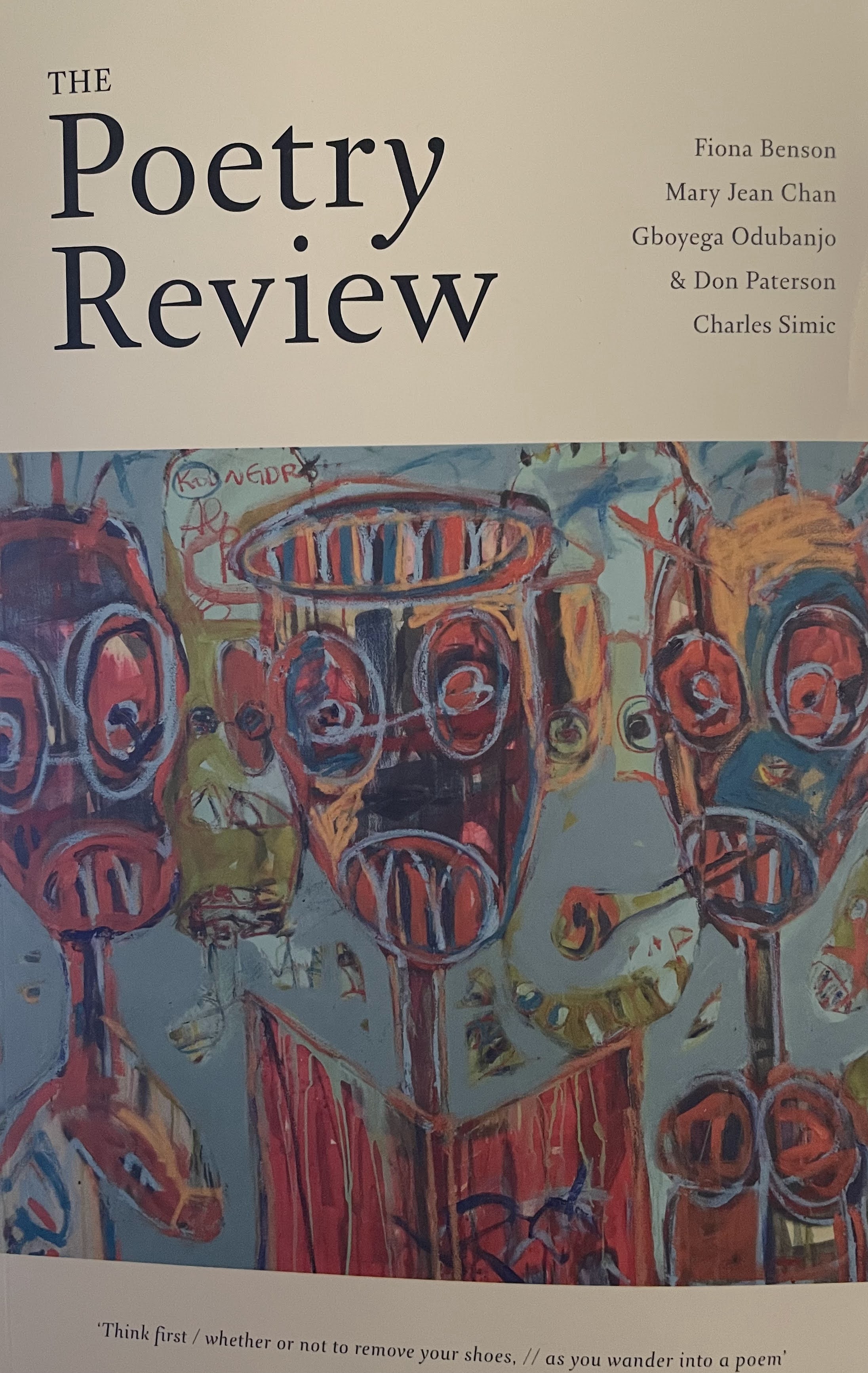
The exchange* between Don Paterson and Gboyega Odubanjo in the new Poetry Review is a welcome, necessary, and much overdue intervention in the unsettled and unsettling world of UK poetry community dynamics. Having barely stepped into that world, I stepped back out of it again a couple of years ago, finding that, mediated as it is by digital platforms, it was too disorienting a place to feel entirely comfortable. It was a dangerous world in which to take the chances I felt gave poetry life, and all too easy to get blocked, unfollowed, or whatever. And now it has started to feel as though cracks which had already become chasms, have become oceans of open water.

In fact, it might not be particularly useful to talk about a poetry community at all, given that its members claim nothing in common but Poetry itself, and Poetry, as Paterson and Odubanjo touch on, has by no means a single unified definition or means of assessing excellence. Perhaps ‘poetry community’ is itself an oxymoron; or at least, maybe speaking of cracks or divisions in the poetry community is little more than stating the obvious.

These are societal problems of course, which I shall subject to amateur analysis in a moment if you’re interested (if not, you have been warned), and they are only Poetry’s problem in as far as there is a small section of society who read and write poetry. As experts in the artform that deals most forensically and creatively with language, though, I have been disappointed over the last few years that big name poets and editors have not more meaningfully explored ways of learning from this difficult social moment. This piece in Wayne Holloway-Smith’s first Poetry Review is, therefore, a very pleasant surprise.

The much-feared ‘generational gap’ is far from being the only fault line weakening the integrity of our shared sense of community, but all things considered it is probably our San Andreas. The many other aspects of identity that divide and sub-divide us crosshatch the dynamics of our interactions with each other in every aspect of life, but these tensions have all been heightened by a more fundamental weakness in the relationship between the generations.

It’s tempting to think about the generations in terms of Boomers, GenXers, Millennials and Alphagens (all of which sound more like gangs of superheroes than age groups) but tagged in this way you don’t so much find gaps as false delineations and generalisations that serve only to bolster what were artificial categories in the first place. Generations are, like many things in the modern world, easy to pin down when you look at individuals (Paterson is old enough to be Odubanjo’s father, therefore they are two different generations) but much messier when looked at across society (where GenXers end and Millennials begin is at best a blurred sketch of a Venn diagram). There’s no escaping it though, without categories there is no meaning and so we do need these divisions, however inadequate; but let’s not use them as boxes where we can collect our most recent bunch of antagonistic words and phrases, what Paterson rightly calls ‘the holy watchwords of both left and right…(those) nuance-free signifiers…(which are)…an abuse of language’.

So it there really a problem with the generations? Do we need this tête-à-tête between Methuselah Paterson and Gboyega The Younger? Well, yes and yes.

There has always been conflict between the generations; at least, there has since the Cultural Teen was invented in the fifties and James Dean screamed ‘You’re tearing me apart!’ at his parents. In literary and artistic terms, this generational conflict is just a truism: Modernism was reacting against Romanticism, Post-modernism against Modernism etc.; these are generations of writers rubbing up against each other and creating sparks. And let’s not pretend it was all a friendly process: snide and angry remarks were made, punches were thrown, battles were fought (against real Fascists), but the outcome was, if not progress then at least changes in the cultural zeitgeist.

What’s different now isn’t Political – the left and right have been pushing and pulling since the French Revolution – but Economic. Odubanjo gets closest to the nub of the point when he mentions neoliberalism – to which Paterson, perhaps tellingly, doesn’t respond. With the advent and evolution of the internet, Capitalism has moved on at breakneck speed since Paterson and his gang were in the position that Odubanjo and his are in now. Call it Techno-Feudalism, call it Surveillance Capitalism, whatever, but something has changed. And with it, the modern West’s over-emphasis on individualism, which is a keystone of the liberal consensus that has reigned supreme since World War Two, was given a lightening jolt that has triggered its mutation into something resembling a Cuchulainn warp spasm. The personal freedoms demanded by rampant liberalism, mixed with now-monetised groupthink (which is driven, behind-the-scenes, by what Shoshana Zuboff calls ‘behavioural futures markets’), pervades a society wealthy and tolerant enough (probably tolerant because it’s wealthy) to educate everyone to the same comparatively high level, regardless of their biological or cultural identity preferences. This has led to, let’s say…fireworks.

So here are Paterson and Odubanjo sitting down (metaphorically) to an ‘intergenerational discussion’, or what they have termed a ‘mutual agitation’ (lovely phrase). Neither of them are arrogant enough to think that two poets can solve the world’s problems and they are both careful to try and strike an un-self-important tone, acutely aware I suspect that arrogance and its perception is at the core of the antagonisms between the ‘richly matured’ and the ‘excitingly fresh’.

This exchange is not only a delightful moment, but also I think a more important one than either interlocutor realises. Odubanjo seems to think they ‘failed’ and though Paterson disagrees, he also limits their success to ‘clarifying differences’. But they are under-selling themselves. I haven’t seen this kind of thoughtful, respectful, anger-free, and above all relatively lengthy, dialogue between two people of clearly differing views in any other literary or cultural media**. It’s so beautifully and majestically Not Twitter. It’s the kind of thing the BBC would like to do but never seem to get right, either because of not having enough airtime available, not getting the right people involved, or just by making a general hash of it. Perhaps it needs something like The Poetry Review, which can allow the space, and whose contributors and readers both understand already the genre specifics of the divisions under discussion, to lead the march here.

I had just cancelled my subscription to TPR because, like everyone else, I don’t have as much money as I used to; but I regretted it on receiving Spring 2023, my last issue; Wayne Holloway-Smith has done his readers a great service by commissioning the piece. I hope he will continue the series with more exchanges of opposing views conducted in similarly respectful terms, because the importance of them is not that they answer the questions they raise, or solve the disputes, but that they contribute to setting a new tone for public cultural discourse; that they add to the sense that even though there may still be oceans between us, we are at least finally paddling somewhere.


*I was going to call it an ‘epistolary exchange’ and deleted it because it sounds too pretentious, even by my standards, but I love the phrase so much I can’t resist adding it back in as a footnote.

**I may be wrong and if anyone who reads this knows of similar dialogues elsewhere, please comment.

The Body as Anarchist and Anchor 

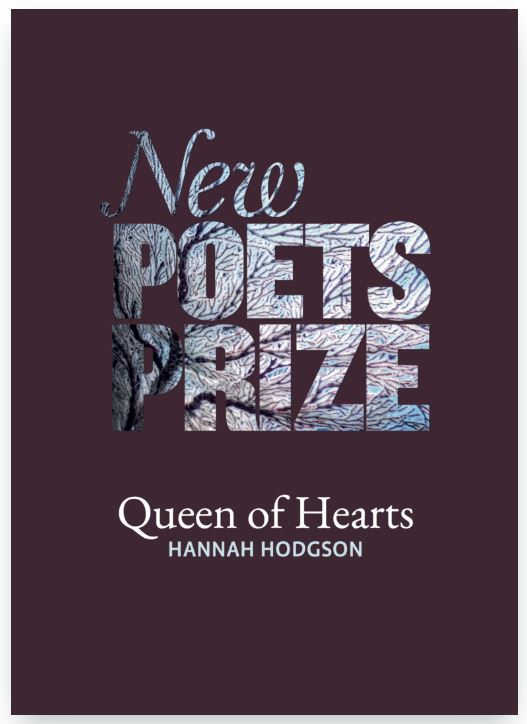
Queen of Hearts by Hannah Hodgson 

The Poetry Business 2023 New Poet’s Prize was declared opened a couple of weeks ago; it is open to 17–24-year-olds and will be judged by Kim Moore. This declaration has nudged me finally to review a pamphlet from the 2021 competition, also judged by Moore, which I read earlier this year and has been sitting on my bedside table for six months waiting for me to find time to write about it. 

The pamphlet in question is Queen of Hearts by Hannah Hodgson, which seems to me as good as – and better than – work by much more established poets that gets far more social media publicity and acclaim. I don’t know why this is (well, I do: poetry readers, including reviewers, tend to wait until any given writer has hit a certain critical mass of praise before they join in) but it should be rectified because Hodgson’s work – and that of 2021’s other winners Safia Khan, Karl Knights, and Charlotte Shevchenko Knight – deserves a wide readership (I’m very pleased to find that Hodgson had a full collection, 163 Days, out this year from Seren, which I will be sure finds a place on my necessarily curtal Austerity Christmas list). 

Hodgson’s collection particularly startled (and then sank into) me, not because she is a palliative care patient who brings an unusual, difficult and inspiring perspective to the big subjects like life, death, love, and dildos, but because her imagery, pacing and sheer clarity of thought are just so arresting (“We specialise in living when we shouldn’t. / Death between our teeth, a cold black flag.” she says in ‘Colonel Mustard is Waiting in the Dining Room’). Somehow, Hodgson manages to create a surreal world from hospital and house interiors, where the psychological turmoil of her family comes through as clearly and movingly as her own – perhaps more so.  

While the physical pain of her condition is not ignored (‘Last Night, I Finally Remembered the Screaming’ is a shocking journey into the agony behind the anaesthetised mind) neither is it highlighted or played for pity. And as for fear – surely there must be fear if you live in such a position – but if that is part of Hodgson’s experience, when we look for it (and this is one of the marvels of the pamphlet) we find in its place fury and humour, the former sharpening the latter, and the latter leavening the former. 

There is the fury at her betrayal by contemporaries (“Eight months // of his pretending to be dying, whilst I actually was” – ‘Year 11’), fury at the church (“Our vicar left the Church of England upon legislation / of gay marriage, and when I saw him in ASDA / he walked right through me, a miracle of mine, I guess.” – ‘Jesus Loved Men Too’) and fury at the lack of Covid provision for the disabled (a poem that is difficult to quote from, entitled ‘Do you ever think about all of the photos in which you’re accidentally in the background?’). 

The humour is, perhaps inevitably, dark and generally understated, but there is a wry surreal smile sitting behind many poems here, and which (like Lewis Carrol’s Cheshire Cat) fades in and out leaving only its general sensation until it finally takes on its full form in the Caroline Bird inspired hallucinatory madness of ‘A Family Christmas’ towards the end of the collection. Before that, Hodgson’s humour serves many purposes; for example, to take the edge off the potentially over-depressive ‘Beauty’ where she brackets the central five couplets (which begin “Summer is heavy in painful bones” and end “My mother couldn’t look at me without grimacing”) with two grimly amusing comments (1) “Emptying a stoma bag is a transferrable skill – // an icing bag of shit piped down the toilet” and (2) “Tesco had given me priority delivery – / until I spent two weeks in hospital, // where I was briefly pronounced dead,  / cancelling my slot automatically.” The effect of this is interesting, the archly raised eyebrow almost heightens the power of the poem’s central theme, which is the poet’s own body image, by sucking out of it any trace of self-pity. It is, I think, a deft and mature move. 

The surrealism evokes something, perhaps, of the in-and-out-of-consciousness daily experience of those living with constant serious illness, where the reality of an ‘anarchist’ body and the ‘void’ of being either passed out or sedated appear – through Hodgson’s sharp use of metaphor – to blend with each other into a heightened rather than a diminished level of awareness. In ‘Clairvoyant for the Unconscious’ she describes her bedroom as “the space used to come back / from transparency, reclaiming autonomy / from the void” as she and her parents wait “for the breeze of oxygen to leak / through the window seal of my brain”. This room-within-a-room (both within the stanzaic room of the poem itself) create an almost claustrophobic sensation which heighten the relief of the ‘breeze of oxygen’ for the reader and turn this short poem into an HD evocation of the movement from ‘transparency’ back to consciousness. 

One of my favourite poems here is the wonderful ‘translation & interpretation’ of Jules Laforgue’s ‘Complainte d’une convalescence en mai’ (‘Convalescence in May’), where the poet’s body is “an anchor on a seabed” and her brain “sits pickling in a jar” but both she and her tragic ward mate are “so sick (they are) disembodied”. Hodgson takes Laforgue’s images and reimagines them to her own symbolic purpose, weaving a world between her parents’ “unmedicated” pain and her own dreams, where she wanders “along the coastlines of (her) imagination”.  

Something else I like about this collection is the way the imagery leaps from the expected to the leftfield and back again with ease and grace. Many poems use metaphors and similes that emphasise the body as part of the natural world and the natural world as part of the body as she considers both her internal and the external physical worlds (“my body retreats and advances, tidal”, “organs like obstructing hawthorn”, “I waited there / for someone to pluck me / like a fresh egg from the coop”, “Doctors, wasps.”), which both serves to increase the sense that the poet is inhabiting a hinterland between life and death, and also gives priority to life over death – not a position that can always come easily to someone on palliative care. Hodgson only occasionally allows herself to play on the old ‘vegetable’ insults thrown at the mentally unwell (“We wait to soften as vegetables must / in boiling water” she says in ‘The Mark Holland Trust’, one of the few poems where bitterness seems close to despair).  

But in between such images we hear of her relationships with her family: “The three of us are like fine bone china”, “We operate as a carriage clock, our minds / equal, opposite, unable to touch”, and the unbearably moving (for me as a father) “Once this is over / I’ll surrender every candle he hates; embrace the familial equivalent / of a fireman’s lift – saved from this awful void of space.” From the organic natural images she keeps for her own body, to the small, intricate, utilitarian objects that symbolise her family, the reader gets a sense of a small, precious human world at the mercy of a capricious universe – particularly during the Pandemic, to which a lot of these poems relate. 

The loss of autonomy that comes with serious illness is another central theme, and some poems feel like attempts to wrest back some self-determination from her situation. In ‘Exhibitionist’ she refers to herself as an “exhibit” in “this museum / of self”, and during what is presumably an operation she is almost sinisterly objectified as she says “Somewhere, a doctor / is live streaming this / to his students.” And in ‘Missing Posters’, she finishes “I’m a blow-up version of myself; my valve belongs to someone else.” but even here it feels as though the very writing of the poem, the expressing of this humiliation, is an act of defiance. 

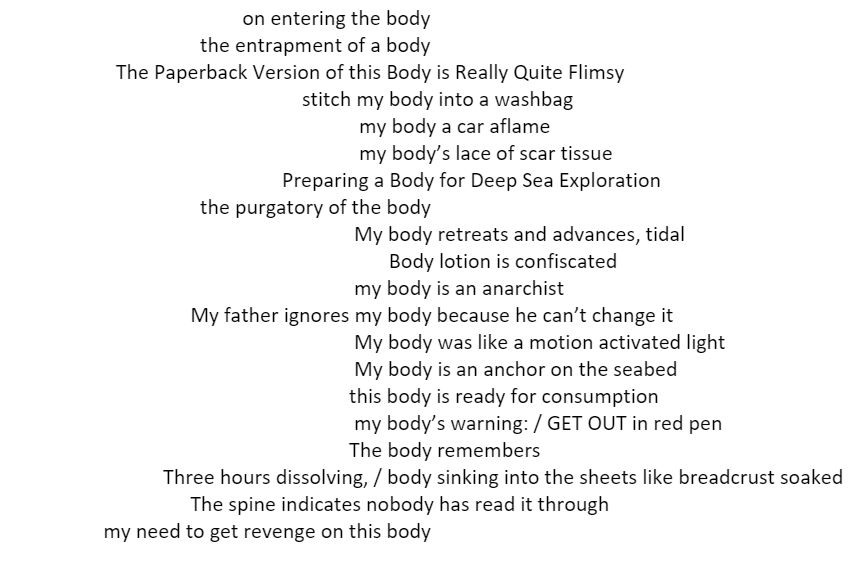
The body, the poet’s body, the disabled body, is inevitably at the centre of the collection, and the variety of ways that Hodgson describes the body is like an artist trying various angles to find the right way of expressing what they need to express – perhaps even like Picasso where all the perspectives are integrated and merged. From “the entrapment” of the body, to the body as “a car aflame”; and, wonderfully, from the body as an “anarchist” to the body as an “anchor”.  I wrote out all the direct refences to ‘body’ to look for themes, and as I saw them written in the order in which they appear in the collection, it occurred to me that they are a poem in themselves, which I include here (let’s call it a found poem) as a final way of recommending this excellent pamphlet:  


You can buy Queen of Hearts by Hannah Hodgson from The Poetry Business New Poets List, here

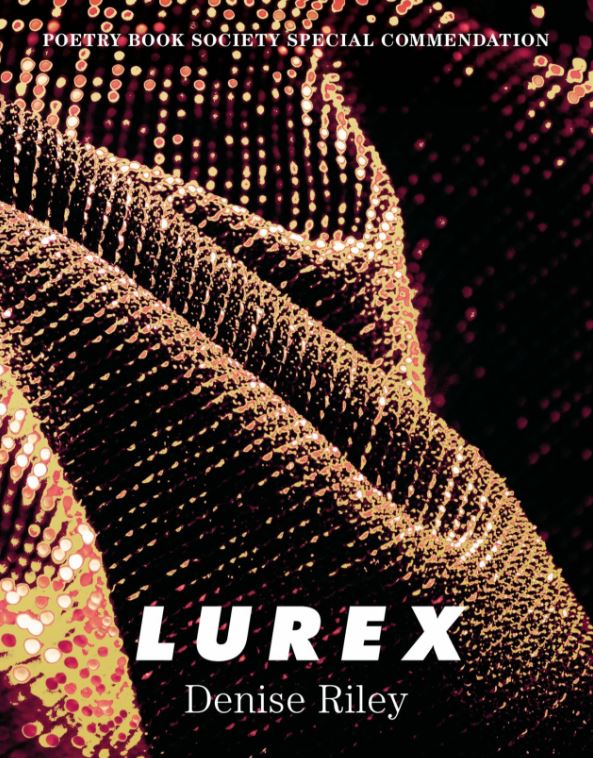
Dark yet sparkly – Denise Riley, Lurex and ‘the flesh of words’

Any reviewer of Denise Riley who has read her 2000 book The Words of Selves, proceeds if not with caution, then with a definite sense of unease. There are two principal reasons for this. One is that Riley’s work is difficult; she is known as a poets’ poet for good reason – her poems contain a lot for those knowledgeable about poetry to get their teeth into, but on a first reading many can appear a little like crossword puzzles to be solved, codes to be broken. And this is intimidating – to review and misread her work would be to expose oneself as an inadequate reviewer. She knows this, and comments in The Words of Selves, specifically on the interpretation of literary references: “When reviewers interpret a poem, they may confidently misconstrue an allusion. Often they’ll think up the most ingeniously elaborate sources for something in the text that had a plainer association, a far less baroque connection, behind it.” (p.74) So there is the concern of making a fool of yourself by over-reading (something I’m sure I’ve been guilty of in this blog more than once); that’s the first reason. The second is that much space is given in The Words of Selves to questioning and problematising the lyric I, and Riley is skeptical, even scathing, of biographical ‘selves’ in contemporary poetry: “Poetry can be heard to stagger under a weight of self-portrayal…Today’s lyric form (is) frequently a vehicle for innocuous display and confessionals” (p.94) And yet, for Riley’s reviewer, the fact of her son’s tragic death and the fact that she has written in prose and poetry about this, leaves the poet’s biographical self very close to the surface, and (the reviewer might feel) liable to breach at any time. How then to know at what point the real Denise Riley steps back and an imagined subject takes over? As one of Riley’s great philosophical concerns is the means by which language creates the Self, the uncertainty that Lurex (Picador) creates in the reader around what is being said and by whom, is unlikely to be coincidental.  

And this sense of unease is not entirely out of place. Riley herself writes of the “linguistic unease” of the writer, and so there is some solidarity perhaps between these two unequal partners in the generation of a text’s meaning, the writer-poet and the reader-reviewer. If we can proceed together with a joint feeling of guilt and inadequacy, the job of searching for meaning might not seem so lonely. 

So, to the review.  

Riley’s discomfiture at the intense focus on her personal grief is one of the central themes in Lurex I would, tentatively and with all due caveats, suggest. Part of this seems down to the inadequacy of the word itself (“’Grief’ is too bland a word, and I’ve always found it irritating, all the more so since he died” she says in ‘Beggars of Life’); and part of it could be due to a physical reluctance to be looked at – to be ‘seen’ in even the smallest way (“Hopeless to caution the scanning eye ‘keep off me’ – an unfocused look just is promiscuous” she says in ‘And as I sit and I feel the gaze’, riffing on WS Graham). But mostly there is a sense that Riley does not see her grief as anything special – that singling out an individual’s misfortune in a world of pain is not entirely, for want of a better word, appropriate:

What authority could my old pain, broadcast, allow me to claim?  

– None, I’d say.  

The humans sound their billions-fold democracy of distress – a dying spillage.  

How clear and plain its songs, how hummable. 

from ‘Were I September’ 

These beautiful words, evoking another of Riley’s central philosophical concerns, solidarity (worked in with the gorgeous irony implicit in ‘the humans’ – and we’ll come to irony in a moment), are the final ones of the collection; and they carry all the weight that this privileged position affords them. 

This unease with a focus on herself in Lurex chimes with comments Riley has made in interviews, and I can think of very few other poets who appear to feel this way about the limelight (and those I can think of are all women I should note) – it is enormously refreshing in a culture/industry that overwhelmingly encourages inflated egos, over-confidence, and self-aggrandisement. 

But we can assume too much about a writer, even if our assumptions appear borne out by public appearances and other sources, and I realise that my inferences above risk falling into the “all too common” reviewers’ trap of imagining “character profiles or amateur psychoanalyses of the author” (Words of Selves, p.74) but the sadness of the lines quoted above, modulated between the personal and the political, the past and the present, the internal and the external, show how meaning in Riley’s poems is no simple thing, and the character/psychology of the poet could only ever be a speculative point of departure; a springboard perhaps, but too flimsy a one to use with any confidence.  

And anyway, as with much modernist writing, the question is not always ‘what do these words mean?’ but more ‘where do they take me?’. In the case of Lurex, they may lead you to continue the journey of personal and political speculation about the generalities of loss, grief, loneliness, and old age, or the specificities of post-war adoption policy, personal experience of abuse, and the act of writing; Lurex is about all these things. But lots of poetry collections are about these things, or things much like them; what is special about Riley is that her writing is about them while simultaneously asking questions (of us? of itself?) about how language creates us, what we are within language, and what language is, materially. These are not just a wordsmith’s musings or a smart-arse poet’s cryptography; they are questions fundamental to the human experience of Being. It always sounds a bit self-satisfied and pompous for a reviewer to declare a poet ‘important’ (it’s up there with ‘one of our finest living poets’ as an unforgivable reviewers’ cliché) but in spite of myself I can’t help agreeing with what seems to be commonly accepted, that Riley is, especially in these times when self-identification seems so central to cultural discourse… pretty important. 

Yet, where I say Riley says this or Riley says that in this review, I can imagine her wincing should she ever read it, because it is clear that she doesn’t really believe that she writes the poetry at all, and that it would be much closer to the truth to say that the words write her. She refers to this obliquely and directly in Lurex, and in The Words of Selves she states it plainly as the paradox at the heart of her ‘linguistic unease’; it’s a lovely passage:

Words are brought forward as things, even if their semantic element is not completely overthrown. Stuff predominates, but sense insistently wells up through it later. This generates awkwardness at being called a writer, because really I am largely written. Writing, my writing, has got to know far more than I know for it to be of any interest whatsoever. It knows superficially – at its surface laid bare to scrutiny. I wrote it, but more interestingly I didn’t; yet I am not its agent or vice versa. As writer, I must be the ostensible source of my own work, yet I know that I’ve only been the conduit for the onrush, or for the rusty trickle, of language.

from The Words of Selves, p. 90

This understanding of language as worker and language-user as work-in-progress (that which is ‘worked on’ to quote ‘What are you working on’ from Lurex) follows the Continental strand of philosophy much beloved of Riley and which is central to many of the Culture War (sic) squabbles that have been flustering people for the past five or six years. Riley is concerned with how we are created by our shared understanding of words, and as such she is as worth reading as Judith Butler on gender and identity. Lurex introduces complexity to the question of gender pronouns without claxon-signalling a position in any spurious ‘debate’, by highlighting them as a feature of language. The importance of pronouns has been part of Riley’s work since her first collection, Marxism for Infants (1977), where she says in ‘A note on sex and the ‘reclaiming of language’’, “The work is / e.g. to write ‘she’ and for that to be a statement / of fact only, and not a strong image / of everything which is not-you, which sees you”. But where in that early work the pronoun reference seems most likely aimed at steeling feminism to wrest language from the patriarchy, in Lurex they take on a more paradoxical, less easily defined importance (although her pokes at the patriarchy remain gloriously intact): 

To write the word she does less than you might think. Or it does more. 

To write the word she does more than you might think. Or it does less. 

What about he? – Well, what about he. 

Typing a solitary word, indifferent, doesn’t do much one way or another. 

from ‘Colour words, person words’

The pronoun minefield is stepped into with almost comic glibness in ‘Prize Cultures’, during a wittily sardonic comment on the contemporary poetry scene, where we read: 

‘They’ is storming the Recommendeds for International Pronouns of Boldness (mine was always an ‘it’). 

from ‘Prize Cultures’

This poem was published in the TLS as a stand-alone, and I can’t help feeling that if it had been written by a less well-known, and less incontrovertibly good, poet, it might have received words of criticism from some areas (perhaps it did and I missed them). But, like colours, our perception of poems changes depending on those that surround them, and the sequence that follows ‘Prize Cultures’ in Lurex, ‘1948’ – fifteen shocking and powerful poems about the abuse of a child who I take to be Riley herself (my doubts about autobiography in Lurex notwithstanding) – shows that the poem’s ‘it’ is far from mocking other people’s pronoun choices, it is in fact a sign of the dehumanisation visited on an adopted child by violent adoptive parents, and as such it is a comment on the profound importance of what we call each other and what we call ourselves (if there is an archness to the line quoted above it is aimed at the current fuss made around pronouns rather than the pronoun choices themselves):  

I tell my past it’s passed, though it can’t tell. 

More training, to teach obedience: the toddler 

who’d wet herself gripped by the scruff of the neck 

and her nose rubbed in it, in freshly damp white cotton. 

Their real beloved dog I envied, while I stayed an ‘it’  

burrowing through straw quills in the kennel 

to study the grace of the dog, to poach the secret of being liked. 

Yet gradually, my life as an ‘it’ has grown muscular. 

Almost, I am that dog. 

‘from 1948’

This “muscular” life as an ‘it’ is key here I think, because it represents the strength of a learned empowerment and self-actualisation, the arrival at a point of that, albeit ironic, dog-like grace. 

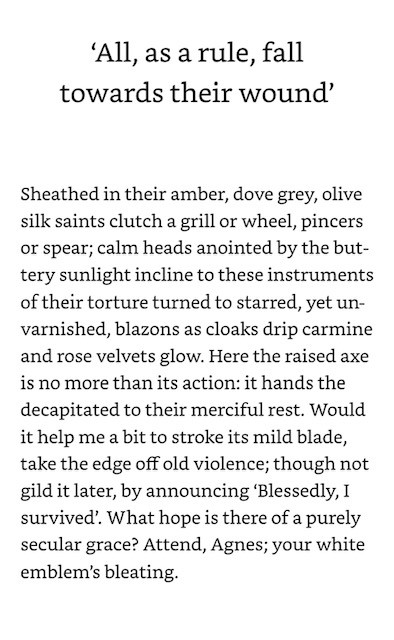
Riley is an advocate for and analyst of irony, as mentioned above, and she deploys it throughout Lurex to great and subtle effect, often burying it just below the surface, and as an addendum to allusions. One example of this is her apparent allusion to Lucretius in the prose poem ‘All, as a rule, fall towards their wound’, which while it is a reference to Lucretius, it is also pointing us back to Riley herself, the prose writer rather than the poet, as it is a quote which forms the title and part of the structure of a chapter in The Words of Selves (‘The wounded fall in the direction of their wound’, Ch 4). Is this irony? Well, I think so, but irony is, as any reader of Riley’s work knows, more complicated than Alanis Morissette’s critics would have us believe. Here is an allusion which simultaneously directs the reader away from and towards the poet (perhaps what allusion always does – a multi-layering of irony?), and which echoes in poetic form her own line of thought from more than twenty years ago; it calls out and back to itself, it distances and modifies – all features of irony mentioned by Riley. The poem gives symbolic resonance to the notion that we do ourselves a psychological disservice, having been as Riley says, “wounded by an aggressive description”, even a self-description, if we dwell too immovably on ourselves as wounded. 

The wounded fall in the direction of their wound in the sense that the injury, if narrated enough and without transformation, has the terrible capacity to embrace and infiltrate the whole person…I can easily become not just ‘the walking wounded’, but in myself a walking wound. Walking, and talking too; and once I am a talking wound, I am at grave risk of being heard only as a scar on legs.

From The Words of Selves p. 125

This brings us back to both the wound of a child physically and verbally abused by those charged with her protection, and perhaps to the different and differently difficult wound of being labelled a grieving mother.  

Here is the poem in full: 

The sentence at the centre of the poem, is also at the heart of its meaning, relating it back to the chapter quoted above, as I think the title encourages us to do: “Here the raised axe is no more than its action” – its meaning is removed in the same way as it is from words which have no receiving ear (“should a human receiver / fail to bear that light / clatter where no ear is.” – ‘What are you working on?’). I feel that in both the case of language and the violent action we are in Kantian – or more likely Hegelian – territory here, with a stripping down to the noumenon.  Poetry, like religion perhaps, edging towards the unknowable. This death-bringing gesture is a monument to the dead, and its meaning ends there. It is not the ‘old violence’ itself. What is to be gained, the wondering voice wonders, from sharpening those painful, even self-shattering, events from the past and making them real again by considering oneself a ‘survivor’? Would the recipient of this old violence attain some form of “purely secular grace”, or just become a “walking wound”? But the poem ends with a caution which may be aimed at the speaker herself or outwards at those who are tempted to define themselves through their victimhood: Agnes of Rome is patron saint of among other things, girls – and more particularly virgins and victims of sexual abuse – here I take her to be symbolising women as victims, which would of course include Riley herself if she in her autobiographical self is an intended presence – and the double meaning of Agnes’s emblematic lamb “bleating” feels pointed, but I’m not sure what to make of it. Perhaps this is the bleating of a lost or scared lamb – or a bleat of pain – rather than one of complaint. 

In common with a number of the poems in the collection, colour words abound, and they are given such physicality (“cloaks drip carmine and rose velvets glow”) that they seem to exemplify and elucidate what Riley calls “the flesh of words” (The Words of Selves, p.111), the materiality of language that creates us even as we feel we create it. This is why I think that separating Riley’s prose from her poetry is a mistake – they are both part of the same project of working with this raw material of language that is a physical reality in the world – her prose is expository, while her poetry is exemplifying and experimental. 

What lays across Riley’s work, for all its complexity, its sadness and its nuanced anger, is a deeply intelligent and knowing humour; the eagle-eyed reader will have noticed numerous instances of this above. Her humour is inseparable from her irony and comes across with varying degrees of centrality to the poems but is always present even if on the periphery (central to ‘Prize Cultures’ and ‘To a Lady, viewed by a Head-Louse’, on the periphery of ‘Another Agony in the Garden’, ‘Lone Star clattering’, ‘Person on train in August’ and others); and it is as much part of her language’s meaning-making as the grief, loneliness and “vast motherliness”. There is, we might say, a twinkle in her ‘I’. “Dark yet sparkly – / the seriousness of it!” she says in the titular ‘Lurex’. This describes a quality of Lurex the material but could also stand in for the paradoxical language of the Self itself…profound yet silly, heavy yet light, depressing yet amusing etc. 

‘Lone Star clattering’ is a nice example of peripheral humour. It picks up on the “light / clatter where no ear is” from ‘What are you working on?’ and blends the Texan imagery with the idea of someone happy in their own company (being alone she is in fact in a ‘lone star state’) to create a brief inner monologue that again expresses doubt that dwelling on the wound of past pain is helpful: “to canter around its crimson / rosette would tart up a harm”. The poem has begun in high seriousness with “What got done to me stains / through my hopes of passing // as fully human” but here in the third couplet ‘canter’ raises a small smile as it blends the horsiness of the Lone Star State with a very British sense of brisk and easy human movement, which is then consolidated with the “crimson / rosette” which ironically turns a traumatic wound image into a child-like sporting award, and takes it further with “tart up”, jarring with both the seriousness of the poem’s opening and the Americana of “yellow rose” and “Amarillo” that come a few couplets later. Having been shot down like an enemy fighter jet in the first line of the final couplet, the speaker then declares “Yet do I rise, a tad orange”, turning into both morning star and phoenix, picking up perhaps the rousing declamatory mode of Shelley’s “rise like lions”, only to puncture it with the archaic Britishism “tad” in the final clause, the lovely intentional bathos echoing the “orangey grey” of the morning light in ‘Plaguey winter’, and maybe even the “strayed montbretia’s orange flecks” in ‘Is there nobody in here?’. I wonder whether this kind of inter-poem repetition of particular words and intra-poem deflation of the move towards bombast, is a poetic experiment in irony’s potential for protecting the identifying Self against what Riley refers to in The Words of Selves as “cadences for antagonism…(which)…rise as syntactical forms”. Noting that “there may be a syntax of both remembered and anticipatory hostility”, she goes on to ask, “Is there some way in which irony itself can modify this grammar in its latent capacity for damage?” (p.171-2). 

So, I may be guilty of “confidently misconstru(ing)” Lurex, and “think(ing) up…ingeniously elaborate sources” for its associations (as I say above, it wouldn’t be the first time); but I choose to read this brilliant collection as an experiment in psycholinguistics and the sheer materiality of language, and as an expression of the ways in which people (particularly women of course but I don’t see why men need be entirely excluded) hurt by past violence might work towards new strength and grace; and more, through the “clear and plain…songs” of our “billions-fold democracy of distress “, which are “hummable” like plainchant, and hymns, and the buzzing of bees, we might do it in solidarity with each other. 


You can buy Lurex from Picador, here

You can buy The Words of Selves from Stanford University Press, here


Some online material relating to Denise Riley: 

Riley in conversation with Professor Lisa Baraitser from Studies in the Maternal, specifically on the interruption of the sense of temporality described in Time Lived, Without It’s Flow, here. 

Conversation between Riley, Emily Berry and Max Porter concerning their experiences of loss, in which Riley explains among other things her dislike of the word ‘grief’ and her reasons for writing about her son’s death and the language she used to do it, here

Riley and Berry discuss a couple of poems which were later published in Lurex, here

John Self’s Guardian review of Time Lived, Without It’s Flow and Selected Poems, here

Ange Mlinko’s 2016 review of Say Something Back, here. 

Interview in PN Review with Romana Huk from 1995, in which Riley gives in-depth analysis of her work. Behind a paywall – but if you don’t subscribe to PN Review, you should consider it, here.  

An interesting essay by Marxist-feminist Helen Charman, who was inspired by Riley’s early collections but is suspicious of the bourgeois attention given to her later work, here.  

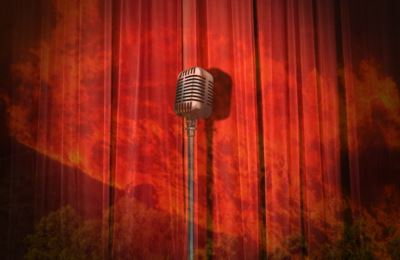
The Comedian

κόσμον τόνδε, τὸν αὐτὸν ἁπάντων, οὔτε τις θεῶν οὐτε ἀνθρώπων ἐποίησεν, ἀλλ’ ἦν ἀεὶ καὶ ἔστιν καὶ ἔσται πῦρ ἀείζωον, ἁπτόμενον μέτρα καὶ ἀποσβεννύμενον μέτρα

Stewart Lee

I can write jokes, I just choose not to

Heraclitus

You don’t get a blaze of laughter but you should
Laughter is like fire
it crackles and splutters
it purifies
Wild like laughter like fire

It dances, it dances
as though mocking time itself
with its not-existing-existence,
and gone
As your brain ticks beneath the heat of the lighting

The machine of your mouth
The subtler machine within
your sandpaper brain
The scratch of your delivery
What you have done is create

substantial nothing
It purifies
Your lips on the mic in caesura – flow
you create
sound after silence

brute noise after a system of manipulations
joy as a by-product
of a political point
The stomach of an auditorium
eructing

like in the cartoon
where the human-like non-human animal
burps so fiercely it sets ablaze
chars to a carbon squiggle
anyone close

It crackles and splutters
and your brain ticks beneath the heat of the lighting
Did you get that
Joy as a by-product of the political point
it purifies

The comedic ouroboros
If there is an escape from ideology
it lies somewhere within the circle
of the seriously silly

Two debuts: Abeer Ameer and Aoife Lyall

Although they are two very different debut collections, Inhale/Exile by Abeer Ameer and Mother, Nature by Aoife Lyall share a number of similarities when considered together, the most obvious being that they are both concerned with notions of Home. In Inhale/Exile, Home is Iraq, or perhaps the more ancient Mesopotamian homeland, ‘the land of two rivers’, from which her own family and many of the characters in her poems fled during the days of Saddam Hussain’s totalitarian Baathist regime. But Home is also the UK for a poet who was born in Sunderland and raised in Wales; and so, much of the work is suffused with both a refugee’s paradoxical longing to return to what is now an ‘alien land / called home’ (The Fugitive’s Wife (vi) return) – Ameer uses the evocative Welsh word hiraeth in her acknowledgement of gratitude to the Iraqi diaspora community – and an understanding of non-belonging in a land which remains foreign: language errors, for example causing a recent exile, who I take to be the poet’s father, ‘an awkwardness he’ll know well’ (The Waiting Groom). The awkwardness is not Ameer’s as a second generation Iraqi immigrant to the UK, but that of her parents’ and her grandparents’ generations, for whom Inhale/Exhale stands as an impressive tribute. For Lyall, simultaneously celebrating the birth of one child and mourning the loss by miscarriage of another, the speaker/poet herself is Home to her surviving baby: ‘I am your home / Hold me close and you can hear the ocean’ (‘Hermit Crab’). The ‘I’ and the ‘you’ of these poems exist in a state of symbiosis, their mutual dependencies are the fabric that binds them and protects them from the outside world. They are the universe drawn inwards, and for a time (painfully short for the mother) they are hermetically sealed and yet all-containing. But this is no smugly beatific Earth Mother; the Mother-as-Home in Mother, Nature bears all the pain and responsibilty of nature’s personification: ‘…I tried not to cry. I felt your stomach fill / with the violant sting of golden milk. / My body bled for you.’ (‘3oz’); ‘There is no room for error / (…) / …If I open / my eyes to the chance of falling / I will fall. And down will come baby, / cradle and all.’ (‘Trapeze’). And the grief of a mother’s loss, Lyall shows us, is an emptiness which is far from metaphorical; it is of course the all-too-physical reality of an unoccupied womb, ‘this house your home in me a hollow place’ (‘Ithaca’). This is a truth we may have already known, but Lyall’s language begins to make us feel it. Body-liness and the material mechanics of life pervade Mother, Nature, from the contractions of childbirth (astonishingly rendered in the typography of ‘Labour’) to the ‘unfolded’ family resemblances of ‘“Origami…”’, a well-crafted concrete poem in the shape of an ear (knowing where to place words on the page is a particular strength of Lyall’s), to ‘each starry breath’ of the sleeping child in ‘Caledonian Sleeper’. And breathing, of course, is also central to  Inhale/Exile, as the title suggests: the held breath of ‘The Diver’ who dredges the Tigris of dead bodies ‘holding his breath hoping for peace’; the ‘shallow breaths’ of the boy hiding from Saddam’s soldiers in a watertank in Sulaymaniyah (‘Kurdish’); and the breath that brings music from a reed flute, whose ‘inhale / is your exhale’, and whose ‘larynx speaks your exile’ in one of the collection’s several stand-out poems, ‘The Reed Flute and I’. And just as Lyall considers the unspoken name of her lost child to be a ‘folded treasure map / I hold in my throat’ which when she is lost will ‘lead me back to you’ (‘Your name’), Ameer also makes a connection between words and motherhood as her speaker struggles to find a word for a sensation of survivor’s guilt that she cannot quite express, searching ‘for a link between / the tip of the tongue / and the body of the larynx / vocal cords stretched / to umbilical chords’, going on to ask what the word is that could describe the feeling ‘when the words / form a tumour in your throat / but do not make a sound?’ (‘A Word I&II’). The relationship between the mother, the word, and the body is implicit in a number of Ameer’s poems, but made extraordinarily explicit in the third poem of the four-poem sequence ‘The Interpreter (Alif to Thaa)’ where she notes the inadequacy of English to capture Arabic’s intense employment of body metaphors, as a son recalls the last time he heard his mother’s voice: ‘she calls him the light of her eyes, / her heart, / her after-liver,  / says she’ll put him on her head, / go to sacrifice for him, / that his leaving burst her gall-bladder / and dragged her soul from her body.’ English translation from Arabic, Ameer tells us, ‘is too dry to taste the spoken blood / which flows through gutteral throats. ’ (‘Taaت ’) and we can well believe her. While Ameer’s poems are social, political and outward-looking, Lyall’s are ostensibly almost the opposite – their power coming from the unwavering gaze of a mother on her child – but the final poem of Lyall’s collection, ‘Acrania’, changes gear, turns around and faces politics head on with a powerful attack on Ireland’s Eighth Amendment (‘By law she carries you. / She will know the sound of your first breath. / The rest is silence.’) Such a stark final move should not work, especially post-repeal, but it emphatically does, bringing all the tenderness and strength built up over the preceding poems to bear in this now-historical context and serving, as Lyall notes in her preface, to ‘give voice to the present before it becomes an inevitable, and untouchable, past.’ – something which is achieved in both of these startlingly successful debuts.   

Inhale/Exile by Abeer Ameer (Seren) £9.99 

Mother, Nature by Aoife Lyall (Bloodaxe) £9.95 

Like something about to be born

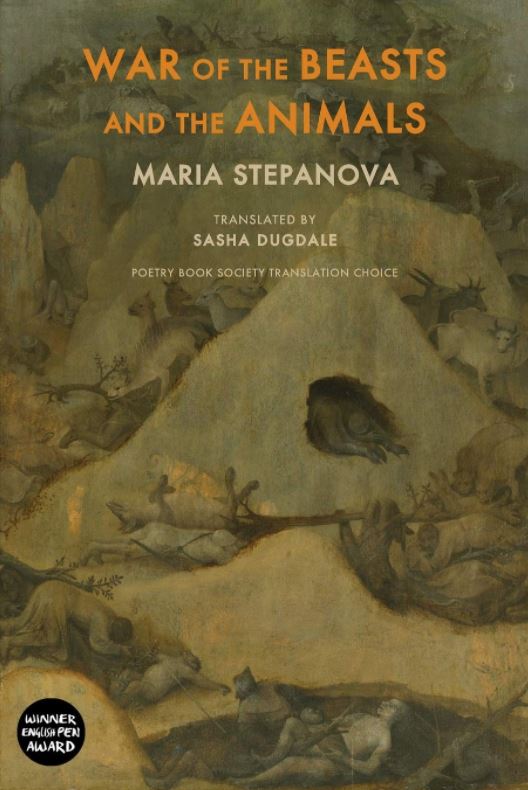
On Maria Stepanova’s War of the Beasts and the Animals (Trans. Sasha Dugdale)

“My poems, I suppose, are indeed written by various authors, and from various points of view and with various voices, they attempt to bear witness to or to overturn one hypothesis that someone put in my mind as a lifelong sting. Like a prisoner in shackles, the poet is bound with the shared chain to precisely this hypothesis, rather than voice-manner-gait – and in order to estrange oneself from it, see it from a distance and from above, one needs these series of fissions and substitutions, of exits from the self and from the world, familiar-unfamiliar voices that speak with you from the sidelines, with the indifferent engagement of a stranger. Thus, a fictive poetics forms around the hole in reality. Its task is to overturn the paving stones of personal pain that have rooted into the earth and to make the water of life flow beneath them. If that works out.”

Maria Stepanova, Displaced Person (2012), Trans. Sibelan Forrester

Introduction

Towards the end of February 2020, on a chilly evening in Cambridge and in what turned out to be my final attendance at a public event before lockdown forced all such pleasures to become online affairs, I sat at the back of the Latimer Room at Clare College to hear Maria Stepanova in conversation with Irina Sandomirskaia on the subject of ‘Memory’. Of the many interesting things they said that evening, one comment that passed between the two women has stayed with me more than any other – though I may be paraphrasing (my memory, ironically or appositely, not being my strongest faculty): “The present is a battlegound for the past”, Stepanova said, or some phrase very similar. This strikes me as true; but it is not its truth particularly that is the reason it stays me, or necessarily its originality, it was after all used in conversation not poetically and it is a phrase which may well have been used many times before, but it is in relation to Stepanova’s poetry that it takes on extra significance for me. And there is a sense in which the idea behind this phrase, although it may sound rather grandiose to say so, changes everything. Stepanova was speaking specifically about the Russian state manipulating the memorialisation of the siege of Leningrad, but the idea of battling over the past is a truth which we in the UK see played out over the treatment of public memorials to those with links to slavery, and in conflicting perspectives on how our history as an Empire-building nation should be treated. The battleground metaphor contains not only ideas of opposing sides and violence, but also loss, mourning, pain, genocide, devastation, confusion, fear, pity, humiliation, the obliteration of the individual to the group and to the earth, and many other associations which, when applied to memory, either individual or cultural (ultimately both), rightly conflates the past and the present into a single physical zone in which those who are living use whatever power is at their disposal to gain control over the dead. And the weapon used in this battle (although real war stripped of all metaphor is its ultimate expression) is language. Memory is an event in the present, it is an event of the mind that takes place through language, which in turn is a social activity that is subject to negotiation and power play. Our language moreover is a social activity in the vertical as well as the horizontal sense (to pilfer and distort Helen Vendler’s expression), i.e. we use it and morph it in dialogue with those in the present but it is bequeathed us by those in the past. Any language possible in the present (and to the extent that we cannot think in any precision without language, any thought possible in the present) owes its meaning to the past. This is what I mean when I say that Stepanova’s phrase changes everything. And while Stepanova writes specifically about Russia and what she sees as Russians’ “strange relationship with the past and its objects” (‘Intending to Live’, 2016, trans. Maria Vassileva) I think my point above about her work’s applicability to the present cultural moment in the UK holds, as I will try to expand in the final part of this essay. My reading of War of the Beasts and the Animals (Bloodaxe), the recent collection of Stepanova’s work translated by Sasha Dugdale, essentially a selection of poems from as early as 2005, is steeped not only in the idea of the present battling for the past, but also in the idea encapsulated in the quote that began this essay, specifically the notion that “a fictive poetics forms around the hole in reality” and perhaps something can be learned about this hole in the same way that we can learn about black holes by the way light bends around them.

I – Why does she speak in voices?

This leads me to ‘Spolia’ (2014), the first poem in the collection and one which is structured on just this language-around-a-hole basis. “I’m a bagel I’m a bagel says the speaker-without-an-I,” the speaker says early on in the poem, in response to those traditionalists who ask her (Stepanova we assume) “why on earth does she speak in voices”. And in the middle of this long series of what I guess we could call ‘movements’ (linked, poems in themselves to some extent, but more importantly carriers of the poem’s flow) there is a pause:

………

<insert hole in bagel here>

The surreal humour is pointed here, aimed at those critics who dismiss a female voice which rejects traditional male discourse (the multiple repetitions of she, her and herself in the early part of the poem makes the point clearly without having to make it at all). And so the hole in the poem becomes the hole in reality, which is also a hole – an ‘unknowable’ – in the self; at the same time as the poem becomes the self, the self becomes the body. And in turn, as literary quotations and allusions build up through the course of the poem (the ‘voices’ which she is condemned for speaking ‘in’ – the association being with the chaotic nonsense of ‘speaking in tongues’) the body becomes both bodies-plural and the state of Russia itself – the hole therefore taking on the added symbolic value of both a bullet hole in an individual and a sense of national vacancy – a lacuna in the country’s self-understanding.

So the self and the state become fundamentally intertwined in this poem (and others in the collection), as does the individual and the collective, and materialism and idealism. And central to this blurring of boundaries are the ‘voices’ that sit within the text, driving it onwards and drawing in its meanings from throughout literary history. There are direct quotations and allusions as I mentioned above, but that does not do justice to Stepanova’s (and Dugdale’s as translator) extraordinary treatment of other texts. The references are sometimes clear and straightforward, sometimes buried, often manipulated and bent out of shape, and sometimes they just seem to breeze across the surface of the poem, leaving “a nagging sensation of familiarity” as Dugdale says in her introduction. I will, I’m sure, have missed many of these “embedded quotes” as some will be from writers both Russian and otherwise that I don’t know, but Dugdale has brought in allusions to English language writers in order to replicate for an English speaking audience the vastness of Stepanova’s intertextual creativity. There are moments where this creativity seems to go into overdrive: at one point, in three or four short stanzas, I found references to Walt Whitman, Byron, Charlotte Mew, Edward Lear, Robert Browning, Philip Larkin, Wilfred Owen and Rupert Brooke (I admit to a little help from Google). Later, Paul Celan rubs shoulders with Thomas Hardy, Shakespeare with the King James Bible; Frantz Fanon slips in and slips away again. And always these allusions are soldered together, often with the simple rhythms of nursery rhymes and folk ballads, accentuating the way language builds on language, alters and twists meaning, with the past materially affecting the way we think in the present from the very earliest stages of life.

II – Out of the murky pool

And this brings us to the notion of memory, which is never far away in Stepanova’s work, because woven into the structure of ‘Spolia’, alongside the allusions and the wordplay, family memories (some half-familiar to readers of Stepanova’s Booker-shortlisted ‘In Memory of Memory’) appear and disappear like snapshots and fragments of notebooks, as though they are being glanced at and then discarded (“five-year-old mother flicks her silken ribbon …//… a headless cockerel…swooped dead through the yard”). But as the personal memories and family stories bubble up, they mingle with more abstract images of war and again the boundary between the personal and the universal is blurred:

everyone round a laden table

ninth of may victory celebration

windows thrown back radio on

victoria herself sitting at the table

singing the blue scarf song singing schubert

as if there were no death

This reference to both a member of Stepanova’s family and a Russian patriotic song juxtaposed with (what I take to be) a reference to ‘Death and the Maiden’ highlights the other boundary that is continually questioned in several poems in this collection, that between the dead and the living. The swirling rhythms that carry ‘Spolia’ are the voices of the past (that is to say, the physical non-presence of the dead) in continual and almost hallucinatory dialogue with the “speaker-without-an-I” of the present (the living, present in both time and space). These rhythms are presented to the reader alongside the idea of a single, eternal ‘nation’ and a single, eternal ‘people’ who are almost literally born of the national earth in the sense of the Narod – the ‘folk’, like the serfs, the workers of the land who were seen by narodnik nineteenth century intelligentsia as “autochthonous man…born from the earth, historically tied to the soil and therefore custodian of ‘true’ Russian national identity”* That the latter creaks and strains, if not entirely breaks apart, from the centrifugal force of the former, is one of the great themes of Stepanova’s work.

The earth, and of course the soil that comes from it, is rich with ideological significance both on the left – the anti-tsarist narodniks were the precursors of the the revolutionaries of 1905 and 1918 – and on the right – the blood and soil movement of nationhood was and is a mainstay of the fascist worldview. So in Stepanova, the dead speaking through the earth to the living not only brings the past together with the present but also pulls opposing political forces into the gyre of its ‘Natasha’s Dance’**. As a whole, the collection seems to spin at the crossroads where individual, cultural and ‘post’ memory intersect with History.

Time and again the interplay between the materiality of the individual and that of Russia itself is expressed in single stanzas, lines and even words so that the distinction between the two almost entirely disappears:

holes and dugouts and pores

through the skin of the country, these doors

through which passers-by

may not descend unauthorised

not a tear duct, nor a shallow well

but a mine in every hole

a deep long shaft

to where the canary me is held aloft

And then in ‘War of the Beasts and the Animals’, the title poem here, but also from 2015’s Spolia, the profoundly present materiality of the human body is expressed in terms of seasonal renewal – again the body and the earth become one; this time in my favourite section in the collection, a sonnet, if you take its first line as its title:

the human body

is not soap wearing thin to a hole

in the scented water bowl

nor is it ever wholly

of the past, always of the here and now

glows through the deadwood

not easy to dispatch

it creeps up like a snowdrop

through the carbon patch

and what was pining, barely alive

shut away within its bony cage

now floods into the dark recesses

to happen again

new life emerges when hope is no more

and you stand there, empty-handed and unsure

III – Made of deep hole

The reference in the second line of the section just quoted to the hole in the soap not only triggers grim associations with the myths around Nazis creating soap from murdered victims of concentration camps, it also links us back to the ‘bagel’ structure of ‘Spolia’ and the unknowable centre of the self. This exemplifies another characteristic of Stepanova’s verse, its use of theme, motif and internal referencing to build and enrich ideas which are in a constant state of flow. The “hole in reality” returns as “earth’s caesura”, also in ‘War of the Beasts and the Animals’, where it appears to be a feature of war – the pause between battles or no man’s land. It returns again in a small selection from the cycle ‘Underground Pathephone’, from the earlier collection, Kireevsky (2012), which wittily creates a folk-musical voice for Persephone (Goddess of Spring, Nature and the Underworld, i.e. life and death) and the dead of war: “Dig a hole, speak into it / Press your ear to it, catch a sound…//…The one who stood at the window with you / Is made of deep hole”. It returns again in the most recent sequence in the collection ‘The Body Returns’ (2018) where it takes the form of the “space” that needs “to be cleared” in a woman’s body – signifying the creativity/fertility of the metaphorical/literal womb; and again when it is politicised: “Where is my body says the middle stratum / The earth’s middle class: dead and still unresurrected”; and again in the final stanza, whose middle lines are missing, represented by three dots, as though the absence at the centre of ‘Spolia’ has returned in this contemplation of the century since World War One. It is as though Stepanova is an artist revisiting the same model or landscape again and again sketching it in different lights and from different angles.

Sparrows, legs, pelts, the warming sun, petals, soap, and roses are all images that are repeated either locally or across poems written years apart, glinting off one another and adding to the sense of thematic coherence that I think is unusual in ‘selected’ collections – and sometimes this might just be a repeated structure, like “fish hooks a fish” in ‘War of the Beasts and the Animals’ picked up a few poems later (though chronologically three years earlier) with “Tear answers tear” in ‘Kireevsky 3”.

IV – Like something about to be born

‘The Body Returns’ is worth focusing on because it ties together so many of the themes in previous sequences – they ‘return’ to the reader in the same way as the earth returns the dead, and in a way which reminds me of the body of the mountain climber in Sebald’s ‘The Emigrants’ which is returned years after his death by the movement and melting of the glacier he fell into. The sequence plays with ideas of fertility and creativity, reimagining the idea of the Earth Mother as a female poet (drawing on Inger Christensen, Anne Carson, Marjorie Pickthall, and Virginia Woolf – probably among others I didn’t spot) whose poetry becomes, like an as-yet-unmade foetus, the great symbolic ‘potential’ (i.e. the future that the past and present have “rendered useless” – see section V). Poetry is both an allegorical figure and a composite, made of “manymouths” and “found in many bodies at the same time”, definitely female, but also Christ-like, not yet risen but “(l)ike something about to be born. Paradoxically, poetry is not only the watcher of – or listener to – the conflict-riven world over the last hundred years (the sequence was written to mark one hundred years since World War One) it also becomes the manifestation of the war dead themselves, lying beneath the old battlefields, who return “like earthed-up potatoes”; they, and it, are the seed in the creative ‘room’/womb/stanza of the female poet. But there is also a hint of something more, something undefined but bordering on the spiritual: “There is a Presence here”. But this is not nebulous idealism as much as an acknowledgement that the material earth gives the impression of something beyond the Human: “As if wind … / Gainsaid any human part in this … //… As if the ear of the earth … // … received and transmitted the very same” (my italics). In the end, though, as always in Stepanova, the human – the human body – is at the very centre, and the returning body is less a resurrected Christ than a Lazarus, who comes back to life not to take part in it fully but whose physical presence is a symbol of, and a receptacle for, life (“You hold my head like a basket … // … Put it in a sack. / Put it in a pot. / Grow basil from it”). What is dead is male, patriarchy; what returns is female, the future potential inherent in creativity/fertility; and there is therefore a deeply feminist streak running through the poem.

“The unheroine makes an uncourageous effort

Trickles

(like underground water through a seive)

Attaches herself to the dead

Her own body a tessera

Between dead white men”

The resurrection that is taking place, then, is a living female poetry replacing a dead male one. And the bird that stirs within the “observant little girl” is not Bede’s sparrow-as-soul (“Word is not a sparrow”) but something more closely resembles Emily Dickinson’s ‘thing with feathers’ (“The swallow’s heart had started beating again.”)

Whether these allusions are Stepanova’s in the original Russian or Dugdale’s for the English translation, or whether I am reading more into the text here than was intended, is probably not important. What is important is that together Maria Stepanova and Sasha Dugdale have created a rich and profoundly affecting work, which presents seemingly endless ideas – and it seems nothing short of miraculous that such a complex work in Russian is available to those of us who can only access it through English. More than any work I have attempted to write about here this is one which frustrates only because there is always more to say about it.

V – Envoi

In her essay ‘Intending to Live’, Stepanova writes of Russia’s obsession with the past being “unlike any other illness I know of”. She goes on:

“…it needs to be analyzed and treated. The inability to allow even a sliver of air to come between oneself and the past, the absence of any distance, or even the desire to create distance, between oneself and everything that has already happened – lead to strange transmutations. When the past and the present coexist with such intensity, the future is rendered useless – and it comes to resemble a descent into Hades.”

From the standpoint of the UK, it is hard to read these lines without relating them to the current state of the liberal, middle-class disorientation that is central to what has become misleadingly known in the mainstream press as the Culture Wars (the Ideology Wars would be more appropriate). I have already said how it seems to me that Stepanova’s melding of the past and present on a linguistic level provides a new way of thinking about thinking. But here she goes further and diagnoses an ‘illness’ that needs to be cured.

The UK, and more specifically England, and more specifically still White England, has a relationship with the past that is an illness in the same way, I think, as Russia’s. The past, be it Nelson’s defeat of Napoleon, VE Day, or the 1966 World Cup final, is with us in the present at all times. We are caught in something not entirely dissimilar to Timothy Snyder’s ‘politics of eternity’, a key feature of his ‘Road to Unfreedom’, and one way in which, as Stepanova has it, “the future is rendered useless”. Furthermore, in post-Brexit Britain, the ideological capaciousness of Liberalism has been stretched to breaking point with the centre-right looking back to a time before the UK joined the EU, and the centre-left looking back to a time before we left it. At the same time the language of gender and race is changing, further disorienting liberals of a certain age and causing them to look back to a time before Millennials and Gen-Z came along with their new and disturbing ideas. The political centre then is reeling from the shock delivered by the events of the first twenty years of the twenty-first century as, like Russia under Putin, its future seems to have disappeared and it has come to “resemble a descent into Hades”. “Strange transmutations” indeed.

The truly future-facing movements, like Black Lives Matter and Trans Rights, ones for which Liberalism would have, I think, under different conditions, created room, appear revolutionary to many white, heterosexual, middle-aged liberals (are revolutionary, in fact) because they refuse to get caught in the hellish authoritarian descent – ironically appearing authoritarian themselves (to liberals) as a result – insisting on the re-evaluation of core assumptions. They ask, in effect, that we do not drop the future “like a coat into someone else’s hands”, as Stepanova puts it.

My view is that the treatment this Stepanovan illness in the UK needs is a wholesale re-evaluation of our relationship with Empire – a surgical investigation of what colonialism means and how its legacy has affected how we think and act; and a similar investigation of the ways in which we categorise our bodies and sexuality. It seems to me that poetry is in an ideal position to do this for the UK, as Maria Stepanova’s does for Russia. She talks, in ‘intending to Live’,  about “flashpoints” in Russian history appearing like “clusters of conflicting versions” rather than “paragraphs of a shared narrative”. She says

“There is no period in the past three centuries that we could consider free of such conflict – and that wouldn’t belong to the territory of the artistic. That is – of restless, unfinished, effervescent uncertainty rather than reconciled knowledge.”

Is the territory of British colonial history not artistic in the same sense? And isn’t this “effervescent uncertainty” exactly the realm which poetry, the artform of language, is best suited to explore? Aside from the many insights, pleasures and challenges that come from Maria Stepanova’s work, there is surely great value in the fact that it might inspire other poets to look as seriously and unsparingly as she does at the past and its relationship with the present.


You can buy War of the Beasts and the Animals by Maria Stepanova from Bloodaxe, here.

‘Intending to Live’ is from The Voice Over: Poems and Essays by Maria Stepanova (Ed. Irina Shevelenko), which you can buy here.

* quoted from Laura Mieka Erley, Reclaiming Native Soil: Cultural Mythologies of Soil in Russia (freely available here).

**Natasha’s Dance is a reference to Natasha Rostova’s famous folk dance in Tolstoy’s War and Peace, and it is also the title of Orlando Figes’s cultural history of Russia, which I read to help me orient myself in Stepanova’s work.

Paris by Emily Berry

In a week in which, inexplicably, a kerfuffle was kicked up over Ange Mlinko’s not-extravagantly-unreasonable comments about Adrienne Rich in the London Review of Books, the poetry contribution to the same edition of the LRB, Emily Berry’s Paris, seems to have passed more or less without comment. I’m surprised only because Paris is a prose poem and prose poems always seem capable of getting someone’s goat; I would at least have expected someone to take to Twitter with a complaint about how this sort of thing ‘isn’t poetry’. I’m posting about it now not to bemoan the form of Berry’s offering (if interested, see more on the subject in relation to Jeremy Noel-Tod’s prose poetry anthology, here) but to celebrate it as a complexification of literary power dynamics, an exposé of authorial paranoia, and a parody of Proustian psychological observations.

This week is also of course Proust’s one hundred and fiftieth anniversaire, and so it is appropriate that the LRB should mark the occasion, even if it is tucked away in the sub-text of a prose poem. Berry is very witty in shrinking the vastness of Á la recherche du temps perdu to what is (prose/poetry debates notwithstanding) basically a single paragraph. And it is a paragraph repleat with ironic thoughts on that most thoughtless of modern mechanisms for capturing lost time, the selfie. What took Proust thirteen years to write, and most readers months if not years to read, is whittled down to a minute or two for readers of the LRB and a single moment of posing for the protagonist of the poem. Not that we ever find out if the speaker actually takes the selfie, comically wracked with doubts and insecurities as she is (I say ‘she’ but the speaker is not gendered, we know only that the admired poet who Berry’s ‘I’ is visiting is male and famous and therefore in some position of implied authority – which is part of what Berry is dissecting). The sentences have a rather Proustian feel to them too; the first is short and clear, but from the second sentence onwards they are curiously difficult to parse, as the protagonist’s thoughts layer and divide and digress, so the clauses build within lengthening sentences, punctuation causes the reader to double-take slightly, and sense also seems to leap across full-stops sometimes, which sounds perfectly normal when read aloud but requires a little more from the working memory than would usually be asked. The opening of the poem begins to give a flavour of this:

“I went to Paris to visit a writer I admired. Because I was not confident he really wanted me to be there, he promised me that he did and we hugged for a long time but he let go first and I was not completely reassured. In his apartment he had taken my photograph when I had just finished showering and was looking rather dishevelled because I had dressed hurriedly and I asked if he would take another one later, or if maybe we could take a selfie together.”

With seven ‘I’s, six ‘he’s, two ‘me’s, two ‘we’s, a ‘my’ and a ‘his’, the proliferation of personal pronouns in these opening sentences suggests another reason that the reader needs to slow down a little: the things being done in the poem are swamped by the two people doing them; the verbs feel crowded, harried almost, by their subjects. As with selfies themselves, the people involved are paradoxically both foregrounded and stripped of any real identity, while blocking out anything of real interest that might be going on.

We are offered the suggestion (one we can accept or not) that the ‘admiring’ writer is in Paris having an affair with the ‘admired’ writer – it is after all the city where clichés tell us such things are commonplace, and anyway why is the protagonist showering in the other writer’s apartment? And why does the admired writer photograph his admirer in a state of post-shower dishevelment? There is an unexplained level of intimacy here, and we do not have enough information about the couple to disentangle the innocent from the creepy, or the romantic from the manipulative. Is the male writer a symbol of the power an aging literary patriarchy wields over rising millennials?

And if there is no affair going on here, why is the speaker in Paris at all, other than out of this professed admiration? What is in this visit for either of them? Is it simply the professional kudos of proximity to a ‘famous’ and ‘interesting’ writer? To gather that all-important photographic evidence that one literary celebrity has been close to another – with all the intimations of heavy-weight intellectual conversation that brings with it? Are they each other’s trophies? Paris, city of literary as well as romantic clichés, is the right place for such trophy gathering.

This brings us back to the poem’s central theme, the overwhelming and crippling sense of paranoia and insecurity (a word used multiple times, building almost feverishly and comically towards the end of the poem) which the speaker feels both in relation to the other writer and their respective social media ‘audiences’. It is the level of over-thinking that the speaker brings to the more-or-less thoughtless, impulsive activity of selfie-taking, and, for example, the solemn use of the word “collaborate” to describe the two writers posing together for a selfie, that seems to me both amusing and profound in equal measure. We know what research has to say about the effect of selfies and social media on emotional health, and by juxtaposing this with the supposedly High Intellectual world of literary relationships, Berry both pokes fun at such relationships and exposes the dissonance between what we show of ourselves to the world and the turbulent individual emotions laying just below the digitally connected surface.

“I wanted to appear secure and aloof but it seemed to me that what such pictures conveyed was quite the opposite, even though that wasn’t their intention.”

The speaker gets tied up not because she is paranoid that she is not “famous or interesting enough”, although she is paranoid about that, but because she is applying the very observations required to be a good author to her actual relationships, layering psychological insight upon psychological insight, as though she is in a game of chess with herself and finally finds herself in check-mate. Ultimately, the reader leaves Berry’s speaker tangled up in a final sentence that takes a particular effort to unpick:

“He had done almost everything in his power to assure me that I had every reason to feel secure, except by going to such lengths that he himself would feel insecure in the event that I failed to assure him of his security.”

We can pull from this the criticism of the male writer for his hidden, but ever-present and ever-fragile, ego; but this criticism is itself hidden within the speaker’s own insecurities, which clog up the narrative in a way that, for me, brings to mind Sylvia Plath’s descriptions in The Bell Jar of the physicality of words on the page coming between a reader and a text’s meaning, impeding rather than facilitating progress. Is this writer, too, on the brink of a breakdown?

We can only guess, because there we leave our speaker, trapped in the box of a prose poem, a little like Proust sitting in his Paris bedroom not going anywhere but thinking himself into eternity.