Why aren’t we happy that poetry is popular?

Capture

A couple of interesting and thoughtful blogs I’ve come across recently (via Matthew Stewart’s useful hub for all things poetry at Rogue Strands) have expressed some disquiet about the current state of the ‘poetry world’. These concerns are reasonable if not exactly new (as the blog writers acknowledge). Is poetry today too competition-focused? Is it too dictated by a central establishment? Is it too driven by the cult of personality and the desire for renown?
At the The Cat Flap, Richie McCaffery asks whether poetry is becoming essentially undemocratic, with those who play the festival-networking/self-promotion game rising to the top and as a result much good poetry going unnoticed. Helena Nelson at Happenstance points out that competitions look for ‘winners’ as opposed to good poems. Writing a poem for a competition encourages us to write the kind of poem that we think will get noticed by the judge rather than the kind we might naturally want to write (one that has “space to be its own good self” in Nelson’s lovely phrase).

In relation to this last point, it’s worth saying that every time we write a poem with a view to getting it published we are trying to write ‘the kind of poem’ we think a certain editor will look favourably on; in fact, magazines and publishers explicitly advise us to buy from them to see what sort of poetry is most likely to stand a chance of publication. This is, perhaps, an offer to see if there happens to be a lucky match, but it is also a statement to the effect of: “if you want to be published in this magazine, you will need to change your writing style to fit in with what we publish”.
There is nothing wrong with this of course, but it is also no surprise that as a result a lot of writers attempt to write in a way that will get them published in magazines, just as they will change their style to win competitions.
Poetry competitions and festivals and magazines and books exist as part of the system of commerce we all live by. Poetry is, like it or not, about winners and losers: if you win the competition it means someone else does not; if you get published in a magazine it means someone else does not (Nelson herself makes the same point in her blog). This can pretty much be said of all art at all times, at least since art was first commodified. Michelangelo would never have painted the ceiling of the Sistine Chapel if he had not won the contract, etc. It is just an extension of the basic producer-consumer agreement: I like what you have produced so I’ll look for more of it and even pay for it if necessary, I don’t like what s/he has produced so I’ll give their work a wide berth.
The poetry industry is…wait for it…an industry.

But having said that, it is also true that poetry (all art) can and does also exist within ‘the system’. Pockets of it are able to survive, thrive even, protected sometimes by their smallness and lack of popularity, sometimes perhaps by their lack of quality. Just as up and down the country amateur artists produce huge numbers of unsung sketches, water-colours and even full-scale paintings, so amateur poets scribble in their notebooks, save on their c:drives and post on their unread blog pages. Of course, any that are noticed and deemed good enough may well end up as part of ‘the system’ but not all. Are we a nation of poets desperate for recognition and stifled by jealousy of those chosen few whose talents are recognised by a central London coterie? We’ll probably never know, because all those poets who are inclined to get on with it quietly are doing just that. The ones who enter the competitions and struggle for publication are the ones who crave glory (and I count myself slightly sheepishly amongst them), but we don’t know much about the others. There may be an army of unambitious, uncompetitive poets out there. The next Emily Dickinson may be somewhere quietly among them (and she may not, ours will not be the generation to decide).

You don’t have to look far before you find these little pockets of poetry “hiding inside the system”. Take for example Kevin Bateman, a surrealist poet from Dublin I came across recently, who organises small scale performances in various areas of natural beauty. He invites seven or eight poets to read with him and he broadcasts on Periscope and then publishes on YouTube. These are joyful and joyfully amateurish performances – in fact their very strength is their unrehearsed quality and the fact that they locate the poems amongst trees, on cliff tops and halfway up hills rather than in the more sterile but supposedly intellectual atmosphere of a bookshop or with the self-consciously arty-trendy backdrop of a cellar stage. Kevin and the poets who perform with him exist happily and creatively nestled within the whirling chaos of competitions and networking that surrounds them. The space they and others like them are creating is artistically and culturally important precisely because it avoids (however much the poets themselves may want to get published ultimately) the rush and the push for central establishment acceptance.
This feels very democratic to me.
Very different, but also democratic by its nature, is the website footballpoets.org, which is an enormous repository of verse written for the sole purpose of expressing delight in football. The poetry here is written by anyone who chooses to submit, with (as far as I can tell) no vetting for quality at all. Judging the quality of the work in poetic terms would be missing the point; football comes first, and the language is put to its service, not the other way round. There is nothing here that would win a poetry competition, but also nothing that would particularly want to. On the other hand, if any of these poems were to be adopted and chanted by fans on the terraces, or quoted by a football manager after a game, I imagine that would be a prize worth winning. It is one of the few places I have come across poetry genuinely moving away from its middle-class home.
In Democracy, Culture and the Voice of Poetry, Robert Pinsky makes a point of distinguishing between poetry as an art form (as which he says it will always be important to the individual) and poetry as a form of entertainment (as which it will always be at best marginal). I agree with Richie McCaffery that the distinction between print and performance poetry is largely a false one (although poetry in performance is clearly different to poetry read in the head) and Pinsky’s antithesis seems similarly dubious. This perception of duality forms the basis of the vague but common illusion that one set of poets (the performers) are democrats, jobbing entertainers who somehow represent the proletariat, while the others (the silent readers) are the snobbish elite gobbing poetic pearls from their ivory tower. I like to think poets can be all these things at once. But Pinsky’s wider point is that poetry itself is essentially democratic because it allows the inner world of the individual to link with the outer world of the landscape through the primal sounds of grunt and echo, and through metaphor link the psychological with the political. I can’t find anything to disagree with in this, and it might actually help to explain why so many people seem to feel aggrieved and concerned when poetry shows the outward signs of becoming popular: something we consider sacred to our inner selves is being profaned; something which on one level is deeply ‘ours’ is, on another, being manhandled by someone else.

It occurs to me that there are two ways of approaching the poetry industry and its associated battles for individual recognition and popularity: a) enjoy them, or (b) ignore them. Poetry, like so many things, is something we do to make us feel special; but it can do this in many ways, getting published or winning a competition are just two. One of the reasons I like poets like David Jones is not because I claim to understand The Anathemata any better than anyone else, but because I know it’s never going to be very popular and so reading it gives me that tingle of doing something just a little bit different from the crowd; and so, I briefly can allow myself to believe that I am different. This is part of what attracted me to poetry in the first place, and probably why, despite the thrust of my argument above, I am one of the many who, while yearning for recognition, feel the same awkwardness with the idea of competitions and festivals and national poetry days: they feel a little herd-like. When I got into this I thought it was just me and Auden; where did all these people come from?
Better just get used to it I suppose.

Clarity & Obscurity in Now We Can Talk Openly about Men 

downing_street_1921 (2)

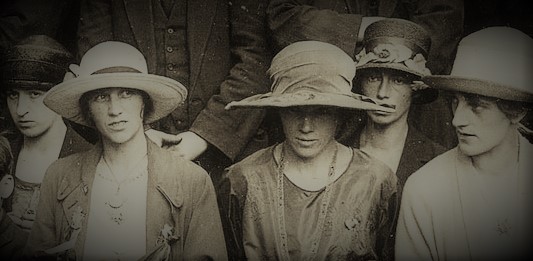
The characters Martina Evans has created in her 74-poem-long sequence of dramatic monologues Now We Can Talk Openly about Men (Carcanet) (actually two sequences of 39 and 35 poems), feel so real that it comes as a bit of a surprise not to be able to google Kitty and Flora Donovan, Babe Cronin and Eileen Murphy and find out more about them on Irish history websites. Although based around the factual killing of a British sergeant at Mallow Barracks, County Cork, in 1920 and subsequent military reprisals, the story/stories are entirely fictional. But somehow Evans has turned these short poems (only a couple cross over onto a second page) into what feel like primary sources of data about the characters and their time; Bernard O’Donoghue calls the book a “remarkable document” in the blurb on the back cover for a good reason, the poems have the feeling of authenticity and legitimacy that the word suggests). Her ability to replicate on the page colloquial Irish rhythms and phrasing has been commented on before (John McAuliffe has called the style “talky, jumpy, gothic”), and it draws the reader in from the beginning of the first poem:

I was in a weakness. I couldn’t stand up,
leant back against the wall like a drunkard.
Was that Himself I’d seen on the back
of a Crossley tender on Main Street?

Here it is not just the use of the sobriquet ‘Himself’ with all its connotations of indignant but ingrained respect for ‘the man of the house’, but also the second line, which is a participle clause to the second-half of the first, using the spondee leant back to evoke strongly not only an Irish cadence, but a female Irish cadence of the middle-twentieth century (I don’t claim to be an authority on female Irish cadences of the middle-twentieth century so I stand ready to be corrected, but this is how it sounds to me). Such careful attention to the narrating characters’ voices is maintained throughout.

It is in part the very believability of the authentic-sounding voices of Mallow seamstress Kitty Donovan in the first sequence and former stenographer from Dublin Babe Cronin in the second that creates a sort of ‘narrative veil’ over the real central characters of the story: Kitty’s strong-willed daughter Flora Donovan and, even more so, the rebellious and impetuous Eileen Murphy (who is also the link between the two sequences). Rather than reading poems about women in the Irish War for Independence, we feel we are witnessing the period of the war through them. But the veil is also generational because we are in effect looking at the younger characters through the eyes of the older – Kitty is Flora’s mother who has an increasing addiction to laudanum, and Babe (also with an increasing dependence, on whiskey), is an older resident of a Dublin hotel who is in love with – or at least infatuated by – the younger Eileen. The older women’s addictions are another gauze between the reader and the younger characters and the action of the piece.

Each poem is, in a sense, akin to a chapter of a novel, and there is narrative drive both within the poems and between them, but as they are poems, i.e. stand-alone entities and in this sense equally analogous to paintings, they serve as much as windows onto moments, thoughts, memories and feelings as narrative blocks. As the chronology of events progresses, each poem, each line, builds on our impression of Kitty’s and Babe’s mental states (or their memory of their mental states), so we emerge with the two older women’s psychologies fore-fronted and emphasised (the extravagant use of colour in the first sequence and monochromatic second add significantly to the difference between the two women here) and all the actual events are filtered through this. In short, cultural history and folk memory are the currency of these ‘documents’, as opposed to the history of statistics and other written records.

All this goes to making the already enigmatic title, Now We Can Talk Openly about Men, even more abstruse: these poems are not, primarily, about men; and very little in them is talked about openly; even what is discussed in direct terms is hidden behind this ‘narrative veil’. In fact, the men who are directly involved with the action are almost always either not actually there (Himself), masked (the Tans who attack Eileen), or dressed in a disguise (Donnacha); alternatively, they are (like Mr Bloom and Captain Galway) only briefly sketched in character. Little open talking here. Is the title ironic then? In part it is, I think; but there is more going on that that. Occasionally men are seen clearly and almost demonically (Himself’s “red eyes” in that first poem; the Tan as Eileen rips off his mask and shouts “I’ll identify you in court!”) and these moments are often marked by direct speech, also something which seems to pull them clear of the above-mentioned obscuring veil. In the final poem, and dying in bed from consumption, Eileen says “Mrs Donovan taught/me darning & fancy darning. I could/do the Peacock’s Eye but all I darned was/men’s socks & they were always on the run.” At the end of her life Eileen seems to find a melancholy clarity within her half-delirium (conjured by that blurred and dreamy repetition of “darning & fancy darning”) as she recognises her relative importance to the men and women in her life, and the difference in how capable they thought her – how much they valued her. She is, at last, speaking openly about men – and in doing so it is disappointment she is expressing.

The title was apparently a phrase used by Evans’ mother after the poet’s difficult divorce, and thereafter it served as a ten-syllable phrase to get this extraordinary work of art (mostly decasyllabic, or thereabouts) underway. So it is, on top of everything else, a practical departure point for a work that will I imagine be discussed and written about for a long time to come.

After writing the above, I discover that Eileen Murphy was the name of Evans’ cat who featured in a well-known (although not by me until now) earlier poem “The Day my Cat Spoke to Me”. On my original reading I had not considered the surreal, psychological angle of the poem as an exploration of Evans’ own inner-world. Having recently read and written about, Sophie Collins’ criticism of male critics’ inability to allow women credit for creating art free of their own autobiography in Who Is Mary Sue? I resist this reading. But I will enjoy returning to Evans’ book to think more about it.

Now We Can Talk Openly about Men is published by Carcanet, and is available here.

12 Observations on translations of Al-Saddiq Al-Raddi


a monkey at the window

What can I write in response to the beautiful 2016 collection of translations from the Arabic of Al-Saddiq Al-Raddi, A Monkey at the Window (Bloodaxe)? What might be useful? What might be interesting from someone with no more knowledge of or insight into Arabic or Sudanese culture, history and religion than anyone else?

Should a reviewer pause before reviewing a translation? Well, this is my first; and I do pause, briefly. It’s not that I don’t read poems in translation much, I do; and of course I feel I’m as entitled to have reactions to them as anyone else. But to review them, and publish on a blog? Am I qualified?

There is a Philip Larkin quote from The Paris Review, which comes over these days as pretty xenophobic:

“I don’t see how one can ever know a foreign language well enough to make reading poems in it worthwhile. Foreigners’ ideas of good English poems are dreadfully crude . . . But deep down I think foreign languages irrelevant. If that glass thing over there is a window, then it isn’t a fenster or a fenêtre or whatever.”

Although hemmed in by the prejudices of his day, Larkin was making a good point. Isn’t it true that you must have a fairly profound understanding of a language before you can enter into its poetry, either as reader or writer? And doesn’t reading a translation just present you with the same problem at one step removed? Yes and no.

The problem – if it is a problem – can be overcome to an extent firstly by the teamwork between the writer and the translator (or translators, literal and final), who work together towards a text which is more than any one of them could produce alone; and, secondly by the understanding that the word translation does not mean “exact copy into a different language”, rather “new piece of work inspired by a previously existing one which happened to be in another language”.

But Larkin’s point can be extended, I think, to include a ‘foreign’ culture as well as just another language. I feel this sometimes when I hear rap – I understand the words, but do I really understand what’s going on beneath the words? On the other hand, perhaps if you follow this road in the direction logic takes it, you must also include work by those of other regions, cities, classes, genders…every body is a foreign body, after all.

And besides, Carol Rumens wrote this 2007 article in The Guardian which convinces me that translations are in fact worth the effort. The only crime, for reviewer as well as translator, is to ignore the fact and nature of the translation.


Anyway, brief pause over and my urge to ruminate being the same for poems in translation as any other poems, I present not a review exactly but 12 observations on this almost exhaustingly lovely collection:

1.

I quoted Auden recently in this blog: “Poetry makes nothing happen”. Now, I read these lines in Sarah Maguire’s and Sabry Hafez’s translation of ‘Theatre’:

Write
to set the world ablaze
so poetry quickens in your hands
and inflames you with desire

I think about these two poets and what must be their very different experiences of life that led them to have such polar views of what poetry can do. Suddenly Auden appears rather lazy and dismissive.

2.

The literal translations on the PtC website (an amazing resource) make me wonder whether the final translation above adds a political dimension which is not there in the original (transcribed as “I write/so that the world lights up in you”); but it also makes me consider the conversations between Maguire, Hafez and Al-Raddi that must have led to the final version. What has the final translation mined from the Arabic that the literal translation was not able to express, I wonder.

3.

As I read these translations and I look for meaning, almost blindly feeling around for sense and significance, I feel like the poems are asking me to forget for a moment as much as I know. They are lights onto a different world of understanding from the one I exist in.

4.

The original Arabic is set out on the left-hand page with the translations on the right; so English readers begin towards the middle and move further to the right, while Arabic speakers who also begin towards the middle, move further to the left. But at the line endings both readers’ eyes return towards the middle, together.

The Arabic and the English reader go on their separate journeys, but they come home to the same place. Is the ultimate aim of translation? It feels too simple. The ghost of Larkin stirs.

5.

Each poem and its translation could be friends leaning against one another, facing outwards and poised for attack from an enemy circling the page. Or they could be duellists about to march their paces, turn, and shoot. Or lovers, sleeping – we do after all make odd shapes with our bodies in our sleep.

Or they could just be Rorschach blots.

6.

I’m aware of seeing the two versions of the same poem with different parts of my brain.

7.

The English looks solid, calm, to my trained eye.
The Arabic looks as though its quivering, straining to be free, to my untrained eye.

8.

The body of a bird in your mouth
breathing songs.
Raw light spills from your eyes,
utterly naked.

These lines of Al-Raddi’s (the first from ‘A Body’), translated by Sarah Maguire and Atef Alshaer, demand attention. If you take a moment, you can feel the scratchy, feathery, beaky bird inside the soft flesh of your mouth; you can feel the warmth of its breath against the inside of your lips causing them to open and allowing the song to escape. That’s the mouth, then there are the eyes. If I block out Cyclops from the X-Men, I suddenly see that something terrifying is happening: by ‘looking’ you are giving to the world not taking from it, and by giving you are exposing yourself entirely. The words ‘raw’, ‘spill’ and ‘utterly’ are the translators’ I notice, but they heighten the lines to an emotional level which I have to assume is equalled or surpassed by the original.
The rest of the poem demands equal attention.

9.

I am not usually aware of needing to rest between poems, but with these I am.

10.

I think again about (8) above, then about (5) and (6). On the right, my cynical western atheism; on the left Al-Raddi’s Sudanese Sufi mysticism. These poems are taking me into the crevasse, the inside of the spine, between the two.

11.

And a violet blossomed fiercely in the bosom of the sky

These words (from ‘A Star’) are a negotiation between Al-Raddi, Mark Ford, Hafiz Kheir and…here’s the revelation…me. And they’ll remain a negotiation.

What they are negotiating is not Arabic or English but an understanding to which both languages lead.

12.

When I return to ‘A Body’, the image of the X-Men’s Cyclops again invades my brain, and I resent this elbowing-in of my own culture as I try and open my Self to Al-Raddi’s. It happens again in ‘Traces of an Unknown Woman’:

The end of a tribe is a tribe.

Here, against my will and denting my pride, I hear The Who singing ‘Won’t Get Fooled Again’: “Meet the new boss/Same as the old boss”.

The snob in me wishes my cultural references were more cerebral.


A Monkey at the Window is published by Bloodaxe and is available here.

Words in Your Ear

monet waterlilies

In some poems the speaker feels closer to you than in others. I’m not sure why. It may have as much to do with the reader as the speaker, but it’s also something about the poet’s ‘voice’ I think: their approach to rhyme, choice of syntax, sense of rhythm, even the subject matter. The speaker’s mouth just seems closer to your ear and gives you – even without hearing the work read out – a stronger sense of a character standing there behind the poem. This is not a dramatic character but a personality – either the poet’s own or their creation’s – which fully inhabits the words. Some of Simon Armitage’s poetry has this quality I think, and Sharon Olds’, in a very different way, often has it too. Paul Stephenson’s Selfie with Waterlilies (Paper Swans) is a pamphlet of such poems, although I’m not suggesting it bears any other similarities to either of these two poets’ work.
Stephenson takes a more-than-usual delight in language, and this comes through in all sorts of ways: his use of internal and half-rhyme, imaginative repetition, knowingly deployed cliché, shaped poems, punning and other word-play; and it seems to me that he uses this delight as a distancing mechanism, a way of stepping back from the objects of his poems in order to take a clearer look. Perhaps it is this stepping back that brings him a step closer to us. It’s a technique similar to that employed by comedians who use humour to dissect and analyse the world; but Stephenson’s aim is not to amuse, although there are funny poems like ‘The Apprentice’, which memorably teases barrow-boy-cum-millionaire Alan Sugar by ending every line of an open letter to him with the word beetroot. His main purpose here is I think to use language as a distorting lens which emphasises features that might otherwise be missed, features of his parents and their infirmities, his childhood, and his relationship with continental Europe, Russia and Turkey. And of course, the sense of delight in language works in particular contrast to the sadness of the poems which deal with death in the family.
There is a lot of travel in these poems. The speaker takes a taxi across the Bosphorus in ‘Turkish Delight’, before travelling home to see a dying relative (whom we assume to be this father from subsequent poems, though interestingly this is never directly said); he takes a trip in a car with his family only for his father to refuse to get out when they arrive (‘Where are we going?’); he drives down the sleepily repeated “motorways of France” (‘Autoroutes’); he blurs weather and security at Houston Airport (‘Going through’); and finally he has fun with airline safety instructions by putting them into an imperfect online translator: “So listen hard, belt up and fear the worst safely” (‘Waistcoat of Life’). These poems not only reflect a globalised twenty-first century, they also create a sense of personal dislocation, a jitteriness, an inability, perhaps, to settle down; here the speaker’s movement in the world reflects a life thrown into turmoil by death. But the travel in these poems is juxtaposed starkly with the stillness of poems like ‘Womb’ (a sonnet of single word images surrealistically building a portrait of a child in the womb), and ‘Selfie with Waterlilies’ (a double page of two waterlily shapes made up of phrases beginning with a self-centred me). So, at the heart of the pamphlet there is both movement and stasis; maybe it’s the reality of the former and the yearning for the latter. For me, the speaker feels tired in the ‘still’ poems, like the tiredness we all feel when we experience inescapable grief. Stephenson knows that there are times when grammar, punctuation and syntax should keep a firm hold of a poem, and other times (as in ‘My Father’s Food’) when the imagery can take over and lead the mechanics of the language.
‘Deathflake’, perhaps more than any other poem, carries the speaker’s playfulness somewhere darker, using the simple but effective idea of transposing the words “death” and “snow” in various phrases, clichés and collocations, creating new, unusual and sometimes unsettling images (“He snowed heavily in his sleep/Death White. Snow duty.”). There are hints too, I think, towards problems of both physical and mental health in the family of these poems, and disillusionment along with the love, a bitterness which is vaguely alluded to throughout and then begins to head towards some kind of catharsis in the final poem (‘Appeasement’), which picks up the /athe/ sound in “swathe” and plays with it almost like a kitten with a ball of string before the speaker finally changes tone and addresses his family directly: “Mother, father, brother,/you know I don’t loathe you/though indeed at times I’ve seethed”.
Because family and the speaker’s youth play such central roles, it also feels like there is more to be said than was possible in twenty-three poems, as though we are reading a selection of stories from a much longer text. There are unanswered but intriguing questions at the end of this enjoyable and thought-provoking pamphlet, and I hope we’ll soon get to read a full collection from Stephenson for some answers to those questions. He has, with this pamphlet and its predecessor The Days That Followed Paris, begun the process of creating a strong poetic voice which knows both what it wants to say and how it wants to say it; and because it has this quality of proximity to the reader (this reader anyway), it feels like a voice to return to and hear again.

Selfie with Waterlilies is published by Paper Swans Press and is available here.

The painting above is a detail of Water Lilies by Claude Monet, National Museum of Western Art, Tokyo.

To Helen Dunmore

hlen dunmore

I came to your work very late
and had no reason to expect

that it would be waiting.
We might say the sun

had already gone down,
and it’s true your back was turned.

Would I have been embarrassed
to admit your last collection

was all I’d read?
We have to start somewhere

I suppose, there are no rules
of metaphor to follow.

I choose for you to smile as
you are writing now.

Let’s count backwards together
and one by one

return to your juvenilia.
Then I’ll see where I am.

Poetry, Uncertain Knowledge, and Linguistic DNA.

dna

Jack Underwood wrote in the Winter 2017 issue of The Poetry Review:

“If a poem works it’s because you’ve made it such that other people might participate in making it meaningful, and this participation will always rest on another person’s understanding of the poem and its relationship to a world that is not your own.”
(from ‘On Poetry and Uncertain Subjects’ TPR p.43)

I don’t disagree with this at all, but when I read Underwood’s essay, I also happened to be reading Helen Dunmore’s Inside the Wave, and these two texts have come into alignment for me with a recent TES article called ‘There is no “correct” answer in English’.

It was argued in the TES piece that schools should be asking students to give interesting and creative interpretations of texts instead of asking them questions of the ‘How did the writer use…?’ variety. This sounds like quite a tempting idea – creativity is after all a Good Thing – and it ties in with Underwood’s comment on the key importance of “another person’s understanding”. This is (part of) the idea behind Rolande Barthes’ The Death of the Author; in fact Andrew Otty, the author of the TES article, dismisses any thought of authorial importance as the kind of thing any first-year undergraduate should be outgrowing, citing Barthes along with IA Richards and others. But I disagree with Otty and reading Helen Dunmore has helped me crystallise for myself exactly why. This: no one but Helen Dunmore, in her exact situation at that specific time at the end of her life, could have written the poems in Inside the Wave. There was only one way it was ever going to come into existence – this one particular woman being who she was, when she was and (certainly for some of the poems) where she was. There’s no way round that for me – Dunmore gave creative birth to Inside the Wave shortly before she died, and we are all the beneficiaries of that.
I realise this is missing the main Barthesian point that once the text is in the world, then the Author dies, leaving the reader with all the power for meaning generation (and for Barthes in 1968 The Death of the Author was all about the transfer of power); and this may make it appear that Dunmore works against me as an example, and becomes a slightly over-literal reading of the Barthes metaphor, but I don’t think so: she as an author is gone, and the text remains for all and sundry to make of what they will; but the DNA of the text (that is the choices of words, phrases, thought-groups or lexical chunks, grammar structures, metaphor, juxtapositions, line breaks etc., the “foregrounded language” as Underwood has it) is hers and it will always be hers no matter what new meanings are attached by subsequent readers. Underwood quotes a line from Momtaza Mehri to illustrate the impressionistic nature of poetic language:

“Here is where an afternoon eats its meal from the hollow of elbow pits.”
(from Asmura Road, NW2)

But as impressionistic and open to interpretation as it may be, there is not a single element of this sentence (including, to one extent or another, its adherence to spelling and grammar conventions) which did not involve a choice being made, and each one could only possibly have been made by Momtaza Mehri. Those choices, which remain now as the words in the line, are the line’s linguistic DNA. Think of all the other choices that Mehri could have made all the way along that line. Change any one thing and you have a different line. Change any one line and you have a different poem:

“Here is where an afternoon eats her meal from the hollow of elbow pits.”
(from Asmura Road, NW2)

In some cases, of course, the choices may not be the author’s at all but those of their editor or friends, or anyone who may have added ideas. Whoever made the choices (and in this sense the poet whose name appears above the poem may not be as important as they seem), they become the genes from which any subsequent meanings will be able to grow. The area of criticism which analyses a text’s heredity, or ‘how it came to be’, is called Genetic Criticism for a good reason.
Underwood uses several extremely apt metaphors to illustrate the uncertainty of a poetic text: “a huge shoal of jellyfish”, “an open habitation” in which the poet leaves “holes in the walls”, “unstable material”, “someone who has something specific to say by their dancing”, “the precarious ledge of an inconsolable question”. All these metaphors make the point with great clarity, but to them we might also add this: the child who has been left alone in the world when their parents are gone, who may be influenced in life one way or another, who will make decisions and have decisions made for them, who will become one thing or another, who will fail or thrive; one thing amongst all this uncertainty will remain unchanged and unchangeable about this child – their parents’ genes which they carry in their linguistic DNA.

I think this addendum to everything that Underwood pointed out in his Poetry Review essay out is important because it underlines a dichotomy at the heart of contemporary poetry – that is: poems are places of “uncertain knowledge” as Underwood says, and yet they have a stable genetic core because they are built by people who are themselves definite (as in well-defined), certain (as in very sure) and very diverse (clearly, as in of very different backgrounds, sexualities, genders etc.). Within contemporary poetry, then, the uncertain and the certain come into direct confrontation.

And yet if we acknowledge that there is both certainty and uncertainty in poetry, we may avoid misunderstandings like January’s Rebecca Watts controversy. One way of describing what happened there might be to say that Watts was defending the rigorous analysis of “uncertain knowledge”, while Hollie McNish and her fans were wounded by an attack on the certainties of her poems’ DNA.

All of this is why I disagree with giving students a free hand to be creative with their analyses of literature. This should be part of it of course, but if they are allowed to ignore the author entirely they are simply not being asked to tackle the work in its entirety.

And finally, could linguistic DNA be a way of approaching issues of race and gender in writing and reviewing poetry, as highlighted by last week’s Ledbury Festival event? It is surely important to allow that while uncertainty is one of the great strengths of poetry, the twin certainties of ‘who wrote a poem’ and ‘where they came from’ also matter; otherwise the call for diversity in writing and reviewing sounds purely political.

It seems that Jack Underwood is working on a book of essays on uncertainty in poetry called NOT EVEN THIS. It should be a fascinating read.

*Postscript*

When I copied a link to him on Twitter, Jack Underwood kindly replied to my mini-essay. I summarise what he said here:

The author is not a constant. The linguistic DNA is never there because in language the subject is always in the process of becoming. We see the evidence of the writer’s decisions but that writer is only a further text which requires constant reinterpretation and self-reinterpretation. Poems may be evidence of the “problem” of personhood, but they cannot be authenticated by it. We are changeable and changed by our own poems as much as they are different in the heads of others. This leaves us as very unreliable narrators of ourselves to ourselves since the narration belongs to language and not to us. It is very voidy, and the void is very much against our nature. A lot of gender studies comes out of this and numerous writers talk about the constructedness of race in language terms.

I had not thought of the author of a text in these fluid terms, or the idea of a poem as evidence of personhood – but of course it is. I get the feeling I am just scratching the surface here. I need to regroup on some of these fascinating ideas (especially the notion that ‘the subject is always in the process of becoming’ – a poem in itself!) and post again in the not-too-distant future. In the meantime, if anyone has any comments of agreement or disagreement on any of the above (or any suggestions of good books to pick up to learn more), I’d love to hear from you in the comments below.

Thanks again to Jack for his stimulating essay and response to mine.


All Dark Matter


1-gouty-oak-gall

Matt Howard’s debut full-length collection (Gall, Rialto) is both remarkable and remarkably intense. It is pungent with death and almost claustrophobic at times in the intensity of its gaze at the intricate machinery of life. Howard is a conservationist but to call this a book of conservation poems, eco-poems or even nature poems would be to belittle an astonishingly steely-eyed examination of what it means, from a rational empirical viewpoint, to be a living creature.
Many of the poems force us to join the speaker in his hard stare at exposed, collected and arranged examples of ‘life’: tables displaying human internal-workings, anatomical dolls, deformed skeletons, preserved moles, kingfishers stored for study. Others look equally coldly – or at least dispassionately – into cultural memory and myth (‘The Green Children’ and ‘Clouties at Madron’), individual memory (‘Stash’ and ‘Maggot-Mouth’), and psychological symbolism (which is how I read the sonnet-like sequence ‘The House of Owls’, although others may find something different in its dense, powerful imagery).
But what makes this book the success that it is, for me, is that behind all the examination of life-parts, and what in some poems (e.g. ‘Tic’, ‘Thanatosis’, the ‘Blackwater Carr’ sequence) feels like a microscopic investigation of Darwin’s “entangled bank”, there is also an unfolding drama taking place, bookended by the first and last poems and alluded to throughout. This is the drama of a disintegrating relationship between a nebulous and distant woman (the you) and what I can only read as an ever-present borderline psychopath (the I).
The speaker is not content to look at, he wants to look into bodies, the way a biologist looks into the pinned-out remains of an animal. Poems like ‘Making Evelyn’s Tables’ and ‘The Drawer of Kingfishers’ conjure a macabrely voyeuristic atmosphere of a cold clinician enjoying his proximity to death. The reader’s uneasiness is amplified when the cabinets’ contents are either female remains (‘Acquired Deformities: Constriction of Female Thorax’) or representations of female bodies (‘To an Anatomical Venus’). Are we watching in these poems a scientist-figure musing on the intricate systems that maintain life or a necrophiliac harbouring his dark fantasies?
The “veins, nerves, arteries, set in a triptych” on the Evelyn’s Table, and the “architecture/of a face, its harmony and balance” which has been badly burned in war (‘Total Reconstruction of the Burned Face’), and Capa’s Loyalist soldier with his “heart burst into that white shirt” (‘’If Your Pictures Aren’t Good Enough, You’re Not Close Enough’’), are all fascinating images of the workings of life exposed but they are also examples of how Howard’s speaker tends to make artworks of the dead: triptych, architecture, pictures. This is more than just a collector (though John Fowles’ The Collector does come to mind), this feels like the grim aestheticising of a serial killer. And it is not just that the speaker is staring, it is his fixation with the staring eyes of death, the emptiness of the hole left where life once was and the intimacy of staring closely into this hole (the ‘Wonderful Boy’ who “They had to bury with his eyes beautifully open.”; the “Unreasonably young” dead girl in ‘Maggot-Mouth’ with her “still open eyes”).
The you, with whom we recoil slightly at the beginning on being presented ‘A Jar of Moles’, and whom we cannot entirely blame for “the tell-tale nervousness/about your lower left eyelid” (‘Tic’), has become the object of our concern by the final poem, when it is hard to tell whether the digging out of the elder is a metaphor for leaving or killing her (but the phrase “if I give/everything with the billhook and axe then wreck/the ball of my foot on the lug-end of a spade” is certainly more than a little sinister).
And do I hear admiration in the speaker’s voice when he describes how Vedius Pollio, a councillor to Augustus, used to throw his slaves into a tank of lampreys to be torn apart?

the flurry, arterial and venous, all dark matter –
how gravity is unfixed by rings of teeth.
(‘From Natural History’)

Of course, it is very likely (as the cosmological reference above suggests) that what we are reading are personifications of more universal truths; this is an allegory: the psycho here is Mankind in a godless universe and the you is the Earth itself. And ultimately, it is this coming together of the two ways of reading the book that provides its real and unusual power.
So, this is a collection which troubles the reader, and it does so deliberately. The sensation reaches a high-point about two-thirds of the way through when we reach two poems facing each other which present us with the only two clearly living bodies to come under the speaker’s scrutiny. On the right-hand page he witnesses a man hit by a vase of flowers in Italy, hears his last words in a language he can’t speak and then holds him as he dies. Opposite, the speaker and others look on without obvious emotion as a mother weeps while she is breastfeeding her baby in the National Gallery. Both of these poems, but particularly the image of the weeping woman, will present some readers with almost insurmountable problems. In a work which presents women as dead and skeletal or anatomical ‘erotica’ behind glass, or as an “off-camera” you, how can the single inclusion of an apparently real woman, in some distress, juxtaposed with the objets d’art in a gallery, be justified? It’s a good question. Both the poems fit the ‘psycho theory’ in that here our potential killer-speaker takes his cold gaze out of the Norfolk woods, the Victorian anatomy museums and his history books, and he heads off to London and Rome. He suddenly becomes part of our real, busy, modern world. But Howard is doing more than creating a Hannibal Lecter chill, I think. Both of these human characters do become objectified by these poems for the very reason that we, men and women, are all objects. Their inclusion fits with the thesis of the rest of the collection: Howard strips back our humanity and challenges readers to dispense with human emotion. Perhaps what we are being forced to confront is some raw amorality within ourselves. Can you bear to look at your real (psychopathic/natural) self, we are being asked. Most of us will find this uncomfortable, and some may question whether we should even attempt. However, we could also read these two poems as part of the overall allegory: the Earth feeding, and weeping for, its demanding child; Mankind dying in its own arms, unable to express or save itself.
There is no doubt that there is difficulty in some of the poems in this collection, but for me the pay-off is a fascinating and powerful work which has remained circling in my head for a week after my second reading. The feeling of claustrophobia is potentially constricting for the reader, and a few more ‘wider open’ poems that invite a conventional eco-reading such as the lovely ‘Redwood’ would be welcome (“If I buy the idea of my very birth-cry as a release of carbon,” is as excellent a first-line as any I have read for a long time) – but more such poems would possibly have detracted from the oppressive, rotting and gnarly atmosphere necessary to summon a psychopathic Man in a world he seems bent on studying and destroying.

Gall is published by The Rialto, and can be bought here.

Coram’s Fields

corams

We got to know them just a little, for a while,
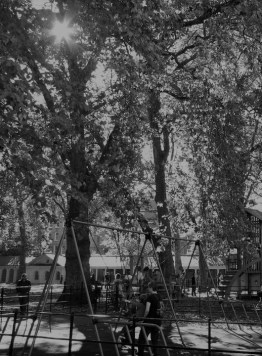
in the playground behind the hospital,
chaperoned by our other, healthy children
in the sand and swings of early Autumn.

She was French and wore her worry openly,
he ran a business from his mobile phone.
A nice couple. Lives on hold while life went on.
He’d bought a copy of The Jungle Book

and each day enjoyed reading it to his son;
although the boy was far too ill and young
to take it in, he might register something
of his father’s cadence. Just as they’d said

when we arrived: sit beside your boy,
spend time with him, speak, read, sing, anything.
Just let him hear your voice. Create
a comfort zone, terrain, from sound.

My wife sat there for hours on hours
and spoke to him about I don’t know what,
her lips moved silently in silhouette
although I didn’t notice at the time;

there was a job she had to do for him
and so she did it. But I found perching
on a backless stool like a garden gnome
uncomfortable; his brown-yellow skin,

more like a lipid membrane over yolk
than anything that might contain the future,
deprived me of the power to talk.
I sat more with the monitors and tubes,

the CPAP mask, the windows and the floor
than with a real boy. Call this my confession.
I tried to read from books like Mr Strong
but soon pulled out the looped recording

we had made on Dictaphone and let
technology do all my work for me.
Half an hour was often all I stayed
before I headed back to Coram’s Fields

to end my shift early, to talk to those other
mums and dads – or often their mums and dads
looking after other, healthy grandchildren,
or just to stand outside the gate and listen:

to the rhythm of the roundabout, the swing
of swings, the tapped beat of small-booted feet
climbing ladders, and water coursing through veins
scraped into the landscape of a sandpit.

This poem was published in PN Review.

The Diary of a NaPoCoLo

penguin

In the semi-acronymic spirit of NaPoWriMo, and to celebrate the recent announcement of the winners of this year’s Rialto Nature Poetry Competition, I thought I’d share some extracts of my diary over the period of the competition and try to figure out where I went wrong…

I give you: the Diary of a NaPoCoLo (a Nature Poetry Competition Loser).

November 27th 2017

There’s another poetry competition up. Rialto Nature this year judged by the magnificent Michael Longley (surely one of our finest living poets). I read his ‘Collected’ on holiday in York one year; he obsessed me and I spent most of my time with him in our little Self-Catering while my wife and daughter were out painting the Shambles red. I’ve got a few nature poems kicking around so I’m going to have a look and see if anything will fit the bill.

December 3rd 2017

Not sure my old efforts will quite make the grade, but I’ve come up with a few ideas that I hope might catch Michael’s attention. I went on a Hawking afternoon after reading that Helen MacDonald book the year before last, I think that might provide a bit of inspiration with a little thought; if not then Seaton Carew near my parents’ place up north is good for birds and shells and wildflowers things like that. I’m pretty confident I can come up with the goods this year.

December 14th 2017

I’ve written five poems that I’m thinking of sending in to the Rialto comp. Three of them are about flora of various types and I’m extremely pleased with them. I got a couple of old folk-names in there and I’m happy that they work metaphorically. The other two have got the fauna end covered. Fox at Night is probably the strongest single work and frankly I’d be surprised if it didn’t make the longlist at the very least. I’m not quite so sure about At Swim Two Penguins but I’ve got plenty of time to tinker.

December 15th 2017

Spent the whole evening and most of the night on the penguins poem. Changed almost everything. This is, quite simply, the best thing that I or anyone else has ever written, I’m absolutely sure of it. It is called The Stooping Men. I can almost see Michael’s kind old face smiling down on it as he reads. Possibly brushing away an admiring tear. I sent it straight off (I sent the others too, but I’ve emotionally invested in my penguins now). I honestly don’t think it can fail to win.

January 15th 2018

Argh! The waiting is hell. I emailed Rialto today to find out what the hold-up was only to be told that the deadline isn’t until the beginning of March.

March 1st 2018

Deadline Day. So, the first half of the waiting is over, and now the second half begins. And all the time The Stooping Men is just sitting there in the middle of a pile of papers by Michael’s venerable elbow. No need to worry though, he’ll get to it in time; and when he does…game over. Apologies to other entrants, but you’ve wasted your money this year. I have absolute faith in Michael’s good taste as a writer and reader.

March 31st 2018

Argh! The waiting is hell.

April 15th 2018

Spent the drive to work daydreaming about standing on stage with Michael and the Rialto crew, accepting my award. I assume they’ll want me to do a reading. Might print it off this evening so it’s all ready. Planned a little anecdote about penguins.

April 30th 2018

Argh! The waiting is hell.

May 1st 2018

The email was waiting when I got back from walking the dog this afternoon. I closed my eyes, took a deep breath and prepared for glory…

WTAF?
The pounding in my chest as I realised that my name did not appear either in the first three, or the second two, or…insult without end! …even on the longlist.
For the love of God, what is going on here? I switched the TV on and off in fury. I went upstairs. I came back down. I boiled the kettle, twice. Then I had a cup of tea and finally settled down, but I could still feel my blood bubbling away in my ears as I started to come to terms with this stark new reality. It was like waking up after the referendum. Worse. It wasn’t so much that I didn’t win. I don’t even care about the winning, it’s just a little hobby of mine really, you know? It was more the betrayal. The bloody Rialto say they are going to pick the best and then they fail to notice a bloody classic right under their bloody noses. I don’t think Michael can have ever even seen the poem. They must have had some underling working on it, someone who doesn’t know a classic piece of contemporary literature from a slap in the face with a cold fish. I’m going to have to look into legal action.

May 5th 2018

Reading back over couple of Longley’s poems, I’m not sure he hasn’t been over-rated all these years. I mean, are we really interested in his grandchildren and the mosses of Carrigskeewaun?

May 7th 2018

The days pass. The anger subsides ands turns to shock, the shock to disappointment. And finally, acceptance.

May 10th 2018

I opened up The Stooping Men on the laptop this evening. I just thought I’d have a look over it. Bit of a post mortem I suppose. I read it through a few times in my head. I read it aloud. I recorded myself reading it and played it back. I read it to my wife when she got back from work. I read it to my daughter when she got back from school. And the funny thing is that as I read it over and over and looked at my family’s kind and sympathetic faces, I noticed something that I’d never noticed about it before. Something that had never occurred to me in all the time I was writing it and in all the time I was waiting for the competition results, but which now jumps out at me as the overriding and fundamental feature of the poem. It’s shit.

frantic bashful

Rialto-Pamphlet-Sean WK

That the first poem in Sean Wai Keung’s debut pamphlet begins with the phrase ‘the most important principle is the principle/of never looking back…’ is apt as it lays down immediately two key structural strategies of his writing, both of which give you are mistaken its impressive sense of bewildered/neurotic/eccentric thoughtfulness.

The first is his use of unpuncuated repetition. Almost all of the poems here repeat individual words, phrases, sentence structures, images, and symbols in the intense and exhausting manner of an obsessive. Over the course of twenty poems this builds into an impression of the speaker (we probably do Wai Keung a disservice to assume that it is meant to be him, but that seems a fair conclusion) as a teenage or young-adult misfit who can filter neither his emotions nor his outbursts (‘+ so I said to the guy what…’) but who is also oddly introverted and stands silently at the shopping checkout watching his customers, lost in thought until he blurts some muttered phrase under his breath (‘the gift’), and who thinks constantly about the girl/boy who he loved but who never loved him and left Norwich for some far-off city (‘over skype…’). But this is ultimately, we feel, someone who would rather be explaining Chinese philosophy to his friends than talking yet again about his poetry or his mixed heritage when neither are understood by any of those around him (‘i think i want to write about race’ and ‘you are mistaken’ respectively). The constant wall of repetition and the impression that no one understands add to a sense of alienation and isolation, which is emphasised by the use of Chinese characters as titles for some of the poems – the non-Chinese-speaking reader is distanced from these poems by their titles and we feel for a moment something of what it is to be Not Entirely Part Of Something (and, equally, to need to have it explained).

Which leads to the second of the strategies used by Wai Keung, that is negation. Negatives abound in this pamphlet, adding to both the feeling of alienation and the youthful sullenness of the character we are hearing speak through the poems, but it also serves to emphasise the points he is making about stereotypes, misunderstandings, and myths which also abound when his Chinese heritage grates against the British culture around him:

‘those/translations aren’t completely right’ (‘三寶 [慈 -儉 -不敢為天下先]’)
‘they say they said i was none of those things/but don’t worry/its not a big deal’ (‘cny 2016’)
‘its not enough/you say/this/isn’t/enough’ (‘stealing table sauces from wetherspoons’)
‘…asia + europe used to be the same/massive place but now they arent’ (‘太極’)
‘which isn’t to say that yin promotes’ (‘陰’)
‘which isn’t to say that yan promotes’ (‘陽’).

All of this, of course, is entirely appropriate in a pamphlet entitled you are mistaken; and throughout we are being corrected in our potential misconceptions of what it means to be of mixed Chinese-British heritage and living in Britain. These are unlikely to be mistakes that any single individual would make (they are not only one person’s prejudices) but another effect of the repetition and negation is to make the reader feel the cumulative force of small-stereotype-upon-small-stereotype. It is slightly wearying, but it is meant to be.

The apotheosis of both these strategies comes in the title poem itself, which is a dense page-and-a-half block (indeed, two blocks) of negatively framed stereotype-corrections that build up into an overwhelming monolith of words. All the subtlety and grace of the other poems’ pagination is thrown out here, and we are made to feel that the quiet, shy, intelligent/eccentric boy (all part of the Asian stereotype, perhaps) is starting to lose his patience. When read out loud as a list (see Wai Keung performing with Kevin Bateman and others here) there is a controlled irritation about this poem, which because of the sheer quantity of observations feels as though it is just brimming over into anger.

Some of the poems work extremely well on their own; the yin/yang duo are particular successes, finding a powerfully ironic metaphor for the balanced duality of 陰 and 陽 in the circular centrality of pornhub.com and the slightly surreal, almost comic image of hermaphroditic self-sex. Others, like the ‘16 slices’ placed opposite the yin/yang poems, and ‘earnings’, are amusing and intriguingly experimental but add more to the overall feeling of unconventionality than to the many insights of the pamphlet. Although, having said that, the reference to ABBA’s ‘Money, Money, Money’ in the receipt-misprint ending of ‘earnings’ is one of the funniest moments in the pamphlet, and probably worth inclusion on that basis alone.

This will, I hope, be the first of many collectionsfrom Sean Wai Keung. The strategies this review has focused on work well in the context of the twenty poems on show here, but it would be difficult to maintain interest in this way over a full collection, even more so over several; being trapped by repetition and oppressed by negatives reveals much in the way of in-grown attitudes but it can also be emotionally and tonally limiting. To this extent, 無極, the final poem of the pamphlet, is perhaps auspicious as it is low on negatives, subtle in its repetitions, and it ends with ‘…just look out of the window now look/how did that get there’. Does this indicate that Wai Keung will turn in future as much towards what is as what isn’t? I look forward to finding out.

Sean Wai Keung’s You Are Mistaken is published by The Rialto (£7) and can be bought here.