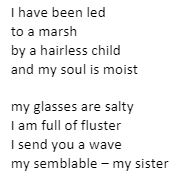
You will either recognise those lines, or you will not. Or perhaps you half recognise them and could make a reasonable guess as to where they come from. Do you like them? Do they say anything to you beyond their immediate sense? If you recognise them, are you reappraising them now, or falling back on an opinion of them that you see no reason to alter? Do you know who wrote them? And does that knowledge have any bearing on how you feel about them? Are you sure?
The lines are the first stanza of a poem that my wife asked the celebrant to read out at her mother’s funeral shortly after Christmas. It was important to her that the lines were not prefaced with either a title or the name of the poet, and when I asked her why she said that she didn’t want any external information about the poem to distract from the lines themselves; she wanted our friends and family to be able to relate them directly to her mother without encouraging the associations, not to say potentially the prejudice and bias, that come with contextualising labels. This seemed to me quite a profound understanding of what the reader of a piece of literature brings to that work.
The lines are in fact from ‘Bilbo’s Walking Song’ by JRR Tolkien, and they are appropriate to my mother-in-law in ways that only those who knew and loved her could know. Their authorship, their provenance you might say, was at best clutter, at worst misleading in the context where they were spoken in memory of Dorothy.
Here, then, is an example of anonymity as a Good Thing.
We are very used to anonymity as a Bad Thing: online trolls hiding behind their faceless social media accounts; masked riot police beating up an innocent civilian; Ku Klux Klanners marching in torchlight; balaclava-wearing terrorists posing with a terrified civilian. Anonymity in all these cases is a masking of identity, allowing excesses of depravity and cruelty to take place unhindered. If identity is taken away, all humanity goes with it.
Anonymity has always been a way of avoiding punishment or retribution: the masked highwayman, the masked rioter. But it has also been a means of escaping persecution – think of the criminal who comes out of prison and moves to a different part of the country to avoid the stigma his prison sentence has brought within his community – to make a fresh start – a form of anonymity, blending, faceless, into a new crowd. And it has been a form of protection: as in the anonymity guaranteed to the witness identifying a criminal from a line-up.
But what of that thing which could be, although I’m not sure it is, called ‘nymity’, the condition of not being anonymous? Outside of the example of my mother-in-law’s funeral, what is wrong with attaching names to poems? On the face of it, it is innocent and practical enough: if you know the name of the poet, you know who to praise or who to condemn, depending on whether you like or dislike the poem. You know whose work to look for online or in a bookshop, and whose to avoid. Perhaps more importantly, you know who to hold to account if the poem contains language you find offensive, or if it makes you feel uncomfortable, or fearful.
And for the poets themselves, there is the personal kudos from receiving praise and prizes – even if there may also be humiliation in the opposite. This is the gamble the artist makes.
We live in a liberal democracy, which prizes individuals and our freedoms above all things: the freedom to choose, the freedom to own. And a less touted but natural concomitant of these central freedoms, one which has come to sit above them all in our current wealthy, capitalist context, is the freedom to have all our desires sated. We must have satisfaction, constant and complete (why else was Mick Jagger so pissed off?)
And what satisfaction is there for a poet if their poem is published without name or context? Some partial satisfaction in having known you wrote it, a quiet sense of accomplishment perhaps, but not the full-on, 21st century level of satisfaction we’ve come to expect.
Context is important, it’s true. I recently responded to Hôtel Amour by Deryn Rees-Jones, and a reading of that work without knowing the context of Rees-Jones’s experience of her husband’s death, is very different to one which has that knowledge. It is less rich, the work’s meanings less apparent.
But still, I think there is a case to be made against nymity. And the case comes in two distinct arguments.
The first is as follows: yes, we live in a liberal democracy, but one in which those central tenets of liberal individualism (those concerning the rights of the individual) have become so magnified and distorted that they are out of all proportion with other important aspects of a well-functioning society. For example, the duties of an individual, the flipside of their rights, are all but forgotten in much liberal discourse, often because they are seen as a more conservative ideological component.
Is there, then, room to be made for a cultural space where the individual, their identity, and all their baggage, are left to one side? Might this be part of a movement that begins to redress the balance of this (actually quite precious, for all its faults) liberal democracy? I think there is, although what it would look like I’m not sure. I imagine an online platform where a weekly anonymous poem is shared, and anonymous commenters are welcome to leave their thoughts. A community of poets and readers who know nothing about one another. There may be some rudeness if the poem met with disapproval, but how long would such rudeness last if the nymity of the poem was denied? Where is the fun in trolling if you don’t know who it is you’re trolling? And might, at last, some form of trust ensue?
The second argument comes from a feeling I have that many (perhaps all) of us tend to base our judgements of poems as much on the identity of the poet and what other people have already said about a poem, as we do on the objective ‘thereness’ of the words on the page. This is part of the function of the blurbs on book covers; they’re partly there to sell the book, obviously, but also, I feel, to tell people what to think: oh, X says this is great; then it will be okay for me to think it’s great too. And this focus on context and nymity also leads (I suspect, although I’m not sure I could prove it) to a slightly cowardly tendency of some online reviewers to wait until a collection has been well reviewed by a couple of other critics, so they know whether they are safe to like or dislike it.
As I say, context is important; but there is also a sense in which critics’ views are both formed and then validated by the identity of the poet. A new poem from a much-admired, multiple TS Eliot Prize winner sits in a different spot in a reader’s brain from one by an unknown – or known and disliked – poet. And can we really say we read a poem we know to be written by a man in the same way as one we know to be written by a woman? Likewise race and sexual preference.
There is a fair rebuttal of this argument, which is: of course we read these works differently, and so we should. There is language that is appropriate for some groups and not for others. In fact, you can probably go further and say we need to know as much as we can discover about a poet’s cultural identity so that we have the information we need in order to form an appropriate opinion of their work.
But this argument only goes so far.
The need expressed in the previous paragraph is only a need if your approach to poetry is extractive and judgemental: one in which you ask yourself, ‘What can I take from this work, and what opinion can I form about it?’. But there is another approach, and one I prefer, which where the reader asks: ‘What can I give of myself to this work, and what can I learn from it?’
If I take the second approach, my own identity and context are key, because I cannot escape them. Outside that… there are words; and there is what occurs when those words meet my own particular outlook on the world. This is my reading; and I must ask myself, what happens to my outlook on the world, now I have encountered these words? What aspects of my Self must I open up, and scrutinise, and change? This process could be seen as a gift I receive from the poem and my encounter with it. I am not so much extracting from the words, but in opening myself up to them, they respond by giving themselves to me.
Again, (for the third time) I will emphasise: context and identity are important, and I am not arguing for the above to be the only approach. The relationship between reader and text that I describe does not preclude the context of the poem or the identity of the poet, in fact those things can increase the possibilities of what the reader can learn. But they are not necessary, and if they are missing, other aspects of learning may be allowed to emerge.
Imagine a sonnet appearing in a magazine. Simply that. No name, no title, no explanation. It is just there in the middle of a blank page. I am being asked to consider far more than I would be if poetic identity and context were provided. I have to think about what the poem might mean if it were written by all sorts of different kinds of people. My opinion may now need to be conditional. I will have to live with an element of doubt. In short, I may need to relinquish some control and accept that my understanding of the work can only ever be provisional and contingent.
In our age of constant demands for individual empowerment and control over everything and everyone around us, and the resultant pandemic of unjustified certainty around us, perhaps some small pools of doubt here and there might be things worth having.
Finally, and by way of a coda to this blogpost, my imaged sonnet appearing anonymously in a magazine does assume that the poem, though free from context and nymity, is written by someone. I’ve written about the clear threat posed by AI to poetry elsewhere; but here again is an example where, whether we like it or not, we are going to have to inject a much-needed element of trust into the cultural conversation. If an editor includes a poem in a magazine now, any poem and any magazine, we only have their word that it is what it claims to be and not created using AI. Just as the editor only has the word of the individual who claims to be the poet. I think accepting space for some anonymous poems in contemporary magazines would help build trust by increasing doubt.
And I’ll end on a suitably dramatic note by saying something I truly believe: in poetry there should always be doubt, as non-fixity and multiplicity of meaning is part of what makes it poetry; and where there is doubt there must also be trust. If there is not to be trust in poetry, poetry as an art form will be dead.
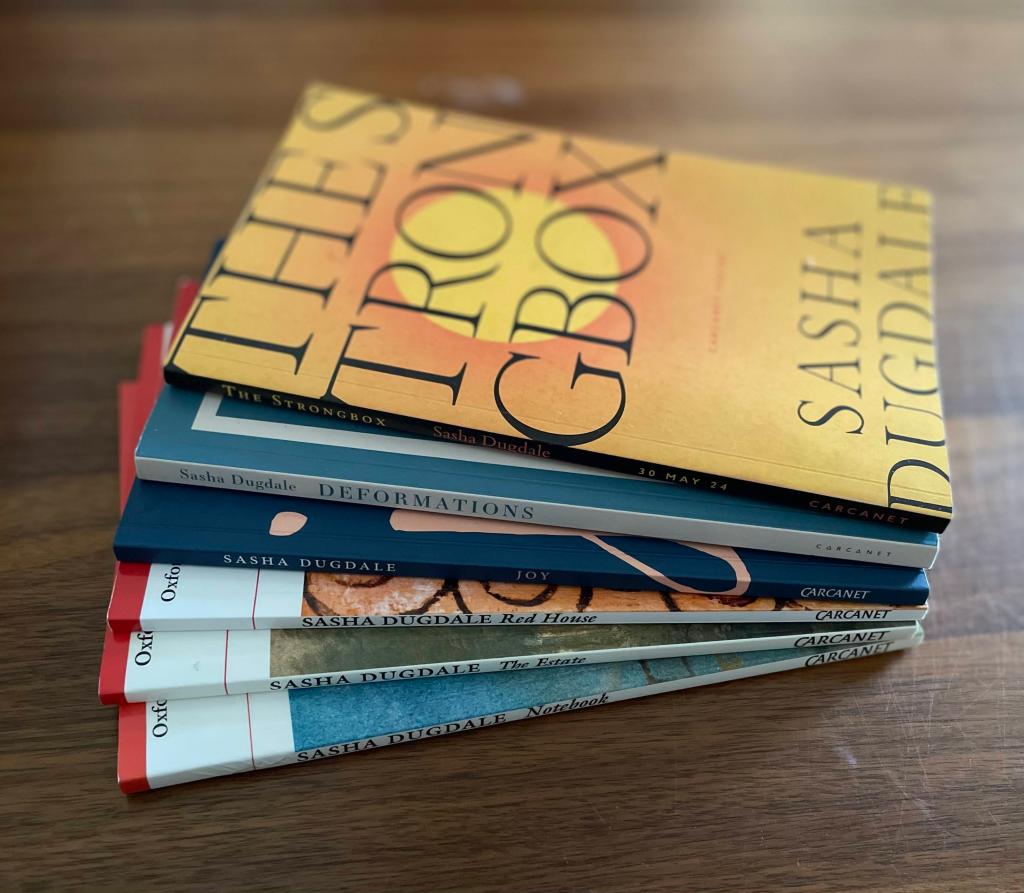
Sasha Dugdale is the kind of poet who is as interested in the work of others as she is in her own. As editor of Modern Poetry In Translation between 2012 and 2017 she championed poets from all over the world; as a translator of Russian poetry and prose she has made the work of writers such as Elena Shvarts, Natalya Vorozhbit, and most recently Maria Stepanova, accessible to the non-Russian-speaking world; and as poet-in-residence at St John’s College Cambridge she organised poetry readings and discussions for both students and those outside the university. And I know from experience that she responds gratefully, enthusiastically and kindly to unpublished poets, readers of poetry and reviewers – encouraging reviews not of her own work but of other poets she admires and who she feels are under-appreciated. There may be other established poets in the UK with this level of generosity, but I can only say that I have not come across them. I’m tempted to say that she puts the Art before the Artist, but that is not quite right. From her earliest collection, 2003’s Notebook (Carcanet), she has been interested in the interaction between Art and Artist, how they simultaneously make and define each other. And how they both arise from their particular social, political and historical contexts – but in doing so become something that transcends those contexts.
In Notebook she considered JMW Turner, imagining him into existence in a series of short dramatic monologues which tended show the man and his work alongside his intimate relationships and social milieu. In The Estate (Carcanet 2007) she turned to Alexander Pushkin, taking the spaces and objects in his Mikhaylovskoye estate as inspiration for ruminations on the poet and how proximity to the material of his life impacted her own writing. In the long titular poem from Joy (Carcanet 2017), she focused on William Blake’s wife Catherine just after Blake’s death in a Forward Prize-winning dramatic monologue which builds in quiet intensity from bleak despair to an almost visionary expression of her intense love for her husband and her own creative identity. Then, in one of two major sequences in Deformations (Carcanet 2020), entitled ‘The Welfare Handbook’ (which I have previously reviewed here), Dugdale used letter cutter and artist Eric Gill’s own letters and diaries to devastating effect, casting difficult artistic light on his sexual experimentation and abuse of his daughters.
The other sequence in Deformations, ‘Pitysad’, a reimagining and fragmentation of Homer’s Odyssey, seems to me both a culmination and a launch pad. In one sense it is the culmination of progressive iterations of a creative strand in Dugdale’s writing which has been moving in a slow arc since the titular sequence of Red House (Carcanet 2011), which marked the moment when (I cannot think of another way to express this) she began using some longer sequences and poems to inhabit poetry; when it became less a tool with which she worked than an environment through which she walked. “The red house lies without the parish of the soul” begins the sequence, a line so replete with metaphorical possibilities that it brings to mind the younger Auden, and not as pastiche but as from a poet similarly living within their own poetic universe, inviting us in to look around for ourselves. Joy’s deep first-person dive into Catherine Blake’s psyche stained with her husband’s mysticism continued this strand; and the steely-eyed, unforgiving journey ‘into’ Eric Gill took it to disturbing new depths. ‘Pitysad’ felt to me like the poetic sequence Dugdale needed to get to, almost the inevitable outcome of those poems I have just mentioned. (Could we have had her Penelope without her Catherine Blake, her Odysseus and Shadow Prince without her William Blake and Eric Gill?)
But ‘Pitysad’ is also a launchpad in that it is the beginning of Dugdale’s modernist exploration and reinvention of Greek mythology which is extended and developed in her latest collection The Strongbox (Carcanet 2024). Her project is ambitious, and her aims multifarious, but it is marked by the fragmentation of linear narrative – exploring the Epic form as an alternative to rather than a subcategory of the Narrative form; the transposition of mythical characters and epic language into modern contexts and idioms; and an exploration of the masculine and feminine in art, both as part of each other and as binaries.
The Strongbox moulds, and works with, the approach to mythology introduced in ‘Pitysad’, and creates a larger, more self-contained work; one in which effectively an argument is made for the use value of poetry as an appropriate means of analysis for love and war. It is simultaneously a cry of distress for the modern world and a cool-headed contemplation of what it is in us that leads us to the dark places; of male violence and hidden female strength.
So, to turn to this latest work in more depth.
The first thing to note is that among the many things signified by the metaphorical ‘strongbox’, the one most immediately introduced to the reader is the collection itself, and by extension Poetry. The Strongbox’s structure is sonnet-like, a single sequence of fourteen poems, complete with an octet, a sestet and a volta (on poem eight ‘VIII – The Empty Stage’, which stands as though in an uncertain stasis between two dream poems either side of it, at that classic point in a sonnet where the movement is both forward and back: “Could be dawn could be dusk / The only difference being that / Dawn has no memory whereas / Dusk remembers everything –”). The integrity of the closed poetic form itself becomes a metaphor for that which is unknowable but unbreakable within us, and of which the most we can coherently say is that its contents is precious – but which it is Dugdale’s bold project to explore.
The egg is quite a common symbol of strength/vulnerability/fertility and could quite easily be allowed to slip into cliché and mundanity, but Dugdale avoids this by developing the motif carefully and in conjunction with other themes so that the egg-like-ness of the ‘strongbox’ becomes just one attribute of the central metaphor, one facet of a more complex jewel.
Through numerous, at first brief and flickering mentions which build in power and momentum as the collection proceeds, the egg image reaches a surreal zenith in poem XI, ‘Gods & Men’, where the egg, dream-like, expands into a giant eye only to fold and contract back into a locket in a jewellery box, in a hidden drawer, in a campaign chest, in a King’s golden tent, amongst thousands of others on the Trojan plain, as a hero walks up and down in a rage (“but he is not the subject of this story? / no / (hesitates) / not him.” This hero seems most likely to be Menelaus the Greek king raging in his anger at Helen’s abduction – the locket perhaps containing her image or a lock of her hair. Is the egg and its contents therefore ‘Love’? Possibly, but if so, it is Love as the engine of Pride, Anger, Power, Hatred, Violence and Humiliation. Is this really what is at the fertile core of the human condition? That possibility perhaps explains the several occasions where Dugdale grapples with concepts of hopelessness and despair.
The egg image often appears in dreamlike contexts, and the fragmentary nature of the whole sequence gives it all the sense of taking place in the unconscious. The dream, as a self-contained entity with an inside and an outside, is another aspect of the ‘strongbox’, a mainstay of modernism and a particularly human mechanism for meaning-making, which is emphasised in the same poem (XI) quoted above as that which distinguishes the human from the god they may take themselves to be: “only mortals turn away from the world / into the privacy of a dream.”
Classical mythology is rife with dreams, often where the Dead and the Gods speak to the living – to reveal truths, but also to command, coerce and mislead. If the strongbox is a dream, I wonder if it is entirely to be trusted?
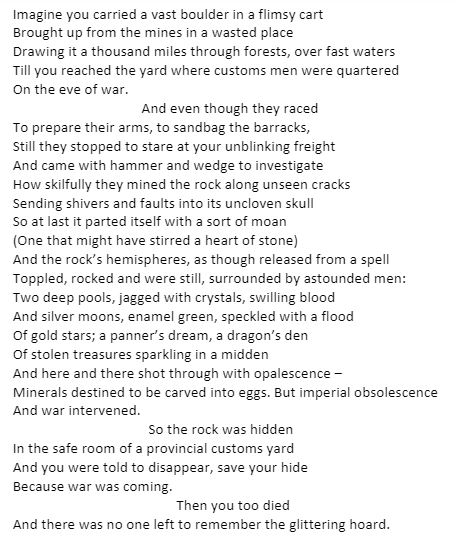
But exploring a terrain of the unconscious has another purpose. As a series of extended and overlapping dream fragments, the collection is a study in the rejection of narrative as an explanatory force. This is explicit: “Narrative appalls me” says the italicised non-narrator in poem X – ‘The Messenger’s Descent”. This poem in particular takes ‘Dream’ to the level of ‘Fever-Vision’, where Hermes, as an exhausted, sickly soldier shivers in front of a television whose images “seemed to speak to him / in the silent voice of an uneasy dream”. The voice has morphed through the ingenious device of a sinister pair of smiling lips from a quite spectacularly constructed section which channels both the richness of Dugdale’s beloved Keats and something of a Coleridgean hallucinatory madness; as though Kubla Khan’s measureless caverns have birthed a great chthonic gift to humanity, only for it to be forgotten and ignored, giving substance to those ancestral voices prophesying war:
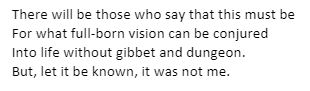
At once a treasure of human potential, an Orphic or Cosmic Egg perhaps, but also in part an earthly gift and in part ‘stolen’ (a reference to treasures of the world pilfered by European Empires? The nod towards Fabergé eggs may suggest this) this split boulder is wasted, lost and hidden by a world literally and psychologically scarred by war (“yellow barred with angry scars”), and Hermes comments with what reads to me like a grimly humorous play on don’t shoot the messenger:
There is a story here, but it exists in images and phrasings, lines and rhymes, which work off each other and need interpreting as a Freudian or Lacanian would interpret a dream. Symbols overlayer, cross-fertilise, and proliferate. Meanings are liberated from the tyranny of narrative. And, to some extent at least, the responsibility for creating those meanings – or we might say the careful curation of them – is passed to the reader.
The first poem of the collection, the long and difficult ‘I – Anatomy of an Abduction’, is in one sense an analytical breakdown of a child’s kidnapping, abuse and (I think) survival, while simultaneously it is a meditation, or the beginning of one, on Helen of Troy, and as such it functions as a way into the egg symbolism that will go on to dominate the collection (the famous myth that Helen emerged from an egg when her mother Leda was raped by Zeus in the form of a swan). But the poem, which exemplifies Dugdale at the height of her powers, also weaves into the text the threat and reality of totalitarian rule and conflict in eastern Europe: the Trojan war (of spears, arrows, tents and plains) is intertwined with an modern warzone, unnamed but presumably Ukraine, where “…troops are dispatched / to erect barriers on all major routes”, and which itself appears to contain echoes of the Second World War kindertransport (“make haste innocents / trust no one”). I should say I think there are many references here (and in the collection overall) that I have missed because of my lack of knowledge of Russian poetry, Dugdale says in the Notes & Acknowledgements that the collection contains her own translations from Russian poems, and I suspect that these, read as such, would make the immediate Russian/Ukrainian layer stand out in fuller relief. My failure as a reader here is not hers as a writer.
The poem is also a study of art as it relates to violence (“Now your poet’s ablaze like Zeus! / whipping up the words in a lather / of horror, of disaster!”). And it asks questions about conceptions of the Masculine (as He Who Abducts/Abuses – Theseus? Paris? Putin? Potentially any man?) and the Feminine (as She Who Is Abducted/Abused – Helen, the lured bride? (do I hear the whispered name of Shamima Begum coming through in some lines?), Ukraine? Potentially any woman?). All these themes come together in deliberately unstable artistic union, tricksy and shifting terrain which the reader must negotiate. And in being all of these things, this remarkable poem is also none of them. Each individually is less clearly defined than they would be, narrative-bound, on their own; but crucially the poem as a whole is also more than any of them could possibly be.
In the intriguing final section of the poem, a “bored guy” is sitting in a yard “sanding his arrow shafts”, and he is watched from a nearby window by the speaker, probably Helen, who is tempted to “reach out and tickle his ear” in order to tempt him into telling her whatever it is that she feels he is “longing” to tell. The archer figure’s identity is, as with all identities in the poem, not fixed. Greek mythology abounds with archers, the most obvious candidate being Paris, at once abductor, abuser, coward and hero; and this reading is given weight when he appears to reference his wounding of Diomedes in the foot in the last stanza of the poem. But here also we simply have a nameless soldier (“a boy, despite the beard” we hear of his previous incarnation earlier in the poem), bored between battles, and keen to get the attention of a pretty girl. More to the point, we have a meaning-sodden symbol in his bow and arrow, which as well as a weapon is the passage of time as the arrow makes its arc, sun-like, across the sky; the span of a human life as its potential turns to kinetic energy and as it speeds “towards the far sea / to plunge itself into non-existence”; and fittingly it is also the arc of Narrative itself as the Homeric “purple song” builds to a violent crescendo until “One final thrust and all is lost / for the tamer of horses…’” (the horse tamer could be a number of mythic characters but I’m tempted to read this as Narrative carrying mankind itself to its final destruction). The archer then brings his “dirty finger” down on his bow “where he’s wedged it in a patch of thyme” and the thyme/time homophone here allows us to speculate that for Dugdale, narrative language is stuck in something more organic where meaning is complex and non-linear but more able to convey the human condition. Thyme symbolised strength, courage and sacrifice for the ancient Greeks, was said to have grown from Helen’s tears on her abduction/seduction by Paris, was rubbed on warriors before battle and worn in the hair of women to accentuate their beauty and was even thought to provide direction to the directionless soul. Such thick-layered symbolism suggests that what is timeless and consistent about the human ‘soul’ (and here we get to the centre of the strongbox as a metaphor) is various, chimerical, paradoxical and perhaps ultimately indefinable, but it is a condition towards which a modernist poetics can point both writer and reader. In Dugdale, such a poetics does not exactly replace narrative, but it is offered, throughout this collection, as in ‘Pitysad’ before it, as a rich alternative. And it is one of course which is particularly rich in potenial for working subversively within the symbolically linear, inflexible and oppressive patriarchy.
This movement towards a modernist poetics, which I’m suggesting is the fruition of a course Dugdale’s poetry has been taking for a number of years, since Red House, but with more purpose and direction recently, is I think closely linked to her translations of Maria Stepanova. It can’t fail to be to some extent, and the relationship between translator and translatee is one I would love to hear more about (especially from Dugdale and Stepanova whose creative relationship seems almost Lennon-and-McCartney-like). I imagine influences come in from many poets, Don Mee Choi, whose work I reviewed here, amongst them; but to my ears there is a particularly clear link here between Dugdale and Stepanova, this is partly in the shattering of narrative, partly in the multiplicity of voices, and partly in their shared thematic interests (memory, war, art, the masculine and the feminine, etc.); but it is mostly in the organic earthiness which Dugdale embraces here for the first time. Stepanova’s War of the Beasts and the Animals (which I reviewed here) is smeared in mud and blood as symbols of war and nationalism but also as the literal and metaphorical ‘matter’ of birth and rebirth.
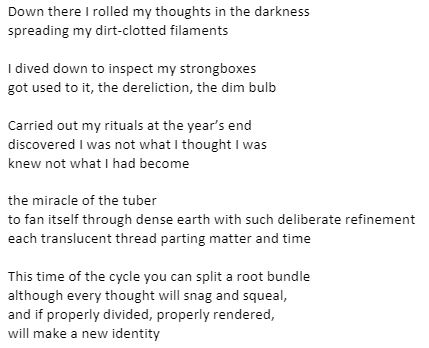
And in The Strongbox: “We are so close to the ground in childhood” says the speaker in an early section of ‘I – Anatomy of an Abduction’, signalling the advantages of such a low viewpoint that the minutiae of the earth come into sharp focus, and hitching it to the innocent and exploratory days of childhood. And later, in ‘VI – The Dirty Fire’, this viewpoint is maintained as the speaker grows like a plant, looking across a battlefield from a position “so low to the ground / I had the perfect view”. There is a space in the wet soil, as in Stepanova, for something new to take root and be born, spreading out and feeling its way plant-like into an underground/Underworld of transformative creativity:
I suspect the close bond between the two writers is taking them both in directions they would not have gone in separately, and I look forward to reading Stepanova’s new (Dugdale translation of) Holy Winter 20/21 (Bloodaxe) later this year.
Another feature common to both writers is a sense of humour, which in both cases (and perhaps this is a feature of Dugdale’s translations of Stepanova rather than being present in the original, but this seems to me unlikely) enter the soundscape of the poems in what feel like tonal jabs. Often aimed at men, or one aspect or another of masculinity or male attitudes, there is a barbed quality which suggests that the humour itself is an act of self-restraint. Sometimes this is in an unexpected image or turn of phrase, with a play on words, as in the gods/dogs turnaround in “gods weave around each other / barely touching / sniffing one another’s genitalia / saying nothing” – both gods and dogs in this case standing in for men. But in The Strongbox, the jabbing humour comes more from the insertion of parodic male characters: the borderline boorish Paris who begins “snoring lightly” when Helen begins describing her dream; the mansplaining Menelaus who is frustrated by Helen’s refusal to accept a flaw in the grand mythological theory of the “glory of seven”; the earnest but patronising theatre director who is trying to elicit verbs which cast light on a section of the previous poem (the meta-analysis itself a sideswipe at over-analytical men) only to receive unsatisfactory abstraction which does not fit in with his plan of analysis “Yep, no, ‘hopelessness’ won’t do either”.
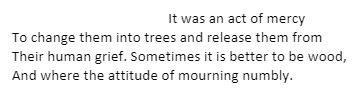
This last character, from ‘II – In the Rehearsal Room’, contains more than an echo of a speaker in a poem from early in Dugdale’s oeuvre, ‘The Film Director Explains his Concept’ from Notebook (“Fuck it, men, we’re talking about women. This is one for them.”) and is quite a nice example of some of the constants across her six collections. I’ve been emphasising the movement towards modernism which took hold over the last three collections particularly, but she has been remarkably consistent over the twenty-plus years since Notebook in the themes she chooses to deal with. One of which is her deep interest in and exploration of Homer, Ovid, and other classical poets. Greek mythology, although treated differently in recent collections as mentioned, was first brought into her work explicitly in one of my favourite poems, ‘Cypresses’ in The Estate. In it, a group of walkers caught out on a cold night burn some cypress logs to keep warm and reflect on quiet grief and how the silhouetted nearby cypress trees (“dark figures”) are like Phaeton’s sisters, the Heliades, who mourned the death of their brother in his disastrous attempt to control his father Helios’s horses as he drove his sun chariot across the sky:
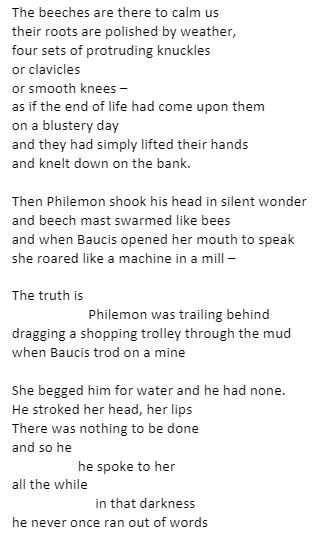
This lovely poem is a neat and complete story in itself – as Ovid’s tales are; the scene is set, the metaphorical device established, and the poem’s meaning(s) satisfactorily accessed and appreciated – I find nothing to criticise in it as a poem of its type, and much to love. But it is instructive for anyone interested in Dugdale’s development as a poet to compare it to a section of ‘VIII – An Empty Stage’ in The Strongbox, where trees are treated very differently and meanings no longer so readily accessible:
Another story out of Metamorphoses, but here Dugdale takes a much more radical approach. Whereas the earlier poem took a step back from the myth and used it as a means of evoking the experience of and reflecting on the value of holding grief internally, this one enters into the landscape of the myth itself and reshapes it to its own purpose. In the metamorphosis of this tale from Metamophoses (could Dugdale be any more meta?!) she suggests that the original, where the elderly couple are turned into trees together by the gods so neither has to mourn for the other, is a lie, one we tell ourselves to make ourselves feel better, but the reality is far more appalling and horrific – it is the reality of war. There is no comfort for Philemon or the reader, and indeed this lack of hope as I have mentioned previously is something Dugdale comes back to more than once (what is the correct response to the horrors of reality if not despair?) and that powerful final phrase “in that darkness / he never once ran out of words” could be interpreted variously as a bleak view of the futility of Frankl’s Will to Meaning, an expression of the male drive to control by explaining (cf. Menelaus in ‘IV – A Lesson in Anthropology’), or more positively as a suggestion that language ultimately may be the scrap of hope at the bottom of Pandora’s (Strong)Box.
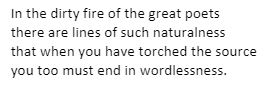
I’d like to finish by trying to take this important notion of metamorphosis and relating it to the theme of reflection, which is at the core of The Strongbox. Even in the structure of the collection we see poems reflecting each other on either side of what I’ve called the volta of ‘VIII – The Empty Stage’. Helen’s dream poems could be looking at each other like Narcissus staring at his own reflection in still waters, and we also see ‘V – Men & Gods’ reflected back and distorted in ‘XI – Gods & Men’. As the titles suggest, these poems ask the same question from different perspectives: in one, Man desires to encroach on the domain of the Gods; in the other, Gods consider in puzzlement what it means to be human. Like their reflection of course, they are ultimately one and the same; and through their reflections they metamorphose into, rather than opposing, one another. Terrible, cruel, capricious Gods; terrible, cruel, capricious Men. The seemingly paradoxical sameness of opposites is taken further in what I take to be one of the “distorted fragments from Heraclitus” that Dugdale mentions in her Notes & Acknowledgements: “fire is not the opposite of water / but its reflection”. And we see the metaphorical fruits of this reflection in ‘VI – The Dirty Fire’, in which the poet Sasha Dugdale appears to be speaking directly to the poet Homer, and where fire becomes that creative, transformative poetic force which almost goes beyond language:
But this scorching of the creative earth is followed by new growth, “My renewal what the world demands”, and then “Out of water comes soul”. This is a modern female poet explaining to a classical male poet why she has transformed his work so drastically. The voice that emerges, having risen through the earth, is female and fecund but also lost and in danger.
This feels very close to what Dugdale described in Deformations as “the voice of water which is good for recording disaster”. But the oppressive heat, if not the fire, of the old male poets threatens to return with echoes of Eliot’s Wasteland in “August is a hopeless month”. Fire and water reflect one another within the structure of the poem, becoming part of a creative whole through which the female voice works to rise through the male; but it is a process, a cycle, in which the tyranny of the male voice is always threatening to deaden that of the female.
So, to finish, finally. What is The Strongbox? Well, I think like any powerful symbol it is both everything and nothing. That’s not a cop out; the answer to what it ‘is’ is contained within the poetic landscape created over the course of the collection, into which Dugdale is inviting us. We might say The Strongbox is symbolic of The Soul, Human Potential, Hidden Strength, Female Creativity, Resistance to Patriarchy, and many other things beside; but actually the list of things it ‘is’ will be different for every reader who gives the collection the attention it deserves, because each reader brings their own understandings and experiences to the text. Without wanting to sound facile, The Strongbox is like the TARDIS, it is an immensely rich poetic world which, when you enter, you find is bigger on the inside than it is on the outside. You, reader, must discover; you must curate.
You can buy all Sasha’s collections, including (from 10th May 2024) The Strongbox from Carcanet, here.


 Wood Bee Poet