You will either recognise those lines, or you will not. Or perhaps you half recognise them and could make a reasonable guess as to where they come from. Do you like them? Do they say anything to you beyond their immediate sense? If you recognise them, are you reappraising them now, or falling back on an opinion of them that you see no reason to alter? Do you know who wrote them? And does that knowledge have any bearing on how you feel about them? Are you sure?
The lines are the first stanza of a poem that my wife asked the celebrant to read out at her mother’s funeral shortly after Christmas. It was important to her that the lines were not prefaced with either a title or the name of the poet, and when I asked her why she said that she didn’t want any external information about the poem to distract from the lines themselves; she wanted our friends and family to be able to relate them directly to her mother without encouraging the associations, not to say potentially the prejudice and bias, that come with contextualising labels. This seemed to me quite a profound understanding of what the reader of a piece of literature brings to that work.
The lines are in fact from ‘Bilbo’s Walking Song’ by JRR Tolkien, and they are appropriate to my mother-in-law in ways that only those who knew and loved her could know. Their authorship, their provenance you might say, was at best clutter, at worst misleading in the context where they were spoken in memory of Dorothy.
Here, then, is an example of anonymity as a Good Thing.
We are very used to anonymity as a Bad Thing: online trolls hiding behind their faceless social media accounts; masked riot police beating up an innocent civilian; Ku Klux Klanners marching in torchlight; balaclava-wearing terrorists posing with a terrified civilian. Anonymity in all these cases is a masking of identity, allowing excesses of depravity and cruelty to take place unhindered. If identity is taken away, all humanity goes with it.
Anonymity has always been a way of avoiding punishment or retribution: the masked highwayman, the masked rioter. But it has also been a means of escaping persecution – think of the criminal who comes out of prison and moves to a different part of the country to avoid the stigma his prison sentence has brought within his community – to make a fresh start – a form of anonymity, blending, faceless, into a new crowd. And it has been a form of protection: as in the anonymity guaranteed to the witness identifying a criminal from a line-up.
But what of that thing which could be, although I’m not sure it is, called ‘nymity’, the condition of not being anonymous? Outside of the example of my mother-in-law’s funeral, what is wrong with attaching names to poems? On the face of it, it is innocent and practical enough: if you know the name of the poet, you know who to praise or who to condemn, depending on whether you like or dislike the poem. You know whose work to look for online or in a bookshop, and whose to avoid. Perhaps more importantly, you know who to hold to account if the poem contains language you find offensive, or if it makes you feel uncomfortable, or fearful.
And for the poets themselves, there is the personal kudos from receiving praise and prizes – even if there may also be humiliation in the opposite. This is the gamble the artist makes.
We live in a liberal democracy, which prizes individuals and our freedoms above all things: the freedom to choose, the freedom to own. And a less touted but natural concomitant of these central freedoms, one which has come to sit above them all in our current wealthy, capitalist context, is the freedom to have all our desires sated. We must have satisfaction, constant and complete (why else was Mick Jagger so pissed off?)
And what satisfaction is there for a poet if their poem is published without name or context? Some partial satisfaction in having known you wrote it, a quiet sense of accomplishment perhaps, but not the full-on, 21st century level of satisfaction we’ve come to expect.
Context is important, it’s true. I recently responded to Hôtel Amour by Deryn Rees-Jones, and a reading of that work without knowing the context of Rees-Jones’s experience of her husband’s death, is very different to one which has that knowledge. It is less rich, the work’s meanings less apparent.
But still, I think there is a case to be made against nymity. And the case comes in two distinct arguments.
The first is as follows: yes, we live in a liberal democracy, but one in which those central tenets of liberal individualism (those concerning the rights of the individual) have become so magnified and distorted that they are out of all proportion with other important aspects of a well-functioning society. For example, the duties of an individual, the flipside of their rights, are all but forgotten in much liberal discourse, often because they are seen as a more conservative ideological component.
Is there, then, room to be made for a cultural space where the individual, their identity, and all their baggage, are left to one side? Might this be part of a movement that begins to redress the balance of this (actually quite precious, for all its faults) liberal democracy? I think there is, although what it would look like I’m not sure. I imagine an online platform where a weekly anonymous poem is shared, and anonymous commenters are welcome to leave their thoughts. A community of poets and readers who know nothing about one another. There may be some rudeness if the poem met with disapproval, but how long would such rudeness last if the nymity of the poem was denied? Where is the fun in trolling if you don’t know who it is you’re trolling? And might, at last, some form of trust ensue?
The second argument comes from a feeling I have that many (perhaps all) of us tend to base our judgements of poems as much on the identity of the poet and what other people have already said about a poem, as we do on the objective ‘thereness’ of the words on the page. This is part of the function of the blurbs on book covers; they’re partly there to sell the book, obviously, but also, I feel, to tell people what to think: oh, X says this is great; then it will be okay for me to think it’s great too. And this focus on context and nymity also leads (I suspect, although I’m not sure I could prove it) to a slightly cowardly tendency of some online reviewers to wait until a collection has been well reviewed by a couple of other critics, so they know whether they are safe to like or dislike it.
As I say, context is important; but there is also a sense in which critics’ views are both formed and then validated by the identity of the poet. A new poem from a much-admired, multiple TS Eliot Prize winner sits in a different spot in a reader’s brain from one by an unknown – or known and disliked – poet. And can we really say we read a poem we know to be written by a man in the same way as one we know to be written by a woman? Likewise race and sexual preference.
There is a fair rebuttal of this argument, which is: of course we read these works differently, and so we should. There is language that is appropriate for some groups and not for others. In fact, you can probably go further and say we need to know as much as we can discover about a poet’s cultural identity so that we have the information we need in order to form an appropriate opinion of their work.
But this argument only goes so far.
The need expressed in the previous paragraph is only a need if your approach to poetry is extractive and judgemental: one in which you ask yourself, ‘What can I take from this work, and what opinion can I form about it?’. But there is another approach, and one I prefer, which where the reader asks: ‘What can I give of myself to this work, and what can I learn from it?’
If I take the second approach, my own identity and context are key, because I cannot escape them. Outside that… there are words; and there is what occurs when those words meet my own particular outlook on the world. This is my reading; and I must ask myself, what happens to my outlook on the world, now I have encountered these words? What aspects of my Self must I open up, and scrutinise, and change? This process could be seen as a gift I receive from the poem and my encounter with it. I am not so much extracting from the words, but in opening myself up to them, they respond by giving themselves to me.
Again, (for the third time) I will emphasise: context and identity are important, and I am not arguing for the above to be the only approach. The relationship between reader and text that I describe does not preclude the context of the poem or the identity of the poet, in fact those things can increase the possibilities of what the reader can learn. But they are not necessary, and if they are missing, other aspects of learning may be allowed to emerge.
Imagine a sonnet appearing in a magazine. Simply that. No name, no title, no explanation. It is just there in the middle of a blank page. I am being asked to consider far more than I would be if poetic identity and context were provided. I have to think about what the poem might mean if it were written by all sorts of different kinds of people. My opinion may now need to be conditional. I will have to live with an element of doubt. In short, I may need to relinquish some control and accept that my understanding of the work can only ever be provisional and contingent.
In our age of constant demands for individual empowerment and control over everything and everyone around us, and the resultant pandemic of unjustified certainty around us, perhaps some small pools of doubt here and there might be things worth having.
Finally, and by way of a coda to this blogpost, my imaged sonnet appearing anonymously in a magazine does assume that the poem, though free from context and nymity, is written by someone. I’ve written about the clear threat posed by AI to poetry elsewhere; but here again is an example where, whether we like it or not, we are going to have to inject a much-needed element of trust into the cultural conversation. If an editor includes a poem in a magazine now, any poem and any magazine, we only have their word that it is what it claims to be and not created using AI. Just as the editor only has the word of the individual who claims to be the poet. I think accepting space for some anonymous poems in contemporary magazines would help build trust by increasing doubt.
And I’ll end on a suitably dramatic note by saying something I truly believe: in poetry there should always be doubt, as non-fixity and multiplicity of meaning is part of what makes it poetry; and where there is doubt there must also be trust. If there is not to be trust in poetry, poetry as an art form will be dead.
Postmodernists who bewail Generative AI should ask themselves why
Back in 2018, I wrote a response to a piece in The Poetry Review by Jack Underwood called ‘On Poetry and Uncertain Subjects’. Underwood had written about the uncertainty of poetic knowledge, and how a poem existed only as the various meanings given to it by its readers. I reflected that however true that readerly instability may be, there must be some stable element always remaining in that text, something of the author who wrote it, I called it the text’s ‘linguistic DNA’. Underwood responded to my response, saying that the author is not stable and that in language the subject is always in a process of ‘becoming’. Linguistic DNA did not, he told me, exist; in fact, the writer themself was nothing more than a text which required constant reinterpretation.
I came away, as so often, with a feeling that in order to take a certain view of what a poem is you must take a certain view of what a person is. If you disagree with someone on the latter, you are unlikely to agree on the former. On reflection, I think I agreed with Underwood that we constantly reinterpret ourselves and others, and to that extent we are impossible to pin down – the inherent uncertainty of the Self is a big part of why we cleave so determinedly to political frameworks and moral certainties. They provide us with an illusion of stability where none exists. We are all memory and projection, making ourselves up over and over. Why should poems be any different?
This was all very well, and as I say there is a lot to admire and agree with in Underwood’s essay, but it left me uncomfortable and for long time I wondered where that discomfort was coming from. Then ChatGPT came along, and suddenly everything seemed to come into focus.
In my abovementioned blog, I brought up the subject of Roland Barthes’ Death of the Author as it relates to these ideas of instability and the locus of meaning-making in texts. For Barthes, the author was nothing, the reader everything; and Underwood’s analysis seems to make the same claim – any point of stability that we might designate ‘The Author’ simply disappears in a puff of smoke, replaced by a multiplicity of shifting and subjective interpretations. A thrillingly postmodern view of what it means to know a text.
But now, here comes generative AI with its Large Language Models that can generate texts of increasing complexity and nuance, literally without the need for an author. And it seems to me that we finally have on the near horizon the possibility of the actual death of the author – a death which when it comes down to it, Barthes was only fantasising about. Now we can really have stories and poems whose meaning really lies only with the reader. Barthesians should celebrate, should they not? Or if they are not, they should at least ask themselves why they are not pleased that we can finally bid farewell to that outmoded and unfashionable concept of ‘authorial intent’.
The truth is, and I don’t think I need to point out the wider cultural relevance of this, theoretical musings on what something is or isn’t make for wonderful philosophy, but they don’t seem so much fun when that thing is actually faced with imminent destruction. Suddenly all the old, simpler, more unfashionably obvious definitions seem important again.
My instincts, as a borderline postmodernist, are that I don’t want AI to replace human authorship, I don’t want engineers to generate quickly adjustable prompts to run algorithms that will generate novels, short stories and poems in seconds (although it is arguable that there is a certain artistry in this), and I don’t want the texts that I hold dear as expressions of humanity to be reduced to reader-only ‘objects’. But why, if I have sympathy for many of the central tenets of postmodernism, should I care?
There’s a coherent argument that generative AI texts are expressions of humanity, because LLMs use neural networks to machine-learn from disparate examples of human expression to produce outputs in the same way that an individual human processes a lifetime of experiences to produce outputs.
But something doesn’t feel right, does it? Machine-learning human expressions is not the same as processing human experiences. And what generative AI texts are missing is nothing to do with their subtlety, nuance, complexity, beauty – all of which may be attributes a reader applies to them perfectly legitimately whether machine or human generated – but it is everything to do with intentionality.
You don’t need to go as far as Nick Cave’s comically overblown comments on “notions of creative struggle” and “fast-tracking the commodification of the human spirit” to agree with his basic point that there is a disconnect between a text created by generative AI and anything that we would feel comfortable calling a piece of art. What is lacking is not necessarily the tortured sweat of a struggling bohemian but the simple human intention to produce.
This isn’t just the intention to produce a complete artefact either, a prompt engineer or the person who presses the ‘print’ button on a computer has that level of intentionality; a piece of art, for it to deserve the name, requires a process of intentionality – a series, or a web, of interlinked and concomitant choices that have been made and which result in a single cultural artefact which is then available for multiple and shifting interpretations. This is the work of an artist, or in literary texts, an author.
But the postmodernist might complain, we have slipped here from ‘text’ to ‘art’; which is like slipping from black to white, or from subjective to objective. Quoting Nick Cave’s bombast takes us in the wrong direction, they might say, it distorts the situation by giving the Ego flesh and blood, giving a living human identity to exactly that signifier from which those attributes are stripped by the act of writing, “…that neutral, composite, oblique space where our subject slips away, the negative where all identity is lost, starting with the very identity of the body writing.” as Barthes put it. And what he did in killing off the author was nothing less than shedding symbolically the Modern in favour of the Postmodern, where there is no fixed ‘truth’ and so there is no fixed ‘artist’ or ‘author’, they themselves are texts, cultural objects with a multiplicity of readers who each carry with them their own version of the truth.
I mentioned above that I have sympathy with this view. And it perhaps goes without saying that the author can only die if they have previously lived. Barthes not only kills off the previously assumed notion of the author being the sole dispenser of a text’s meaning, but he also makes the assumption that any given text must, literally speaking, have a writer, i.e. a ‘subject-who-writes-it’, who only then symbolically dies, having written the text (or more accurately whose very act of writing the text causes them to pass from subject to object). Generative AI represents a future Barthes could not have realistically anticipated, one in which texts do not have authors, and so they cannot die. It is a future in which the premise of his essay, that texts have authors which can be denied their authority, is itself denied.
So, my inner postmodernist reprimands me, there is no reason a Barthesian should not lament the effect of generative AI on literary authorship – to suggest as much confuses the Death of the Author with the Annihilation of the Creative Process, which Barthes was never interested in doing.
But this still leaves a question: if the act of writing causes the authorial subject to become an object, why would we mourn the loss of that subject in the first place? What is wrong, since meaning’s construction is solely in the hands of the reader, with considering a poem in the same way as we might consider a stone used as a paperweight? It is what it is, in its context, uncreated, but selected from others and used to fulfil a purpose. We can ascribe meaning to such objects, read their context, their surroundings, the criteria for their selection. Why should we worry that there was not an actual ‘creator’?
Well, because there is a difference between a stone and a poem. However beautiful, intricate etc the stone may be, however astounding the millions of years it took to fashion it, there was no intention behind the process of creation; whereas the poem had a poet. And the poet had an idea.
The intention to realise an idea, the will to do one-thing-and-not-another in intimately linked succession, projecting forward with some kind of, albeit abstract, hope for an end product, this remains with the text after it is written, and we are justified in analysing authorial intent, as long as the reader makes the assumption, as Barthes did, that the text has an author. If we do not make that assumption, then what I called the text’s linguistic DNA is snuffed out, but at that point we no longer have a text, we have a stone-like object.
So now my inner classical pragmatist speaks up and claims that the postmodernist who mourns the real death of the author at the hands of generative AI does not believe their own doctrine. They want with their reason to rid the text of authorial intent but with their instinct they desire to retain the warmth of human intentionality at a texts core.
Which brings me back round to my earlier comment that in order to take a certain view of what a poem is you must take a certain view of what a person is. Postmodernism does not account for people as homo duplex, as Durkheim had it, that simultaneously singular and multiple creature that we are – both an individual and part of a group, always. Postmodernism turns us into a multiplicity of meanings and denies that we are also a singularity. It has no room for that paradox in its explanations.
So my current position is this: yes, we are all memory and projection, yes, our identities are multiple, shifting, and historically/culturally formed, and yes, poems are the same. But I maintain that there is a single us-ness to us as well (a ‘more-than-the-sum-of-all-our-parts’), just as there is a single strand of linguistic DNA in a poem which runs directly from the intentions of the author to the perceptions of the reader. In coming to that conclusion, it is for me the Postmodernist who dies, not the Author.
Let’s be clear, there are many other reasons for poets to be concerned about the rise of generative AI. Will editors ever again be able to read their vast inboxes each week and be sure that what they are reading was written by a person? Will the judges of poetry competitions now always live in fear that their choice poem will turn out to be AI-generated and they will be shamed in front of the whole poetry community? Can poets be sure that their competitors for space in poetry magazines are not using AI to generate poems that are better than their own in a fraction of the time? Whereas images, and pieces of music and film will all in time have ways developed to prove their provenance, literary texts, particularly poems – that uniquely rememberable cultural commodity – will never have such assurances provided.
My contention is that the postmodernist should not care about any of this because the act of writing kills off the author anyway; my suspicion is that many will.
Sasha Dugdale is the kind of poet who is as interested in the work of others as she is in her own. As editor of Modern Poetry In Translation between 2012 and 2017 she championed poets from all over the world; as a translator of Russian poetry and prose she has made the work of writers such as Elena Shvarts, Natalya Vorozhbit, and most recently Maria Stepanova, accessible to the non-Russian-speaking world; and as poet-in-residence at St John’s College Cambridge she organised poetry readings and discussions for both students and those outside the university. And I know from experience that she responds gratefully, enthusiastically and kindly to unpublished poets, readers of poetry and reviewers – encouraging reviews not of her own work but of other poets she admires and who she feels are under-appreciated. There may be other established poets in the UK with this level of generosity, but I can only say that I have not come across them. I’m tempted to say that she puts the Art before the Artist, but that is not quite right. From her earliest collection, 2003’s Notebook (Carcanet), she has been interested in the interaction between Art and Artist, how they simultaneously make and define each other. And how they both arise from their particular social, political and historical contexts – but in doing so become something that transcends those contexts.
In Notebook she considered JMW Turner, imagining him into existence in a series of short dramatic monologues which tended show the man and his work alongside his intimate relationships and social milieu. In The Estate (Carcanet 2007) she turned to Alexander Pushkin, taking the spaces and objects in his Mikhaylovskoye estate as inspiration for ruminations on the poet and how proximity to the material of his life impacted her own writing. In the long titular poem from Joy (Carcanet 2017), she focused on William Blake’s wife Catherine just after Blake’s death in a Forward Prize-winning dramatic monologue which builds in quiet intensity from bleak despair to an almost visionary expression of her intense love for her husband and her own creative identity. Then, in one of two major sequences in Deformations (Carcanet 2020), entitled ‘The Welfare Handbook’ (which I have previously reviewed here), Dugdale used letter cutter and artist Eric Gill’s own letters and diaries to devastating effect, casting difficult artistic light on his sexual experimentation and abuse of his daughters.
The other sequence in Deformations, ‘Pitysad’, a reimagining and fragmentation of Homer’s Odyssey, seems to me both a culmination and a launch pad. In one sense it is the culmination of progressive iterations of a creative strand in Dugdale’s writing which has been moving in a slow arc since the titular sequence of Red House (Carcanet 2011), which marked the moment when (I cannot think of another way to express this) she began using some longer sequences and poems to inhabit poetry; when it became less a tool with which she worked than an environment through which she walked. “The red house lies without the parish of the soul” begins the sequence, a line so replete with metaphorical possibilities that it brings to mind the younger Auden, and not as pastiche but as from a poet similarly living within their own poetic universe, inviting us in to look around for ourselves. Joy’s deep first-person dive into Catherine Blake’s psyche stained with her husband’s mysticism continued this strand; and the steely-eyed, unforgiving journey ‘into’ Eric Gill took it to disturbing new depths. ‘Pitysad’ felt to me like the poetic sequence Dugdale needed to get to, almost the inevitable outcome of those poems I have just mentioned. (Could we have had her Penelope without her Catherine Blake, her Odysseus and Shadow Prince without her William Blake and Eric Gill?)
But ‘Pitysad’ is also a launchpad in that it is the beginning of Dugdale’s modernist exploration and reinvention of Greek mythology which is extended and developed in her latest collection The Strongbox (Carcanet 2024). Her project is ambitious, and her aims multifarious, but it is marked by the fragmentation of linear narrative – exploring the Epic form as an alternative to rather than a subcategory of the Narrative form; the transposition of mythical characters and epic language into modern contexts and idioms; and an exploration of the masculine and feminine in art, both as part of each other and as binaries.
The Strongbox moulds, and works with, the approach to mythology introduced in ‘Pitysad’, and creates a larger, more self-contained work; one in which effectively an argument is made for the use value of poetry as an appropriate means of analysis for love and war. It is simultaneously a cry of distress for the modern world and a cool-headed contemplation of what it is in us that leads us to the dark places; of male violence and hidden female strength.
So, to turn to this latest work in more depth.
The first thing to note is that among the many things signified by the metaphorical ‘strongbox’, the one most immediately introduced to the reader is the collection itself, and by extension Poetry. The Strongbox’s structure is sonnet-like, a single sequence of fourteen poems, complete with an octet, a sestet and a volta (on poem eight ‘VIII – The Empty Stage’, which stands as though in an uncertain stasis between two dream poems either side of it, at that classic point in a sonnet where the movement is both forward and back: “Could be dawn could be dusk / The only difference being that / Dawn has no memory whereas / Dusk remembers everything –”). The integrity of the closed poetic form itself becomes a metaphor for that which is unknowable but unbreakable within us, and of which the most we can coherently say is that its contents is precious – but which it is Dugdale’s bold project to explore.
The egg is quite a common symbol of strength/vulnerability/fertility and could quite easily be allowed to slip into cliché and mundanity, but Dugdale avoids this by developing the motif carefully and in conjunction with other themes so that the egg-like-ness of the ‘strongbox’ becomes just one attribute of the central metaphor, one facet of a more complex jewel.
Through numerous, at first brief and flickering mentions which build in power and momentum as the collection proceeds, the egg image reaches a surreal zenith in poem XI, ‘Gods & Men’, where the egg, dream-like, expands into a giant eye only to fold and contract back into a locket in a jewellery box, in a hidden drawer, in a campaign chest, in a King’s golden tent, amongst thousands of others on the Trojan plain, as a hero walks up and down in a rage (“but he is not the subject of this story? / no / (hesitates) / not him.” This hero seems most likely to be Menelaus the Greek king raging in his anger at Helen’s abduction – the locket perhaps containing her image or a lock of her hair. Is the egg and its contents therefore ‘Love’? Possibly, but if so, it is Love as the engine of Pride, Anger, Power, Hatred, Violence and Humiliation. Is this really what is at the fertile core of the human condition? That possibility perhaps explains the several occasions where Dugdale grapples with concepts of hopelessness and despair.
The egg image often appears in dreamlike contexts, and the fragmentary nature of the whole sequence gives it all the sense of taking place in the unconscious. The dream, as a self-contained entity with an inside and an outside, is another aspect of the ‘strongbox’, a mainstay of modernism and a particularly human mechanism for meaning-making, which is emphasised in the same poem (XI) quoted above as that which distinguishes the human from the god they may take themselves to be: “only mortals turn away from the world / into the privacy of a dream.”
Classical mythology is rife with dreams, often where the Dead and the Gods speak to the living – to reveal truths, but also to command, coerce and mislead. If the strongbox is a dream, I wonder if it is entirely to be trusted?
But exploring a terrain of the unconscious has another purpose. As a series of extended and overlapping dream fragments, the collection is a study in the rejection of narrative as an explanatory force. This is explicit: “Narrative appalls me” says the italicised non-narrator in poem X – ‘The Messenger’s Descent”. This poem in particular takes ‘Dream’ to the level of ‘Fever-Vision’, where Hermes, as an exhausted, sickly soldier shivers in front of a television whose images “seemed to speak to him / in the silent voice of an uneasy dream”. The voice has morphed through the ingenious device of a sinister pair of smiling lips from a quite spectacularly constructed section which channels both the richness of Dugdale’s beloved Keats and something of a Coleridgean hallucinatory madness; as though Kubla Khan’s measureless caverns have birthed a great chthonic gift to humanity, only for it to be forgotten and ignored, giving substance to those ancestral voices prophesying war:
At once a treasure of human potential, an Orphic or Cosmic Egg perhaps, but also in part an earthly gift and in part ‘stolen’ (a reference to treasures of the world pilfered by European Empires? The nod towards Fabergé eggs may suggest this) this split boulder is wasted, lost and hidden by a world literally and psychologically scarred by war (“yellow barred with angry scars”), and Hermes comments with what reads to me like a grimly humorous play on don’t shoot the messenger:
There is a story here, but it exists in images and phrasings, lines and rhymes, which work off each other and need interpreting as a Freudian or Lacanian would interpret a dream. Symbols overlayer, cross-fertilise, and proliferate. Meanings are liberated from the tyranny of narrative. And, to some extent at least, the responsibility for creating those meanings – or we might say the careful curation of them – is passed to the reader.
The first poem of the collection, the long and difficult ‘I – Anatomy of an Abduction’, is in one sense an analytical breakdown of a child’s kidnapping, abuse and (I think) survival, while simultaneously it is a meditation, or the beginning of one, on Helen of Troy, and as such it functions as a way into the egg symbolism that will go on to dominate the collection (the famous myth that Helen emerged from an egg when her mother Leda was raped by Zeus in the form of a swan). But the poem, which exemplifies Dugdale at the height of her powers, also weaves into the text the threat and reality of totalitarian rule and conflict in eastern Europe: the Trojan war (of spears, arrows, tents and plains) is intertwined with an modern warzone, unnamed but presumably Ukraine, where “…troops are dispatched / to erect barriers on all major routes”, and which itself appears to contain echoes of the Second World War kindertransport (“make haste innocents / trust no one”). I should say I think there are many references here (and in the collection overall) that I have missed because of my lack of knowledge of Russian poetry, Dugdale says in the Notes & Acknowledgements that the collection contains her own translations from Russian poems, and I suspect that these, read as such, would make the immediate Russian/Ukrainian layer stand out in fuller relief. My failure as a reader here is not hers as a writer.
The poem is also a study of art as it relates to violence (“Now your poet’s ablaze like Zeus! / whipping up the words in a lather / of horror, of disaster!”). And it asks questions about conceptions of the Masculine (as He Who Abducts/Abuses – Theseus? Paris? Putin? Potentially any man?) and the Feminine (as She Who Is Abducted/Abused – Helen, the lured bride? (do I hear the whispered name of Shamima Begum coming through in some lines?), Ukraine? Potentially any woman?). All these themes come together in deliberately unstable artistic union, tricksy and shifting terrain which the reader must negotiate. And in being all of these things, this remarkable poem is also none of them. Each individually is less clearly defined than they would be, narrative-bound, on their own; but crucially the poem as a whole is also more than any of them could possibly be.
In the intriguing final section of the poem, a “bored guy” is sitting in a yard “sanding his arrow shafts”, and he is watched from a nearby window by the speaker, probably Helen, who is tempted to “reach out and tickle his ear” in order to tempt him into telling her whatever it is that she feels he is “longing” to tell. The archer figure’s identity is, as with all identities in the poem, not fixed. Greek mythology abounds with archers, the most obvious candidate being Paris, at once abductor, abuser, coward and hero; and this reading is given weight when he appears to reference his wounding of Diomedes in the foot in the last stanza of the poem. But here also we simply have a nameless soldier (“a boy, despite the beard” we hear of his previous incarnation earlier in the poem), bored between battles, and keen to get the attention of a pretty girl. More to the point, we have a meaning-sodden symbol in his bow and arrow, which as well as a weapon is the passage of time as the arrow makes its arc, sun-like, across the sky; the span of a human life as its potential turns to kinetic energy and as it speeds “towards the far sea / to plunge itself into non-existence”; and fittingly it is also the arc of Narrative itself as the Homeric “purple song” builds to a violent crescendo until “One final thrust and all is lost / for the tamer of horses…’” (the horse tamer could be a number of mythic characters but I’m tempted to read this as Narrative carrying mankind itself to its final destruction). The archer then brings his “dirty finger” down on his bow “where he’s wedged it in a patch of thyme” and the thyme/time homophone here allows us to speculate that for Dugdale, narrative language is stuck in something more organic where meaning is complex and non-linear but more able to convey the human condition. Thyme symbolised strength, courage and sacrifice for the ancient Greeks, was said to have grown from Helen’s tears on her abduction/seduction by Paris, was rubbed on warriors before battle and worn in the hair of women to accentuate their beauty and was even thought to provide direction to the directionless soul. Such thick-layered symbolism suggests that what is timeless and consistent about the human ‘soul’ (and here we get to the centre of the strongbox as a metaphor) is various, chimerical, paradoxical and perhaps ultimately indefinable, but it is a condition towards which a modernist poetics can point both writer and reader. In Dugdale, such a poetics does not exactly replace narrative, but it is offered, throughout this collection, as in ‘Pitysad’ before it, as a rich alternative. And it is one of course which is particularly rich in potenial for working subversively within the symbolically linear, inflexible and oppressive patriarchy.
This movement towards a modernist poetics, which I’m suggesting is the fruition of a course Dugdale’s poetry has been taking for a number of years, since Red House, but with more purpose and direction recently, is I think closely linked to her translations of Maria Stepanova. It can’t fail to be to some extent, and the relationship between translator and translatee is one I would love to hear more about (especially from Dugdale and Stepanova whose creative relationship seems almost Lennon-and-McCartney-like). I imagine influences come in from many poets, Don Mee Choi, whose work I reviewed here, amongst them; but to my ears there is a particularly clear link here between Dugdale and Stepanova, this is partly in the shattering of narrative, partly in the multiplicity of voices, and partly in their shared thematic interests (memory, war, art, the masculine and the feminine, etc.); but it is mostly in the organic earthiness which Dugdale embraces here for the first time. Stepanova’s War of the Beasts and the Animals (which I reviewed here) is smeared in mud and blood as symbols of war and nationalism but also as the literal and metaphorical ‘matter’ of birth and rebirth.
And in The Strongbox: “We are so close to the ground in childhood” says the speaker in an early section of ‘I – Anatomy of an Abduction’, signalling the advantages of such a low viewpoint that the minutiae of the earth come into sharp focus, and hitching it to the innocent and exploratory days of childhood. And later, in ‘VI – The Dirty Fire’, this viewpoint is maintained as the speaker grows like a plant, looking across a battlefield from a position “so low to the ground / I had the perfect view”. There is a space in the wet soil, as in Stepanova, for something new to take root and be born, spreading out and feeling its way plant-like into an underground/Underworld of transformative creativity:
I suspect the close bond between the two writers is taking them both in directions they would not have gone in separately, and I look forward to reading Stepanova’s new (Dugdale translation of) Holy Winter 20/21 (Bloodaxe) later this year.
Another feature common to both writers is a sense of humour, which in both cases (and perhaps this is a feature of Dugdale’s translations of Stepanova rather than being present in the original, but this seems to me unlikely) enter the soundscape of the poems in what feel like tonal jabs. Often aimed at men, or one aspect or another of masculinity or male attitudes, there is a barbed quality which suggests that the humour itself is an act of self-restraint. Sometimes this is in an unexpected image or turn of phrase, with a play on words, as in the gods/dogs turnaround in “gods weave around each other / barely touching / sniffing one another’s genitalia / saying nothing” – both gods and dogs in this case standing in for men. But in The Strongbox, the jabbing humour comes more from the insertion of parodic male characters: the borderline boorish Paris who begins “snoring lightly” when Helen begins describing her dream; the mansplaining Menelaus who is frustrated by Helen’s refusal to accept a flaw in the grand mythological theory of the “glory of seven”; the earnest but patronising theatre director who is trying to elicit verbs which cast light on a section of the previous poem (the meta-analysis itself a sideswipe at over-analytical men) only to receive unsatisfactory abstraction which does not fit in with his plan of analysis “Yep, no, ‘hopelessness’ won’t do either”.
This last character, from ‘II – In the Rehearsal Room’, contains more than an echo of a speaker in a poem from early in Dugdale’s oeuvre, ‘The Film Director Explains his Concept’ from Notebook (“Fuck it, men, we’re talking about women. This is one for them.”) and is quite a nice example of some of the constants across her six collections. I’ve been emphasising the movement towards modernism which took hold over the last three collections particularly, but she has been remarkably consistent over the twenty-plus years since Notebook in the themes she chooses to deal with. One of which is her deep interest in and exploration of Homer, Ovid, and other classical poets. Greek mythology, although treated differently in recent collections as mentioned, was first brought into her work explicitly in one of my favourite poems, ‘Cypresses’ in The Estate. In it, a group of walkers caught out on a cold night burn some cypress logs to keep warm and reflect on quiet grief and how the silhouetted nearby cypress trees (“dark figures”) are like Phaeton’s sisters, the Heliades, who mourned the death of their brother in his disastrous attempt to control his father Helios’s horses as he drove his sun chariot across the sky:
This lovely poem is a neat and complete story in itself – as Ovid’s tales are; the scene is set, the metaphorical device established, and the poem’s meaning(s) satisfactorily accessed and appreciated – I find nothing to criticise in it as a poem of its type, and much to love. But it is instructive for anyone interested in Dugdale’s development as a poet to compare it to a section of ‘VIII – An Empty Stage’ in The Strongbox, where trees are treated very differently and meanings no longer so readily accessible:
Another story out of Metamorphoses, but here Dugdale takes a much more radical approach. Whereas the earlier poem took a step back from the myth and used it as a means of evoking the experience of and reflecting on the value of holding grief internally, this one enters into the landscape of the myth itself and reshapes it to its own purpose. In the metamorphosis of this tale from Metamophoses (could Dugdale be any more meta?!) she suggests that the original, where the elderly couple are turned into trees together by the gods so neither has to mourn for the other, is a lie, one we tell ourselves to make ourselves feel better, but the reality is far more appalling and horrific – it is the reality of war. There is no comfort for Philemon or the reader, and indeed this lack of hope as I have mentioned previously is something Dugdale comes back to more than once (what is the correct response to the horrors of reality if not despair?) and that powerful final phrase “in that darkness / he never once ran out of words” could be interpreted variously as a bleak view of the futility of Frankl’s Will to Meaning, an expression of the male drive to control by explaining (cf. Menelaus in ‘IV – A Lesson in Anthropology’), or more positively as a suggestion that language ultimately may be the scrap of hope at the bottom of Pandora’s (Strong)Box.
I’d like to finish by trying to take this important notion of metamorphosis and relating it to the theme of reflection, which is at the core of The Strongbox. Even in the structure of the collection we see poems reflecting each other on either side of what I’ve called the volta of ‘VIII – The Empty Stage’. Helen’s dream poems could be looking at each other like Narcissus staring at his own reflection in still waters, and we also see ‘V – Men & Gods’ reflected back and distorted in ‘XI – Gods & Men’. As the titles suggest, these poems ask the same question from different perspectives: in one, Man desires to encroach on the domain of the Gods; in the other, Gods consider in puzzlement what it means to be human. Like their reflection of course, they are ultimately one and the same; and through their reflections they metamorphose into, rather than opposing, one another. Terrible, cruel, capricious Gods; terrible, cruel, capricious Men. The seemingly paradoxical sameness of opposites is taken further in what I take to be one of the “distorted fragments from Heraclitus” that Dugdale mentions in her Notes & Acknowledgements: “fire is not the opposite of water / but its reflection”. And we see the metaphorical fruits of this reflection in ‘VI – The Dirty Fire’, in which the poet Sasha Dugdale appears to be speaking directly to the poet Homer, and where fire becomes that creative, transformative poetic force which almost goes beyond language:
But this scorching of the creative earth is followed by new growth, “My renewal what the world demands”, and then “Out of water comes soul”. This is a modern female poet explaining to a classical male poet why she has transformed his work so drastically. The voice that emerges, having risen through the earth, is female and fecund but also lost and in danger.
This feels very close to what Dugdale described in Deformations as “the voice of water which is good for recording disaster”. But the oppressive heat, if not the fire, of the old male poets threatens to return with echoes of Eliot’s Wasteland in “August is a hopeless month”. Fire and water reflect one another within the structure of the poem, becoming part of a creative whole through which the female voice works to rise through the male; but it is a process, a cycle, in which the tyranny of the male voice is always threatening to deaden that of the female.
So, to finish, finally. What is The Strongbox? Well, I think like any powerful symbol it is both everything and nothing. That’s not a cop out; the answer to what it ‘is’ is contained within the poetic landscape created over the course of the collection, into which Dugdale is inviting us. We might say The Strongbox is symbolic of The Soul, Human Potential, Hidden Strength, Female Creativity, Resistance to Patriarchy, and many other things beside; but actually the list of things it ‘is’ will be different for every reader who gives the collection the attention it deserves, because each reader brings their own understandings and experiences to the text. Without wanting to sound facile, The Strongbox is like the TARDIS, it is an immensely rich poetic world which, when you enter, you find is bigger on the inside than it is on the outside. You, reader, must discover; you must curate.
You can buy all Sasha’s collections, including (from 10th May 2024) The Strongbox from Carcanet, here.
This is the second of two essays posted some time ago on The Friday Poem. The first was from 2022 on Spender and Ideology; and this is my 2023 essay on Fran Lock ‘One Woman Revolution’. I acknowledge and thank Hilary and Andy from The Friday Poem for the lovely job of editing they did on both these pieces.
One Woman Revolution
A piece of the body torn out by the roots might be more to the point – James Agee
The paradox of communication is that it presupposes a common medium, but one which works – as is seen in the limiting case in which, as often in poetry, the aim is to transmit emotions – only by eliciting and reviving singular, and therefore socially marked, experiences – Pierre Bourdieu
To call a man an animal is to flatter him; he’s a machine, a walking dildo – Valerie Solanas
There is always passion and challenge in Fran Lock’s work, along with a fair bit of discomfort for the middle-class reader, and this has never been more so than in her recent book White/ Other, described on the back cover as “a shapeshifting work of feral lyric riff combing poetry, polemic, and coruscating rant”.
It is certainly a difficult book to pin down. It is not poetry, although there is poetry in it; much of the prose poetry blurs into the actual prose and so “shapeshifting” is very apt. It’s not a book of essays either exactly, although it closely resembles one; the academic mode that Lock writes in creates the appearance of a collection of lectures or a monograph, but she is making use of this with a very specific purpose. And there is a sense that the reader is being lectured so “polemic” is also apt. “Riff” is a clever choice of words as it gets to the spontaneous, improvisational feeling that comes with her rage-filled flow of words. It is an eloquent stream of consciousness that charges onwards with unstoppable force – even the chapter breaks feel like mere pauses for breath. I’ll come back to the “feral”, but “coruscating rant” I think most succinctly captures Lock’s project here – to embrace “the rant as a native art form” as she says herself. She is here, as elsewhere, taking a word which has generally negative connotations – the rant as irritating, as irrational, as unthinking (and therefore dismissible) – and claiming it positively for her own purposes.
Lock is probably the most effective politically radical poet of her generation, and also – I’ve spent a few months seeking out as much of her work as I can find and I can’t escape this conclusion – one of the best poets of her generation, period. I’m not sure she would thank me for the comparisons, but I have not read a poet through whom language more appears to flow as from some magical core of creative fury since Alan Ginsburg in Howl, or more sincere in their use of and need for the act of writing since James Agee in Let Us Now Praise Famous Men. Both dead, white, male writers; I’m acutely aware that the comparisons say as much about my reading as they do about Lock’s writing.
But compare this from the beginning of Let Us Now Praise Famous Men:
If I could do it, I’d do no writing at all here. It would be photographs; the rest would be fragments of cloth, bits of cotton, lumps of earth, records of speech, pieces of wood and iron, phials of odors, plates of food and of excrement. Booksellers would consider it quite a novelty; critics would murmur, yes, but is it art; and I could trust a majority of you to use it as you would a parlor game.
A piece of the body torn out by the roots might be more to the point.
As it is, though, I’ll do what little I can in writing. Only it will be very little. I’m not capable of it; and if I were, you would not go near it at all. For if you did, you would hardly bear to live.
with this from the opening pages of White/ Other:
how to tell them, i am only writing a book where book is to writing what scar is to wound. where book demands the scar but refuses the wound. where scar becomes the denial of the wound that produced it. how can you learn to say: i remember that i was in pain, i do not remember being in pain. and scar is the glittering skin of affect. where the scar is empty, smooth and clean. refigured, devoid. where the scar is pure. how should i write, when the pen pushes back at the hand that holds it? it is not the story that refuses to be told. it is the big idea of the book that refuses the story; it is literature itself that resists and evicts me. put it another way: there is no story, there is only the wound. the wound cannot be said to story, speaking the wound picks open the scab.
What is similar here is the desperate knowledge that their words as they exist in published form can never convey what they are attempting to convey; it is an acknowledgement that their projects are doomed to failure because the written word is not able to capture the livingness – perhaps the lividness – of the experience they are born from. For Agee this is someone else’s experience, someone else’s pain; for Lock it is her own. And this of course is the difference between these two writers (I mean other than the obvious): Agee was a visitor to and an observer, a relatively wealthy one from a middle-class background, of the poverty of dustbowl sharecroppers; whereas Lock is writing from within what she calls the trauma of poverty. To Lock, Agee and his writing would likely not be any part of a solution to the problem of poverty but part of the problem itself, and therefore the enemy.
And let’s be quite clear. If you are middle class, to Lock you are the enemy. There is no point equivocating about this because it is the central theme of her work, and any middle-class reader needs to deal with it and calibrate to the fact that the writer they are engaging with despises them as a representative of a ruling / self-deluding / socio-economic-system-maintaining / arrogant elite. And many middle-class readers, on realising this, will either deny that they are part of the middle class at all (this is a common delusion of the liberal left wing of the middle class) or simply get irritated with Lock and turn off. But poetry, or perhaps I should say literature in general, provides an opportunity for reflection by both the writer and the reader; it does not require agreement between the two; and if the one has made up their mind and is “consol(ing them)self with the absolute license of unfettered fury”, that is no reason for the other to turn on ‘defence mode’ or switch off entirely.
Another way of putting this is to suggest that the best reaction to Lock’s work is not to ask, “why is she so angry?” but to ask, “why am I not?” You have to engage on Lock’s terms, take the willing journey into her radicalism, or you will never get much further than resentment, irritation, and scepticism that she is really the various ‘othered’ things she claim to be. To me this is clearly a non-starter as an approach to her work.
My feeling is that, just as it is impossible to understand the many and mystifying conversations about what it does or doesn’t mean to be trans(phobic) without reading Judith Butler, Luce Irigaray, Jaques Lacan and many others probably going right back along the continental line to Kant, there is similarly no way to engage properly with the work of Fran Lock without spending time reading and thinking about the many and varied thinkers who have influenced her work, among them Butler again, Pierre Bourdieu, Cyththia Cruz, Valerie Solanas, and yes, probably back to Marx, then Hegel, then Kant.
To take Bourdieu, who Lock clearly knows well and quotes approvingly, as an example. Bourdieu says that it’s easy to think that middle class and working class are just words, but in society everything is words, agreed and negotiated meanings which have different currency in different contexts and environments, and which are a form of what Bourdieu calls symbolic capital themselves and so if we use the words middle class and working class, they become real, the same way the value of a banknote is real, and not just as labels that help us conduct ‘objective’ analyses of society, but as part of the way we form our thoughts and define our ‘selves’. More than that, following Bourdieu, the social and economic class we belong to is our habitus, which means it not only forms but limits the way we are able to think and act. The wealth that has congealed in some areas of society under neoliberalism has created power structures that are as much within us as outside us – and within those economic and social structures, gender, sexuality, race, and other factors create complicating cross currents that make the power dynamics of our everyday lives both knotty and ever-changing. It is within these dynamics, Lock claims, that those without wealth, those who diverge from the norm, those from marginal communities, get lost, forgotten, dismissed and ultimately abused and even killed. Her work can be read as a refusal to let any of these things happen.
Lock’s great and radical drive is to resist the power relations that the social, cultural and symbolic capital of our habiti make appear so natural and permanent. She maintains the discourse of academia throughout White/ Other not to rub our noses in her intellect but in order to claim that very discourse for herself, which is to say to claim it for the working class, the female, the queer, the Irish traveller communities, whose capital in the academic field is lacking. Equally, by interminably, obsessively, expressing her anger at the middle class as a single, amorphous, externalised object, she is not merely venting (although I imagine venting is part of it) but deliberately putting any middle-class reader in the position of ‘other’, reversing the situation as she sees it outside her writing. She refuses to be treated the way she sees the middle class treat the working class (“they prefer you dead, those people. by which I mean all those “sensitive” white middle-class students, ipodding winehouse or joy division, making a fetish out of music’s doomed heroes … and being dead, these figures are freed from their difficult contexts”), and by continually referring to the they / them / theirs of the middle class in opposition to the we / us / ours of the various categories of Other that she lays claim to, Lock ensures that the middle class reader will need to make a mental manoeuvre analogous to the muscular adjustments in the eye required to see a stereogram properly; in other words they will have to look at the world differently, if only briefly. How does it feel to be excluded, she seems to be saying, not very nice is it?
Lock is not a sociologist, and her work is not an analysis or even necessarily a critique – in the traditional sense – of society; it is an exploration of what many might see as the ‘internal’. She provides insights through her work, as much of the best poetry does, of a complex and troubled mind (she refers both here and in other works to therapy – “they sent me to see a woman with an office behind her eyes”). But to pathologise Lock’s work would be to fall into one of the many traps she lays for the unwary middle-class reader. The malady, as she says clearly, is in the way we blindly submit to the demands of the obviously unfair and rapacious monster that is late-stage capitalism (“the pathological conformity of neoliberalism”); the way we allow ourselves to be seduced by it and divided from each other. As Emily Dickinson wrote: “Much madness is divinest Sense – / To a discerning Eye – / Much Sense – the starkest Madness”. It is only the extent to which you assent or dissent from the majority that decides the extent of your sanity and how dangerous you are to society. By this measure, Lock is raging within a condition forced on her by a sick world. And she refuses to be cured, as to be cured is to be forced into a cage, or worse – think Jack Nicholson in One Flew Over the Cuckoo’s Nest.
i say to the therapist: what if I don’t want to be consoled? sleek and clean, step back into the world. What they call the world, the oblong box they put me in. and you fuckers, you can only understand language as a way back, as a yellow brick road and a pair of slippers. worse, part retreat and part deliverance. mine is the “feral” menomic of collective fury. i want my words to burn the book that buries them; rage to exceed the scream that carries it.
Language is not for consoling; for Lock it is both her battlefield and her weapon, and it occurs to me that a particular battle metaphor might be another useful way to approach Lock’s work: her rage as the linguistic equivalent of Cu Chulainn’s ríastrad or battle warp spasm, during which the legendary Irish warrior mutated into an unstoppable force that did not distinguish between enemy and friend as it hacked its way through the hordes.
This is a wild, unpredictable and untameable force, and it is the force evoked in the motif of the feral shape-shifter (from tame conformist human; to free deviant beast) that has been there since the start in some of Lock’s imagery and illustrations from her Gentle Reader epistolary PhD work and has continued through the many references to her dog Manny – whose very name seems a radical reversal of ‘doggy’ and a nod towards a therianthropic shift – and through poems such as ‘The Dangerous Dogs Act’ in The Mystic and the Pig Thief (2014) (“Feral beldam, / I sit cross-legged in baskets. I speak / in a rough dog voice”) and more recent ones like ‘The last wolf killed in Ireland’ from Forever Alive (“indulging my jugular thoughts alone”) and her Hyena poems.
Lock has said, “I am not sure it’s poetry’s job to translate the pain of raw experience into some ideal of emotional expressiveness, to mould our traumas into neat little codes of plain statements. Catharsis is too much like absolution, it lets us off the hook.” But if there is consolation for the poet in these poems, it is in the feral, in the creation of a language that does not compromise in any way with the mainstream, the middle class or the moderate. She is to an extent working through a process of what she has called “queer mourning” – for herself, for her friends, those she calls her ‘tribe’ – but when she imagines herself into a hyena or a wolf, she is not creating a happy ending for herself or any of those she sees as oppressed and marginalised. There is more initiation than resolution going on here. Paradoxically, because she claims, “my hyena is an elite of one”, her feral mutations are in one sense a cry to instigate group action, a howl for the solidarity of oppressed and marginalised women: “what if feral weren’t your get thee hence? what if feral stayed, will stay, and is? what i meant to say: oh queer ones, motherless daughters, the wolf-wombed, the womb-wounded. oh all my hyenas, we’re coming, we’re here.”
Insomnia is another frequent theme in Lock, and that silent, dead-of-night, exhausted wakefulness almost begins to feel like a cave that she is carving out for herself, perhaps creating that “space (we deserve) in which to be angry” (from ‘Notes on Rag Town Girls’, Muses and Bruises, 2017) where she is separate from everyone else and so in some sense able to escape “the bogeyman (that) is capitalism”. But it is not so simple. Insomnia becomes a place where she can lament her lost friend, as in ‘On Insomnia’ in Contains Mild Peril (2019)
[...] Grief is a longing in the body, your body, the machine-tooled aesthetics of starvation. It’s so uncool, a super-terrestrial emptiness; the acetone eroded teeth of your disorder. He will not come again. Sleep will not come, and make an amnesty of bandages […]
and in ‘Cohort’ from Dogtooth (2017), a long poem which amounts to a statement of intent for Lock’s whole oeuvre, in which she states, “There will be no poetry […] This is the music of my witness” and goes on to recall Martyn and his death before asking
And who would torture poems out of this? Poem as a trichophobic eyelash tweezered from the red rim of wakefulness. There is no poetry, only the dream, pulled from sleep’s stuttering pre-history; the dream, polluting the pillow like hotel lavender, the reek of week old sweat.
So, the space where her grief is expressible allows only a poetics that disgusts. This is perhaps part of her concept of queer mourning, queer for her being “an identity or mode of being that is imperfectly held within language”. Again, there is little room for consolation here; she is locked into a cyclical condition of capitalism’s making (“it isn’t just that capitalism breaks your knees and then sells you crutches […] but that it continually recreates the conditions for insomnia, then attempts to put your inability to sleep to work.”) and so she needs continually reassess what it means to be in the grip of insomnia, which brings her back to the wound image that she used to stand for White/ Other as a whole:
okay. let’s try this again. suppose insomnia was not the absence of sleep, but its scar, a remaindered state, a remnant, remnants, fragments, debris. suppose lack were the wrong word. think instead in terms of wound or deformity. a messy psychic excess. a kind of mutilation … capitalism is surrender to rapidity … oppression is enacted so fast, and our waking hours are so distracted and compressed, that we are never able to entertain another’s suffering, to enter their space, to apprehend the slinky little operations of a machine that grinds us all to mince. Insomnia makes that space, is a stepping out, is a moral motor too.
There is escape, then, in insomnia, and even space for a morality that sits outside The System; but there is no consolation, and no respite.
To return, finally, to the subject of Lock’s well-documented rage, it is worth pointing out that much of this anger is cast in a slightly different light when you read her view on Valerie Solanas, the radical feminist who became famous for her attempted murder of Andy Warhol:
I needed Valerie, with her swift-witted, savvy, feral burlesque of queer anger. The S.C.U.M. Manifesto somehow embodies the too-muchness the world hates in women, in queers, in poor people. It’s hyperbolic, excessive, polarising, and hilarious. It is incendiary and prescient, and what still impresses me is that such a profound clarion could come from a person so marginalised and so vulnerable. There’s no meekness or shame in Solanas’ writing; her work constitutes an absolute refusal of shame, and this from an abused and destitute woman. The writing’s power and Solanas’ own powerlessness exist in irreconcilable tension; this tension is what gives this work its explosive quality, a quality I have always aspired to within my own best writing.
In Solanas, Lock clearly found more than a role model in the conventional sense: she used her as a template from which to create her own literary self. Those adjectives are exactly ones we could apply to Lock and her own work: swift-witted, savvy, queer, feral, hyperbolic, excessive, polarising, hilarious, incendiary, prescient, marginalised, vulnerable, abused, destitute, explosive. The “irreconcilable tension” between an individual’s powerlessness in society and the power of their writing, is a reframing of anger which turns it not only into an artform, but also a reply to those who criticise her work for being angry for angry’s sake:
the most common and immediate response to such poetry is: the fuck was that? people understand rage. targeted rage. tied to an overt performance of identity. but this, i am told, is ‘oblique’, ‘diffuse’, ‘directionless’. why are you so angry? what are you angry about? it isn’t enough to say everything, everyone. they do not wish to be included.
Solanas has allowed Lock to own her rage, to fill it with all those adjectives she applies to ‘Saint Valerie’, as she calls her in a section of short prose poems in White/ Other (‘MEDITATIONS ON THE LIFE AND EXAMPLE OF SAINT VALERIE’: “better dykily psychotic, than a soother, a breeder, an ego booster […] we asked valerie for guidance: her head was a lantern in a lion’s mouth, inspecting error.”) So, as with all things, Lock’s anger becomes hers alone and can really only be understood on her terms.
Of the adjectives listed above, hilarious may be the word that stands out to some as untrue both for Solanas and Lock, but they are both humorous writers on occasion. “(T)he fuck was that?” is an example of her wit and close linguistic observation. Another is in her section title ‘LISTEN, FUCKER’, and in “by which I mean, shut up, who’s telling this thing anyway” at the end of ‘HORSE FLESH’; and in “what is rage without a body? rhetoric. an acousmatic fart in a jar” from ‘FORMS OF ENCHANTMENT’; another comes from Dogtooth: “Adding insult to Ian Drury. What?”; another from The Mystic and the Pig Thief: “My grief / is a fascist and it vaants to be alone.” Not to speak of the title of the final poem in Muses and Bruises: ‘Rag Town Girls Don’t Want to be in your Shitty Fucking Magazine / Anthology / Stable of Wanky, Middle-class Poets Anyhow’. Such funny / not funny morsels are sprinkled throughout her work, showing both a self-awareness and a sense of irony that is not allowed to develop, I suspect because Lock carefully controls and restrains her wit so that it doesn’t dilute the anger of which it is part.
Lock has always enjoyed wordplay, and especially soundplay that uses her exquisite poetic ear and imagination to turn language in on itself. She frequently plays words off against each other to unlock meanings and expose new angles on them, often bringing in the Irish that she is teaching herself, making the most of their phonetics and etymologies (“broken tongue / broken english”; “more than the kyrie, than the caoin”; “halting site / halting state”; “alternate faces / identical fates”; and most effectively when she is in the incantatory mode of ‘the witch’: black calabash, black bowl, black drum. Black bow, black hole, black gold. We know what we owe, the slaughtered ewe, the warm embraceable you”).
This constant play with and analysis of words is partly because, again following Bourdieu and others, Lock is acutely aware of the interconnectedness of language and being – she is trapped in English as much as she is trapped in society’s structures. And she finds that all the writing that she does, both poetry and prose (and there is a lot of both when you start looking online) cannot express what she needs to express for the simple reason that it is English. She says she feels “the lack” of Irish in her, that “i am not sure english can be forced to hold these feelings”, and she claims, in what I find to be the most memorable comment in White/ Other, that she needs to speak Irish “for my mouth to be more than a basket of knives”. This is the only hint in the book that Lock wants to escape, at least sometimes, from her rage – she acknowledges elsewhere how “pretty wearing” it is to “inhabit a cultural world that simultaneously provokes response and silences reply”.
Shortly after this, we read a full page that repeats and repeats the italicised word money. Lock highlights the one word that many wealthy people prefer to make disappear from view, and underlines how being trapped in a language is part of being trapped within an economic / social system, ending with a comment both as politically profound as her comment about knives was personally profound:
the poor make money visible, we expose the underpinnings of the system in which we operate. we puncture the illusion that art and culture are magically exempt from money, that the position and status of elites are the result of exceptional merit. they fucking hate that.
The reader will make their own mind up as to whether they agree with Lock on this, but to me it feels deeply insightful.
There are hundreds of poets up and down the country entering or judging competitions, running or attending workshops, sending or receiving poetry submissions, but very few who write like they are pulling out their heart and slapping it down on a table before a shocked family. Fran Lock is one of them. I’ve never encountered a poet who pulls me in and pushes me away to such an equal extent. It may be (following all the arguments that Lock herself makes) that it is as impossible for a middle-class person to feel the rage she feels as it is for her not to feel it. And it is important for anyone who identifies as middle class to recognise that when Lock comments at the end of White/ Other:
when i say FUCK CAPITALISM i am telling you i love you
she is not speaking to you, but to “the workers”, “the poor” and to her “undocumented tribe”. Her radicalism is such that you are not and can never be included. That is the point of her work; and her radical genius is her ability to use language to forge a space for herself in which she can – perhaps hopelessly, but certainly uncompromisingly – other all those whom she sees as othering her and those who share her material position in society. She turns alienation entirely on its head.
When the reader leaves the poetic / literary space, where understanding and reflection are prioritised over agreement, and moves back to the political one where choices need to be made, they will need to decide what to do with the experience of engaging with this uniquely relentless and demanding artist. As Lock knows well, the most likely response for the vast majority of people will be to continue moderately with their lives just as before. But maybe, just maybe, not all.
I’m reposting two essays posted some time ago on The Friday Poem. The first is this one from 2022 on Spender and Ideology which I still think is worth reading; and it will be followed in a second post by my 2023 essay on Fran Lock ‘One Woman Revolution‘. I acknowledge and thank Hilary and Andy from The Friday Poem for the lovely job of editing they did on both these pieces.
Two Poetries: Spender, Poetry and Ideology
1 Poetry and revolution
What I like about Stephen Spender is that I disagree with him as much as I agree with him, sometimes in quick succession. In both poetry and prose, he seems to alternate between making a good point and then missing the point entirely, seeing clearly and then muddying the waters. But this makes him more interesting rather than less so because it makes him more human – it makes him, to use Auden’s phrase about Yeats, “silly, like us”. His movement from liberal to liberal-in-communist-clothing and back again in the thirties and his evolving (or revolving) views on art and the interface between art and politics leave us with the impression of a man deeply committed to his fellow Man. But at the same time his intense urge towards autobiography and self-examination can appear egotistical, almost self-obsessed at times. More to the point, Spender’s life and work, taken as a whole, leave the student of them with a sense of disorientation which speaks loudly to the various uncertainties of our present time.
There are reasons to agree with his view in the quote above, from the 1933 essay Poetry and Revolution. But as we experience the seismic shifts in communication that the internet has brought and is bringing about, it is worth pausing to consider what role can be played by an art form whose medium – the shared word – is the very one bending and buckling under the strain of internet-enabled shifts in ideology as they play out in endless streams of ‘content’.
In Poetry and Revolution, Spender goes on to admit that the poet is “often a potential revolutionary” but one who “is able to escape from the urgent problems of social reconstruction into a world of his (sic) own making. This world”, he says, “is a world of the imagination only bounded by the limits of the imagination”. For Spender this goes to the heart of what a poem is: “… the writing of a poem solves the poem’s problem. Separate poems are separate and complete and ideal worlds. If a poem is not complete in itself and if its content spills over into our world of confused emotions, then it is a bad poem, and however much it may impress people at present, soon it will be forgotten and will cease to be a poem at all”.
On Spender’s reading, then, poetry is an activity that stands in the way of social change rather than playing a role in facilitating it, one which diverts the attention of “potential revolutionaries” away from doing anything that will actually make a difference and mires them in their own hermetically-sealed “world of imagination”. It is still a view which would chime, I imagine, with many who are not drawn to poetry and who see poets as self-important introspectionists. And it is certainly true that often even the poetry of dissatisfaction ends up being “sublimated into art which can only be enjoyed by a cultivated and endowed minority” rather than a proletarian rallying cry. This is not snobbery – the cultivated and endowed these days come from both the middle and working classes – but it is the nature of poetry that it is to the taste of only relatively few, who write for each other to a large extent. There is an argument then not so much that a “poem solves the poem’s problem” as “poets solve poets’ problems”.
And it is perhaps a short step from here to charging social-justice-minded poets with virtue signalling. If poets are only talking to each other, are they not just egotistically displaying their virtuousness in the same way they display their publication history and competition wins in their Twitter bios? Although it would probably be idle to argue that this kind of empty gesturing does not happen in the contemporary poetry scene, it is overly-cynical. For one thing it implies a lack of sincerity, but also the tag ‘virtue signalling’, often held up in criticism of Millenials by older generations, is just a loaded name for a neutral feature of human group-bonding behaviour, which social media amplifies. If a poet wants to signal to the rest of their in-group that they wish to establish and strengthen a bond with it, is this so different from signalling to a publisher that you wish to establish and strengthen a bond with them and get published by writing and submitting the ‘right’ kind of poetry? The reward for most poets in both cases is not financial gain but in-group kudos, which is to say ‘belonging’. This impulse is neither surprising nor unusual but it is, if anything, the opposite of revolutionary.
But ultimately Spender’s argument does not stand up. Poems aren’t “separate and complete and ideal worlds”. Whatever else they are, poems are language; and language is not just a system of the mind but an activity between minds – it is communicative, and its meanings only exist in the context of negotiations and relations between minds. The idea that a poem, any more than a person, can be an island entire of itself is, I think, mistaken. No poet is capable of being without other people, and no poem is capable of being without other poems – those read by the poet and those read by the readers of the poem. A poem, in fact, only exists at all as the node of countless other literary, social and psychological acts.
2 Poetry and the internet
Spender was writing almost ninety years ago as a young communist (of sorts) in a Europe where fascism was on the rise. Though much has changed since those pre-Spanish Civil War days, much has clearly also stayed the same or returned in different forms. But the recent rise in authoritarian thinking cannot be separated from the birth and rise of the internet, which is the context in which it is taking place. It’s not unusual to hear the first thirty years of the internet described as a communication revolution on a par with that following the invention of the printing press; this is particularly true in relation to social media, which has turned inward-facing private language outward into the public domain and created a whole new communicative context in which social movements can flourish. For the first time in history we can see ideological shifts happening in real time and in microcosm; we can see, hear, read and feel the tension and conflict this creates as language’s meanings shift beneath the feet of language users. Meaning depends on agreement, and when there is no consensus about what we mean by race, racism, male, female, fascism, science, history, freedom, etc. then language users’ ability to discuss these subjects disappears. The echo chambers we hear so much about are metaphorical spaces for people who agree on certain definitions of words; those who define them differently are in different spaces. Social media provides us with easy access to these spaces and tweet-sized windows through which to shout at each other. And so we are divided – at least, our divisions are consolidated and calcified.
In some ways language use on social media is the diametric opposite of poetry, it’s hasty, often thoughtless, knee-jerk and, for want of a better word, artless; but on the other hand exactly because it is all these things, it’s a reflection of the real inner-lives of real people. And entering, or expressing, the reality of inner-life is very much the domain of poetry. Poets have always turned inward-facing language outward, that is the essence of what they do. They should be on home turf with the shifts in meaning, inherent complexities, and dangers of language communicated via global social media. They should relish, embrace, play with, analyse and problemitise the changes in usage, and the new (or not-so-new) layers of meaning, of key ideological words. Shouldn’t they? In this way they could shine new light on the changes in understanding that are taking place as the communication revolution carries us into uncharted and dangerous territory, as the world shifts and the internet context we all live in develops and matures.
Spender’s essay was poorly received by his fellow communists in the UK and it contributed to a cooling of his relationship with the movement, which would finally be brought to an end by his experiences during the Spanish Civil War. As Louis MacNeice said, “he (Spender) had not been born for dogma”[1].
Groupthink and echo chambers, those breeding grounds for dogmatic thinking, are not new things, they are old things in a new context. And dogmas, or ‘certainties’ which in the political sense are unambiguous articulations of ideologies, have always been receptive to ideas that concur with them and hostile to ideas that repudiate them. Revolutionaries by their very nature must be dogmatic; after all, doubt, ambiguity, and equivocation will never bring down a corrupt system. But the poet, Spender seems to be concluding in Poetry and Revolution, is compelled to stand apart from dogma. If this is so, and such a conclusion needs exploring, it is not because their poems are isolated from the rest of the world as he thought, but because, unlike most prose, they have the potential to allow poets and readers of poetry to see past the rhetoric and signalling of the prevailing ideology.
3 Poetry and ideology
The problem with thinking about ideology is deciding what the word means in the first place. Terry Eagleton proposed sixteen different definitions[2] and others have suggested more. The frustratingly paradoxical fact is that which definition you accept largely depends on which ideology you adhere to or lean towards in the first place. That I find much to agree with in Marxist academic Eagleton’s book but feel most convinced by liberal academic Michael Freeden’s ideas about ideological morphology marks me out immediately as the left-leaning liberal that I cannot deny being. Marxists, and I suspect full-blown fascists, would be likely to reject or downplay his thesis.
For the sake of clarity, then, when I talk about ideology in this essay, I do not take it to be incorrect or ‘false’ thinking, nor do I presume that to call a work of literature ideological is to speak insultingly (not necessarily anyway). Instead, I am thinking about groupings of political concepts that mutate in populations over time, and which have porous borders, overlapping and bleeding into each other. I am also thinking in terms of (to use Freeden’s term) the decontestation of concepts, which is to say, the characteristic of ideologies to strip away any doubt around a political concept’s definition (to insist, for example, openly or by implication, that ‘racism’ or ‘freedom’ or ‘woman’ means x or y, and that any other definitions are invalid). While I don’t agree that everything is ideological, I do think a lot of what we see and hear around us is, and that for an individual’s sense of self, once a particular set of conceptual definitions has taken hold – especially when supported and enforced by peer groups – they are unlikely to be replaced by other definitions; although as a group they are likely to morph over time. But when socio-economic conditions are such that ideologies do shift, sometimes suddenly, it can be disorienting and upsetting for the individual[3].
I believe that poetry can speak to its own ideology very clearly, passionately, illuminatingly. And in doing so it can work to mobilise the Dominated against the Dominating. Korean Translator-poet Don Mee Choi’s recent DMZ Colony is a powerful example of how poetry can disrupt hegemonic discourse to reclaim, or create space for, a language for voices within the ‘neo-colonialism’ of the US which might otherwise be suppressed or lost (see my review of the work of Don Mee Choi here). Rebecca Tamás in Witch does something similar, in a very different way, with a particularly empowering expression of socialist-feminist thought (see Imogen Shaw’s review of Witch, here). The same argument could be made for Danez Smith’s Don’t Call Us Dead (see a review of Danez Smith’s Don’t Call Us Dead by Christopher Spaide here), or indeed for any in the illustrious line of protest poetry going back as far as, and probably further than, Shelley’s ‘The Masque of Anarchy’ (which was memorably put to work by Jeremy Corbyn, British politics’ most recent revolutionary spirit, who knew a galvanising ideological call-to-arms when he heard one).
All of these works speak to and for the poet’s ideology against one more powerful and dominant. In Freeden’s terms they are ideological transmitters[4]. And they suggest that Spender is wrong in so far as writing poetry can be a revolutionary activity to the extent that it can contribute to revolutionary thought, as a clarifier, a motivator, and perhaps more importantly as a focal point around which thought can gather. However, the poetry of protest exists on a scale: at one end the quick-hit, strong-rhythmed adrenalin rush of the anthem, slogan and rock song (Feed The World, Make Poverty History etc.) – Shelley’s slumbering lions are probably towards this end of the scale – and at the opposite end the complexity, subtlety and depth of thought in poets like Choi, who specifically builds her language around thinkers such as Walter Benjamin and Louis Althusser. In one sense, of course, it feels wrong to suggest there is a scale at all because of the clear argument that hollow sloganeering of the Feed The World variety is far more a cohering feature of the dominant rather than any subjugated ideology. But there is an equally clear argument that choice excerpts from thumpingly powerful poems like ‘The Masque of Anarchy’ are stronger ideological transmitters than the other poems I’ve mentioned above exactly because of their sloganeering quality. I justify the suggestion of such a scale simply in as much as the poetry on it speaks to the ideology of its intended audience as opposed to across different ideologies.
But is it possible to speak across ideologies at all, quite apart from the question of whether you would want to? Some would say that only a liberal would entertain the thought and so the enterprise could never claim any ideological standpoint other than a liberal one[5]. Freeden uses the metaphor of a room to illustrate his conception of ideologies, which seems particularly apt when relating them to poems, with their Italian stanzas. He suggests that core concepts are rearranged within ideologies over time, the way furniture may be moved about in a room becoming more or less central or peripheral depending on historical circumstance. The question, then, and perhaps it does touch on a hopelessly middle-of-the-road, middle-class and middle-aged project, is whether it is possible in a poetic room to peek through a hatch and see what it looks like in the next door room, and even speak to its inhabitant. To put it another way, does poetry have the capacity to help us understand someone else’s world view?
4 The poet and the human paradox
Almost ten years after Poetry and Revolution, writing as a fireman during the Second World War, in Life and the Poet (1942), Spender concedes that “the best living poets … all share in common the fact that they are in revolt against the standards of contemporary industrial civilisation” and that “(i)n this, though not always in a political sense, (they) are revolutionary”[6]. He is suggesting here that the political revolutionary and the poetic revolutionary are quite separate beings; and he is right in as much as writing a poem does not have the same potential to change society that running into Parliament with an army behind you does; but again, the Spender of Life and the Poet seems to be misunderstanding not only the nature of a poem but by extension the nature of language and as a result, people. The political and the non-political, just like the external and internal, the individual and the social, are surely less separable than he appears to think.
He goes on to write of the poet as an astronaut landing on the moon and finding ways to describe this alien landscape to the people back on Earth; he uses this analogy to express how he sees the poet’s role as one whose duty it is to “invoke familiarity” in readers and thereby to provide them with the experience of strangeness. For him, poets see what others cannot, and their job is to reveal these unseen aspects of reality in relatable language. This is an attractively deceptive view of the relationship between the poet and the reader because it is profoundly individualistic (which was at Spender’s core and the reason he made such a bad communist).
As we have seen, Spender considered both the poet and the poem to be entirely separate from the rest of society – so separate as to be comparable to a voyager on the moon – but in doing so he misses the reader’s role in meaning-building and indeed the rest of society’s role in forming whatever ‘strangeness’ the poet is able to see and how they are able to see it. His separation and elevation of the poet and the poem to a position above the masses of ‘non-poet’ readers helps explain his ultimately liberal final conviction of the failure of communism / socialism. And it also highlights his failure to identify the great paradox that in our own time social media, and the so-called identity politics it magnifies, has laid bare: the paradox that humans are at the same time both individuals and inseparable on a material level from the rest of society (language and thought being a full part of the material world). Facebook, Twitter, TikTok – they all bring us face to face with this paradox every day in the form of the externalising of internal language mentioned above. And, again, it wouldn’t seem unreasonable to suggest that poets are in a good position to engage with this positively, perhaps channelling John Keats and his negative capability.
But poets and poems are certainly not exempt from the paradox and it cannot be resolved without considering that the poem is a literary form which tolerates experimentation of expression at the micro as well as the macro level of language. It can play with tensions in morphology, syntax, grammar, imagery, rhythm etc., and for this reason it has the capacity to de-normalise the fabric of discourse. It can, in effect, break apart the decontested language of ideology and, I would suggest, ‘recontest’ it. It can do this by unhooking language from one ideological or historical context and hooking it into another, or by juxtaposing language from opposing ideologies, or by breaking lines or even words to emphasise or subvert their ideological function, or through many other means.
5 Two poetries
There are two ways that this capacity of poetry may be marshalled. One way is to put it to the service of an ideology separate to the dominant one (perhaps one new and revolutionary), for example by breaking apart the language of Empire and colonialism to critique it and suggest new, ‘decolonised’ understandings. Choi does this when, for example, she pulls apart and reworks her own translation of an interview with a communist sympathiser and Korean political prisoner in DMZ Colony; Smith does it in a particular poem from Don’t Call Us Dead which unpicks in very few words, from an erotic encounter, questions about the American Civil War and slavery as well as European colonialism; and Tamás does it for feminism by subverting the Hughesian ‘Crow’ voice and pinning it alongside the language of medieval witchcraft to critique patriarchy. These are poems in which the poets challenge orthodoxy by transmitting ideological notions that stand counter to the prevailing ones. Receptive, sympathetic, and – let’s not fool ourselves – educated readers will likely respond by adding them to the catalogue of texts which support their already preferred ideology. But will these texts actually persuade an unreceptive and ideologically opposed reader to change their viewpoint, or will such readers just be irritated by them? The former is possible, the latter more likely I would guess. This is what I call poetry speaking to its own ideology, and I’ve already made the claim that it could be seen as contributing to revolutionary thought, if not truly revolutionary in itself.
But another way to marshal poetry is for a different kind of exploit, one in which the poet is not looking to argue but to observe, not looking to prove anything but to find something out. This is a poetry that plays and experiments with language in order that first the writing of it and then the reading of it is a form of learning, of finding out something previously unknown. To say that this is poetry without an agenda would be naïve, but it might at least be poetry which does not know what its agenda is until the poem is complete. Although this may not be an approach that fits comfortably with the certainties of our times, it is not a new one either, and I will call on two very different poets to provide it, at least from the writing side, with a sense of legitimacy. Firstly, M. NourbeSe Philip, herself quoting Thomas More, in her massive incantatory work Zong!, who wrote “The poet is the detective and the detective a poet”[7]. And secondly, Wallace Stevens, whose comment, “sometimes (the subject of a poem) becomes a little more fluid, and the thing goes ahead rapidly” was glossed by Michael Hamburger as “it is the poem that tells the poet what he (sic) thinks, not vice versa“[8]. But as we have seen, the meaning-value of a poem neither ends with the poet nor begins with the reader.
In elevating the poet too high at the expense of the reader, Spender missed both the contribution poetry can make to revolutionary concepts and its full value to the individual. The poem’s nature provides it with a potential for not only challenging but genuinely investigating meanings, allowing for a break-up and re-assembly of language impossible in other art forms, giving the poet and receptive reader access to new understandings of, for example, groupthink, echo chambers, and ever-changing identity signifiers. My contention here, to be clear, is that the poem is a more powerful tool than Spender gave it credit for.
And in failing to take the poem seriously enough, we may ourselves fail to see that there are these two separate but equally necessary strands of poetics. One strand contributes to inevitable and desireable ongoing revolts in the form of critical voices from sidelined and oppressed communities, and this strand should rightly be given priority in publishing terms as the socioeconomics of the industry recalibrate to reflect wider society. The other strand works to comprehend and orient as these changes take place, and it must come from both minority and majority voices. In short, all of this is to differentiate between a poetry which ‘knows’ and poetry which ‘doesn’t know but wants to find out’.
6 Conclusion: poetry and trust
Poetry which ‘doesn’t know but wants to find out’ might usefully be guided by principles similar to the drivers of morphological ideology suggested by Michael Freeden: that is, to aim for “(r)econstruction, deconstruction, and interpretation, elucidation and exploration, and the accumulation of knowledge, rather than the substantive prescription of ethical positions and solutions”[9]. This will never, and should never, replace the poetry of critical, ethically-certain voices, but it may prove to be equally valuable. After all, while an abuser should face criticism and punishment, the best first step to preventing them from abusing again is to understand them.
Any poetry which is looking for answers rather than providing them, however, has two significant hurdles to get over: one is the skill of the poet, and the other is the skill of the reader. With neither party able to escape ideology, both must approach poetry, from their different angles, as a fertile arena for experimentation and discovery – research – from which what emerges may not always be compatible with either of their beliefs, but which may help both of them understand more fully the vortex spinning around them. Poets must feel free to work with language they find difficult and in some cases repellent, but equally if they do this they must do so skilfully enough to learn from the ideology (be it fascist, racist, misogynist, or homophobic etc) by learning about it rather than contributing to it. Readers must allow that the language which confronts them in poetry is working in a space rich with potential to unpick the fabric of ideologies, and sometimes suppress their initial emotional reactions in favour of dispassionate, interested study. In short, writers and readers of poetry need to put their trust in one another, and in turn they must not abuse the trust put in them.
References
1 – I’m quoting Spender here, himself quoting MacNeice, in ‘Background to the Thirties’ (p.20) in The Thirties and After: Poetry, Politics, People, 1930s-1970s (Vintage, 1979), in which the essay Poetry and Revolution is also available
2 – Ideology: An Introduction Terry Eagleton (ABS, 2007), p 1-2. Eagleton’s book is the best introduction I know of to the various ways of conceptualising ideology, and the challenges of doing so; although it does not include reference to Freeden’s theory, even in the 2007 revised edition
3 – For anyone interested in the morphology of ideology, Freeden’s (very) short, Ideology: a very short introduction (OUP, 2003) is clear and simply put. Also Chapter 7 of The Oxford Handbook of Political Ideologies (OUP, 2013). For a longer, more complete understanding of Freeden’s ideas, try his Ideologies and Political Theory (OUP, 1996).
4 – Ideology: a very short introduction, p.69
5 – Liberalism of course contains multitudes. Of all ideologies it is the one which wants to be all things to all people, and for that reason if no other, it is a very bloated and unsatisfactory world view (I say this despite considering myself a liberal). It contains much of what many people (including conservatives) would call conservativism, and, equally, much that is attractive to those who would prefer to describe themselves as socialists or progressives. It is also tainted by association with the madnesses and villainy of twentieth-century capitalism, and in some cases (not without reason) held to blame for them. Liberalism’s particular amorphousness is probably the key to its success, but at the same time it is what leaves it open to disorienting phenomena such as those at the heart of the present identitarian ‘culture wars’, in which individuals search out ever-more specific categories for themselves within an ideology that survives and evolves by placing ostensible freedom of the individual at its centre.
6 – Life and the Poet, (Searchlight, 1942), p.66
7 – Zong! (WUP, 20060, M. NourbeSe Philip, p.78
8 – The Truth of Poetry (Anvil, 1996), Michael Hamburger p.37 9 – The Oxford Handbook of Political Ideologies (OUP, 2013) Eds. Michael Freeden, Lyman Tower Sargent and Marc Stears, p.117



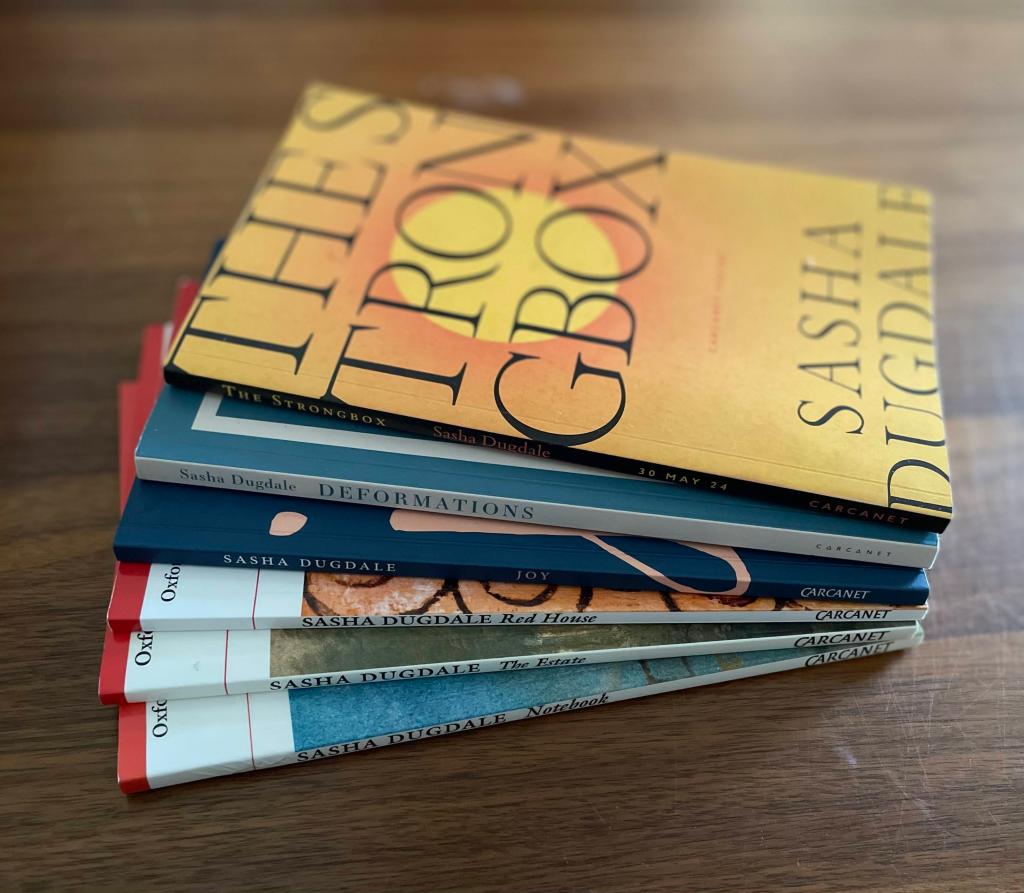
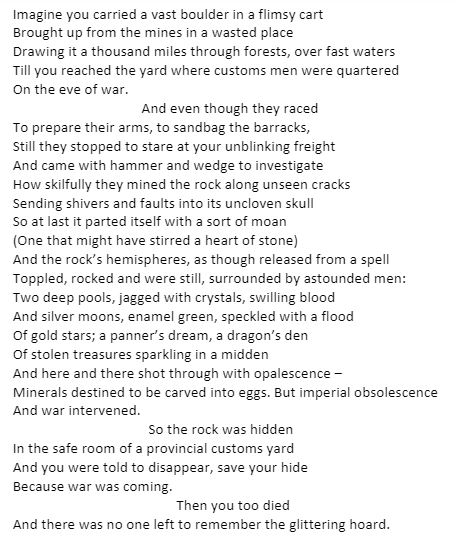
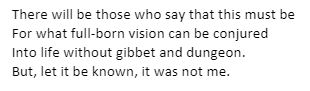
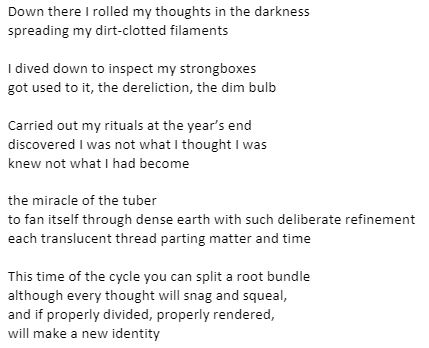
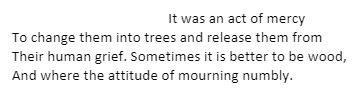
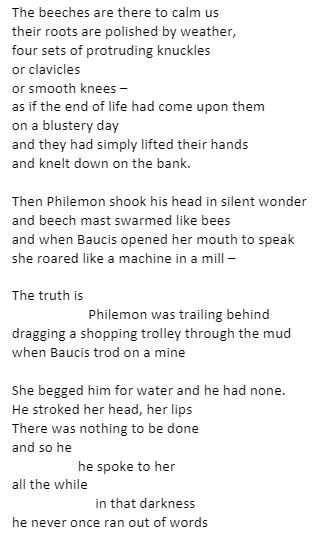
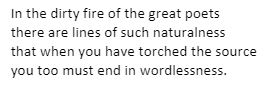
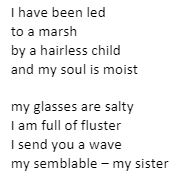

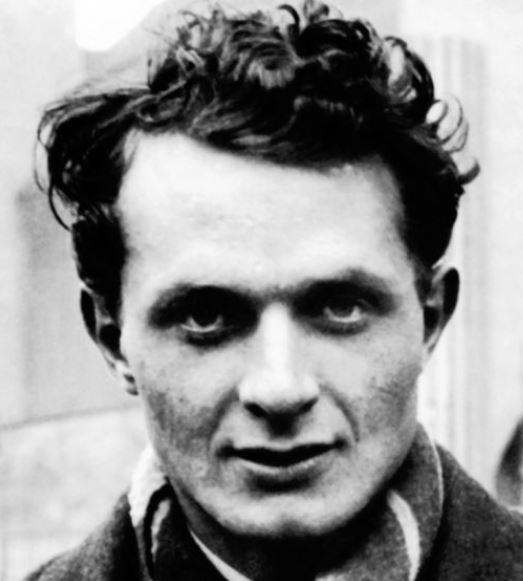
 Wood Bee Poet